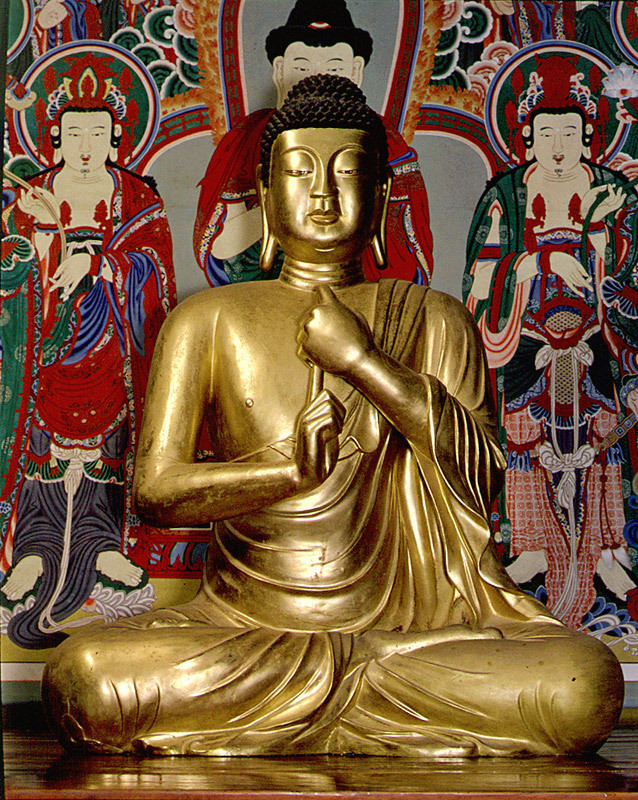
Vairocana Buddha
Seated Vairocana Buddha (National Treasure #26). Unified Silla period, late 8th century; gilt-bronze, h. 1.77 m.; Bulguksa Temple South Korea.
The Great Illuminator: A Comprehensive Study of Vairocana Buddha
I. Introduction: The Cosmic Center
In the pantheon of Mahayana and Vajrayana Buddhism, Vairocana (Sanskrit: Vairocana; Korean: 비로자나불 Birojana-bul; Japanese: Dainichi Nyorai; Chinese: Dàrì Rúlái) occupies the supreme position. His name translates to " The Illuminator," "The Resplendent One," or literally "Belonging to the Sun."
While the historical Buddha, Shakyamuni, is revered as the teacher who lived on earth, Vairocana is the Cosmic Buddha. He is not merely a figure in the universe; in many traditions, he is the universe itself—the embodiment of the absolute reality from which all other Buddhas, Bodhisattvas, and sentient beings emanate.
He represents the Dharmakaya (Truth Body)—the formless, eternal, and omnipresent aspect of enlightenment. If Shakyamuni is the voice that speaks the truth, Vairocana is the Truth itself.
II. Theological Foundation: The Trikaya Doctrine
To understand Vairocana, one must understand the doctrine of the Trikaya (Three Bodies of the Buddha). This concept explains how a Buddha exists on different planes of reality.
1. Nirmanakaya (Transformation Body)
This is the physical body that manifests in time and space to teach sentient beings. Siddhartha Gautama (Shakyamuni) is the prime example of this.
2. Sambhogakaya (Enjoyment Body)
This is the celestial body of bliss, visible only to high-level Bodhisattvas in pure lands.
3. Dharmakaya (Truth Body) — The Realm of Vairocana
This is the ultimate nature of reality—emptiness (sunyata) and wisdom combined. It has no form, no beginning, and no end.
- The Equation: In the Avatamsaka Sutra (Flower Garland Sutra), Vairocana is revealed to be the Dharmakaya.
- Implication: This means the entire universe, with all its galaxies, stars, and life forms, is the physical body of Vairocana. Every sound is his voice; every form is his manifestation.
III. Iconography and Symbolism
Artistic depictions of Vairocana are rich with symbolic meaning, designed to convey his status as the center of existence.
1. The Color White (or Blue)
- White: In the Mandala of the Five Jinas, Vairocana is typically white. This represents the blending of all colors, symbolizing that all qualities of the other Buddhas are united in him. It also symbolizes absolute purity.
- Blue: In some Tibetan traditions, he is depicted as blue, representing the vastness and lack of boundaries of the sky (Emptiness).
2. The Mudras (Hand Gestures)
Vairocana is primarily associated with two specific mudras, which distinguish him from other Buddhas.
- Dharmachakra Mudra (Turning the Wheel of Dharma):
- The hands are held against the chest, thumbs and index fingers touching to form circles. This represents the moment the Truth was set in motion.
- Bodhyangi Mudra (The Wisdom Fist):
- Meaning: The unity of the spiritual and the physical, or the realization that "Samsara is Nirvana."
- Common in East Asian Esoteric Buddhism (Shingon/Tendai). The left hand creates a fist with the index finger pointing up (representing the sentient world or the five elements). The right hand grasps this index finger (representing the protection and wisdom of the Buddha).
3. The Lion Throne
He sits upon a throne supported by lions. The lion is the king of beasts, and its roar represents the bold, fearless proclamation of the Dharma that wakes beings from the sleep of ignorance.
IV. The Five Wisdom Buddhas (The Mandala)
In Esoteric Buddhism (Vajrayana), Vairocana is the central figure of the Five Dhyani Buddhas (Wisdom Buddhas). This system maps the human psyche and transforms negative emotions into enlightened wisdom.
| Buddha | Direction | Color | Poison Transformed | Wisdom Gained |
| Vairocana | Center | White | Ignorance/Delusion | Wisdom of All-Encompassing Reality |
| Akshobhya | East | Blue | Anger | Mirror-like Wisdom |
| Ratnasambhava | South | Yellow | Pride | Wisdom of Equality |
| Amitabha | West | Red | Lust/Greed | Discriminating Wisdom |
| Amoghasiddhi | North | Green | Jealousy/Fear | All-Accomplishing Wisdom |
As the center, Vairocana is the aggregate of the other four. Just as the hub of a wheel holds the spokes, Vairocana holds the order of the Buddhist cosmos.
V. Key Texts and Philosophy
Two major texts elevate Vairocana to his supreme status.
1. The Avatamsaka Sutra (The Flower Garland Sutra)
This is the foundational text of the Huayan (China) and Hwaeom (Korea) schools. It presents a vision of the cosmos as a shimmering net of inter-connection.
- Indra's Net: The Sutra describes the universe as a vast net belonging to the god Indra. At every intersection of the net hangs a jewel. Each jewel reflects all the other jewels in the net perfectly.
- Significance: This metaphor explains that no individual being exists in isolation. We are all reflections of one another, and we are all reflections of Vairocana. The "Great Sun" is the light that makes the jewels shine.
2. The Mahavairocana Tantra
This is the primary text of the Shingon school in Japan. It focuses on rituals, mantras, and visualizations to realize that one's own body, speech, and mind are identical to the body, speech, and mind of Mahavairocana.
VI. Regional Significance in East Asia
Vairocana's influence varies across cultures, shaped by the specific schools that adopted him.
1. China: The Colossus of Longmen
In China, the Empress Wu Zetian (Tang Dynasty) famously commissioned the massive Fengxian Temple statue at the Longmen Grottoes. The central figure is the distinctively serene Vairocana (said to be modeled after the Empress herself). Here, he represents the stability of the state and the vastness of the empire, mirroring the vastness of the Dharma.
2. Korea: Hwaeom and Interpenetration
In Korea, Vairocana (Birojana-bul) is central to the Hwaeom school. The philosophy of Dharmadhatu (the realm of truth) teaches that phenomena and principle are perfectly interfused.
- Bulguksa Temple: One of Korea’s most famous national treasures includes a gilt-bronze seated Vairocana, highlighting his importance in the Unified Silla period.
- He is often venerated as the source of the "Three Truths": Emptiness, Provisional Reality, and the Middle Way.
3. Japan: Dainichi Nyorai and Todai-ji
In Japan, Vairocana is known as Dainichi Nyorai ("Great Sun").
- The Great Buddha of Nara: The massive bronze statue at Todai-ji temple is Vairocana. It was built by Emperor Shomu to protect the nation.
- Esoteric Buddhism (Shingon): Kukai (Kobo Daishi) taught that the entire universe is the "preaching" of Dainichi Nyorai. While Shakyamuni preached via words, Dainichi preaches via the existence of mountains, rivers, and stars.
VII. The Philosophical Core: Emptiness and Light
Why use the metaphor of the Sun?
In ancient Indian thought, the sun was the source of life and visibility. However, the physical sun has limitations: it sets at night, and it creates shadows.
Vairocana is the "Great Sun" because:
- He never sets: The Truth is always present, day or night.
- He casts no shadows: His wisdom penetrates everywhere; there is no place where the light of the Dharma does not reach.
The Resolution of Duality
The ultimate teaching of Vairocana is Non-Duality.
Usually, we think of "Samsara" (this suffering world) and "Nirvana" (enlightenment) as two different places. Vairocana represents the realization that they are the same place. When viewed with ignorance, this world is Samsara. When viewed with the Wisdom of the Universal Truth (Vairocana's wisdom), this very world is the Pure Land.
VIII. Conclusion: The Buddha Within
Vairocana Buddha serves as a powerful reminder of the potential within all beings. He is not a deity to be worshipped in the hope of favors, but a representation of the fundamental nature of our own minds.
To meditate on Vairocana is to meditate on the interconnectedness of all life. It is the practice of expanding one's identity from a small, isolated "self" to a vast, luminous awareness that embraces the entire cosmos. As the Avatamsaka Sutra states:
"The Buddha’s body fills the directions of the universe,
Manifesting before all beings according to their capacity,
Yet always seated in this Bodhi-tree of enlightenment,
He has never departed from his throne."