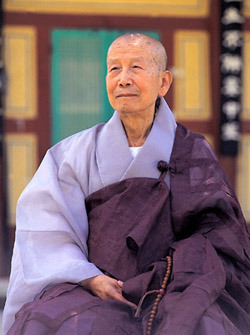
The word 'Seon' comes from the Chinese word ‘Chan’, a transliteration of the Sanskrit word 'Dhyâna'. Loosely translated, it means “meditative absorption.” Another definition would be “silently thinking.” ‘Jwa-seon’ (sitting-seon) thus means “meditating silently while seated.”
The sixth patriarch, Huineng, defined 'sitting' as externally being in the world of good and evil and yet having no thought arising in the heart, and ‘Seon’ as internally seeing the self and not straying away from it. The formal practice Seon entails one sitting upright in a room with a calm atmosphere and some burning incense, breathing deeply and steadily while thinking about something. But what is it you should think about?
Think about life.
'What is life?' 'What should I do in my life?' 'Where have I come from and where am I ultimately heading?' 'What does it mean to live and to die?' 'What is the relationship between the universe and my life?' 'What is the right way to live?' 'What is life’s true meaning?'
Life is invaluable. There is nothing that can compensate for it. As such, we must take the most upright course through this precious life. Living with a false vision of reality, one cannot see one’s own true self, one’s own true existence and this life is simply wasted away. It becomes a “false life.”
You must steel within yourself an ardent determination, thinking, “Life is full of defilements. Where have these defilements come from? I must liberate myself from them and realize my pure original countenance, the true image of my original self.” There is only one path to such a true awakening and you must search deeply into this only path, meditating in silence about the defilements of life, their causes, their cessation, and the means to bring it about.
In the times of Sakyamuni , there was once a disciple with such a bad memory that he could not even remember his own name and had to carry a name tag around his neck. To teach this disciple the way of the upright dharma, Sakyamuni asked him to memorize only a singe sentence, "Brush the dust away and wash the dirt off." For three years, when he was sitting, standing, sleeping and awake, the disciple thought earnestly about only this one short sentence. As he continued to meditate on this one singlehwadu, the dust in his mind was brushed away and the dirt all washed off, such that suddenly he discovered the stage of true self that is without dust, dirt, or defilements, beyond even any truth itself.
The tradition known as “Patriarchal Seon,” developed by successive patriarchs of old, is the teaching that every person, regardless of their powers of intellect or memory, can penetrate into the realm of Buddha in one sweeping stride, awakening to the pure original face, through questioning with absolute diligence one single problem, one hwadu, like the disciple spoken of above. Is this not a rather mysterious and wonderful thing?
This simple problem is equivalent to a passport that allows us through the gateway to enlightenment, and is referred to as a Kongan (Ch. kungan, Jp. koan), a metaphorical borrowing from the wordsgongbu eui andok(公府之案牘 ), which literally means “a case record of the public court,” and in its usage in Chan/Seon/Zen, indicatesa singular example case through which a more universal truth can be known.
Chan Buddhism and the Philosophies of Laozi (老子) and Zhuangzi (莊子)
Among all Chinese philosophies and religions. the thoughts of Laozi and Zhuangzi are perhaps the most profound. It is often said that the Chinese have a tendency to put much weight on reality and are pragmatic by nature. Therefore, the systems of thought developed in China are usually addressed towards practical matters that can be directly applied in everyday life. While ethical and political ideologies abound in Chinese history, rarely can we find metaphysical views on life or thoughts inclined towards a craving for mystical truth.
Contrary to this dominant Chinese tradition are Laozi and Zhuangzi, figures who deal with the most profound problems of life, transcending the common-sense values and thoughts of average Chinese people. Living in times of unprecedented turmoil in China, the Age of the Warring States, Laozi and Zhuangzi witnessed constant war, where schemes and machinations were the norm. The lens of history shows that many instances of unprecedented philosophical and religious development appeared precisely within those countries suffering from chaos and hardships, as a result of efforts taken to overcome such adversity. Laozi and Zhuangzi are perfect examples of this.
When Buddhism was first introduced to China, local scholars tried to interpret Buddhism by borrowing concepts from pre-existing philosophies, mainly those of Laozi and Zhuangzi. For instance, in the Daodejing written by Laozi, there is a statement, "All the things of the world originate from being (有), and being (有) comes from nothingness (無)." The universe has a form and it is thought of as ‘being’ (有), and the origin of the universe without form is considered ‘nothingness’ (無). Accordingly, the concept of voidness1)in Mahayana Buddhism was translated and understood in terms of nothingness as used in the terminology of Laozi.
When Buddhist sutras were translated into Chinese for the first time, the word Nirvana was translated as 'non-doing', meaning 'doing nothing,’ or ‘doing without deliberate manipulation.' Bodhi was translated as 'Tao,' and Tathata (the truth as it is) as 'Originally Nothing.' Buddhism was thus regarded on its deepest levels through the template of Laozi and Zhuangzi. Of course, it would have been difficult for the pragmatic Chinese to accommodate the esoteric thought of Buddhism without borrowing from the conceptual framework of Laozi and Zhuangzi. However, the true meaning of Buddhist thought was somewhat distorted though this process, as it was not simply words, but an entire philosophy that was needing to be translated.
Furthermore, whereas Indians often employed meditation to transcend the suffering of the mundane world, leading to the development of a theoretical, epistemological logic, the Chinese, more active and realistic, preferred intuition to logic. Therefore, rather than the logical meditation into profound Buddhism as seen in India, Chinese Buddhism adopted a practical religious approach in pursuit of the dharma, that is, to experience the ultimate stage of Buddhism and cultivate the mind with intuition. This was the beginning of the Chan Tradition in China, and the subsequent Seon/Zen/Thien traditions in Korea, Japan, and Vietnam, respectively.
Some Buddhist sects consider the intuitive stages of Zhuangzi, such as 'Sitting in Oblivion(坐忘),' 'Seeing the stage of transcending the limitations of reality (朝徹),' and 'Seeing independence (見獨)' to be consistent with Chan, but I would like to quote a critical retort (pingchang 評唱) in case 80 of, a book that reveals the innermost depth of the truth of Linji tradition, to argue that this is not, in fact, the case.
According to the contents of the pingchang, Chan meditation initially consists of our conscious mind (心識). When we proceed deeper into our being, we arrive at the margins of ‘no mind’ (無心 ), the absolute stage undiscerned from the universe or Nature. Chan does not stop here though. With more exertion and devotion, we earn the Panna Wisdom of Buddha that pervades the Store-house consciousness, and then transcends even Buddha, to be limitlessly free and dynamic. This ultimate stage of Chan is called 'Tao, the mind of everyday life,' which is to eat food when hungry, drink tea when thirsty, and to be absolutely free and dynamic, restricted by nothing.
Then what of the stage told by Zhuangzi? In the book titled after his own name, there is a story about 'Sitting in Oblivion' in the Chapter “The Great and Venerable Teacher.”
Yanhui, a pupil of Confucius, said "I have made some gain." Confucius asked, "What do you mean?" Yanhui replied, "I forgot virtue and justice." Confucius commented, "Good, but not enough." After some time, he said to Confucius again, "I made further gain." "What is it?" "I forgot civility and music." "Good, but still not enough." Several days later, he said to Confucius once more, "I have made an even greater gain." Confucius asked, "What is it?" Yanhui replied, "I reached 'Sitting in Oblivion.'" Amazed Confucius asked, "What is 'Sitting in Oblivion'?" Yanhui answered, "It is forgetting hands, feet and body, forgetting the action of ears and eyes, leaving the distinction of form to discard wisdom and becoming one with Tao. This is 'Sitting in Oblivion.'" Confucius praised, "When someone becomes one with Tao, there is no good nor evil. After undergoing transformation into becoming one with Tao, there is no attachment. Wise indeed. Now it is I who should be your follower instead."
The 'Sitting in Oblivion' of Zhuangzi is no more than the severing of consciousness, resting in the margins of no mind (無心 ) where all discriminations vanish, whereas Chan breaks through conscious mind (有心 ), transcends 無心 (no mind), and rises above even Buddhahood to be unlimitedly free and dynamic. To reach Panna Wisdom, one must go beyond even the margins of no mind (無心), to the stage of the eighth sense.
I will give one more example about Zhuangzi, again from “The Great and Venerable Teacher”:
For three days, rising above the world, remaining beyond, I dwell in this stage. After the seventh day, I am beyond all things, and after the ninth day, I am beyond life. Already beyond life, I can see the stage that transcends the limitations of reality, and then I see independence. Then there is no past and present, and then after this stage, I enter the realm without life nor death.
Zhuangzi mentions being outside of all things, outside of life, and then seeing through the stage that transcends the realistic limitations of human beings. In conclusion, he speaks of transcending the limitations of consciousness.
Although people are prone to confuse Zhuangzi's thoughts with Chan, the two lie in totally different spheres. Zhuangzi remains at the boundary of the eighth sense, the margins of unconsciousness, the margins of the great Nature where there is no deliberate human manipulation. Chan transcends this stage of Zhuangzi to reach Panna Wisdom, and transcending even Panna Wisdom, it arrives at the great freedom.
Of course, this analysis is but a brief summary of the very complex differences between Zhuangzi and Chan. All of you must practice more earnestly to see the reality for yourselves.
-------------- 1) Voidness: Sunyata in Sanskrit. In the Indian Madhyamaka philosophy, it refers to the ultimate nature of phenomena. It is often used to describe either non-existence or the absence of all mental and physical sensation experienced at some stages of meditation.
The wooden ox walks in fire
We live in a world of dualistic consciousness. The realm created by consciousness is characterized by our perceived division of things into subjects and objects. Both consciousness and Store-house Consciousness (or unconsciousness) pertain to the level of subjectivity. They are ruled by the principle of arising and passing away. Our minds are imbalanced and impure, and we cannot escape from the round of birth and death.
In order to overcome all duality, we have to break through consciousness and Store-house Consciousness, where there is no distinction between good and evil, birth and death, subject and object, time and space. This state of mind is ultimately free and without obstruction. One can reach it neither through the mere intellect nor through the immobilization of mind. The surest and most direct way to this kind of experience is through the mass of doubt produced by the active kong-an (Ch., kung-an/Jn., koan) practice handed down in the Patriarchal seon tradition.
It is estimated that there are in all some 1700 types of kong-an within the seon tradition. Actually there are countless varieties, because the innumerable problems of human beings are all vivid motifs for kong-an. If any single selected kong-an is resolved, all of them will burst open simultaneously. I shall now introduce you to the way in which one may understand the practice of kong-an.
First of all, the practitioner should have great tenacity in pursuing the fundamental questions of human birth and death. A monk asked Chao-Chou:
"What is the motif of Bodhidharma's coming from the West?"
Chao-Chou replied:
"The arborvitae tree is in the garden!"
This is a question about Patriarchal seon. That is to say, the monk asks Chao-Chou about the purpose of Bodhidharma's mission, the first patriarch of seon, coming from India to China. The seon practitioner must earnestly ask himself why Chao-Chou said "The arborvitae tree is in the garden!". He should make his whole body and mind into one great inquiry. The first step is that he has to be absorbed into the kong-an without any distinction between subject and object. He has to become one with the kong-an, free from all discursive thoughts. If he continually maintains the great inquiry, the kong-an keeps going under its own momentum. This is the second step. Persevering zealously in his practice of kong-an, all thoughts are completely extinguished. Mind at this stage is motionless like stone or iron, but the practitioner is increasingly alert and attentive with his kong-an. If he pushes himself further, he breaks through Store-house Consciousness by the force of his kong-an. His whole mind, conscious and unconscious, is broken through, and simultaneously, the mind manifests, free and without obstacles. Here, there is no distinction between good and evil, birth and death, subject and object, time and space. At this stage, the mind is ultimately liberated. If he breaks through to a further level, there is unity between the break-through and the manifestation of all things. Taken still further, he is free and dynamic because of the limitless liberation of break-though with boundless manifestation of all things. At last, he accomplishes the great life-time work!
None of these stages are separate from each other, for they are all interrelated. But this stupid old man will not allow even this.
"Why don't I allow it? - Answer my question immediately!" "Why? Because I shall deliver my Dharma talk without allowing myself to adhere to even this ultimate stage of realization!"
[Case]
When Linchi was about to pass away, he admonished San-sheng, "After I pass on, don't destroy my secret code of insight into upright dharma (Zhengfayanzang)." San-sheng said, "How would I dare destroy the teacher's secret code of insight into upright dharma?" Linchi said, "If someone suddenly questioned you about it, how would you reply?" At once, San-sheng started shouting. Linchi said, "Who would have thought that my secret code of insight into upright dharma would perish with this blind ass?"
[The Great Patriarch Seo-Ong's Added Saying]
"After I pass on, don't destroy my secret code of insight into upright dharma." Linchi said. "If someone suddenly questioned you about it, how would you reply?" San-sheng said, "How would I dare destroy the teacher's secret code of insight into upright dharma?"
-These refer to the state of all-pervading break-though and the simultaneous manifestation of all things.
Linchi said, "If someone suddenly questions you about it, how will you reply?" and San-sheng immediately started shouting.
-These refer to the state that is free without obstacles due to the unity between all-pervading break-though and the manifestation of all things.
Linchi said, "Who would have thought that my secret code of insight into upright dharma would perish with this blind ass?"
-This shows the state that is ultimately free and dynamic due to the endlessly liberating break-though and the boundless manifestation of mind.
[Verses by Tiantongjue]
The robe of faith is imparted at midnight to Hui-neng,
Stirring up the seven hundred monks at Huang-mei.
The eye of truth of the branch of Linchi;
The blind ass, destroying it, gets the hatred of others.
From mind to mind they seal each other;
From patriarch to patriarch they pass on the lamp,
Leveling oceans and mountains, A fowl turns into a roc.
name and word alone are hard to compare.
In sum, the method is knowing how to fly freely.
[The Great Patriarch Seo-Ong's Commentary on the Verses]
"The robe of faith is imparted at midnight to Hui-neng" refers to the manifestation of all things.
"Stirring up the seven hundred monks at Huang-mei" refers to penetration of all things. "The eye of truth of the branch of Linchi" shows the manifestation of all things.
"The blind ass, destroying it, gets the hatred of others" indicates the state that is ultimately free due to the endless break-though into all things as well as the boundless manifestation of all things. "From mind to mind they seal each other;From patriarch to patriarch they pass on the lamp" refers to the manifestation of all things. "Leveling oceans and mountains" refers to the break-though of all things.
"A fowl turns into a roc" shows the state that is ultimately free due to the unity between the penetration of all things and manifestation of all things. "Name and word alone are hard to compare. In sum, the method is knowing how to fly freely" refers to the state that is ultimately free and dynamic due to the endlessly liberating break-though and the boundless manifestation of all things.
Thus far, I have illustrated the meaning of the practice of kong-an for the sake of beginners. Practitioners, however, should experience this state of complete break-through through their zealous practice of kong-an. This is an active expression of dharma.
[The Great Patriarch Seo-Ong's Added Saying]
Revolving in day and night, restless in eternity,
The bright moon illuminates reed flowers,
Reflecting their identical appearances.
A young accipiter capable of
Flying far away through the sky
Pierces the air with the flap of its wings,
Free from longing for home.
[Auto-commentary on the Added Sayings]
These added sayings depict the state of the all-pervading break-through and the simultaneous manifestation of all things;the state that is free without obstacles due to the unity between all-pervading break-through and the manifestation of all things;the state that is ultimately free and dynamic due to the endlessly liberating break-though and the boundless manifestation of all things.
Speak immediately!!!
"The wooden ox walks in fire"
"A-ak!" (an abrupt roaring).
from The Dharma Assembly of the Great Seon Masters(October, 2002)
An Authentic Person of No Status A foolish monk with hairy eyebrows and grey robes,
Walks along the stream leaning on his staff, his steps skillful on their own.
Observing the clouds and mist, he is both sober and intoxicated.
To fool with mysterious changes makes the blunder even worse.
The golden breeze [of autumn] gently turns the leaves their first shade of red,
Now that the autumn moon shines brightly, the waters are even clearer.
Forgetting both ordinary person and sage, he leisurely plays his flute,
Riding Mount Sumeru backwards, he ascends freely of his own accord.
The ‘high-sky’ season has just arrived. The autumn leaves are changing colors and the moon is bright. This truly may be called a wonderful season. If we are to be called true Buddhist disciples, we must try to live our lives as “authentic persons of no status” [translator’s note: Chinese Chan Master Linji’s saying], who are free and autonomous in the eternal present.
Buddhism originally transcended Brahmanism in India and completely solved the problem of human life by illuminating from an ultimate standpoint the original, true form of human beings. Moreover, the practice that possesses from a historical standpoint the most complete realization of the profound source of Buddhism is Seon (禪). Therefore, Seon can be regarded as both the religious life-essence of Buddhism as well as a religion of free and autonomous authentic persons at its essence, which transcends the doctrinal teachings (Gyo, 敎).
The great significance of Seon is liberation from deluded consciousness and realization of one’s true self on one’s own. What we consider the ‘I’ is not the ‘true I,’ but instead the ‘attachment to I,’ which brings about disturbance and tumult because it involves the suffering and deceptiveness that derive from deluded consciousness. Thus, we must smash the ignorance of this limited ‘I’ and manifest the authentic human form.
Sometimes people who practicechamseon(“investigating Seon”) say that they are not sure if they are practicing Seon correctly, but you must understand that there is nothing clearer than practicing Seon. People talk about “chamseon, chamseon,” so we all consider it to be difficult and an exceptional religious practice, butchamseonjust means to live sincerely and compassionately by fundamentally criticizing and liberating our lives, which are immersed in desire and the attachment to self.
If I were to express it simply in psychological terms, we each live our lives in accordance with our own subjective perspective. Typically, our realities are immersed in either our knowledge or our own subjective views, which derive from dualistic activities. These do not adopt an expansive human perspective that sees all phenomena in the universe as a single fundamental living substance, but instead are projections of the extremely narrow and small dualistic subjective views of an individual, which are ascertained according to the needs of each moment. Furthermore, Western philosophy treats worldview or the problem of human existence only from one limited aspect of human life, such as rationality or desire. However, Seon does not look at human beings from a single point of view, but from a holistic perspective—the perspective of a holistic human being who acts rationally and intuitively while transcending rationality and intuition.
Once, someone asked, “Is the state where subjective discriminations are extinguished the ultimate realm of Seon?” It is not. This is because thestorehouse consciousness(ālayavijñāna), even though it operates in a mind-state in which the discriminations of consciousness have been extinguished, is nothing but the accumulations of our manifesting consciousness (hyeonhaeng uisik), so it does not have the capacity to recognize truth as it is.
Typically, either scholarship or thought is produced in the manifesting consciousness or thestorehouseconsciousness. No matter how the construction of truth is systematized philosophically, when its scope is broadened or deepened, the system falls apart. Thus, new scholarship and philosophical systems keep developing, but they are not the correct paths for contemplating the“original face” (本來面目), which is the fundamental question facing humanity. This is because the original, true form of human beings is the single, universal life substance that transcends both consciousness and unconsciousness. As such,chamseonmeans to awaken to the‘authentic person,’ by completely liberating oneself from all discriminative knowledge, thoughts, and even the unconsciousness.
If you critique more fundamentally the binary dichotomies of good and evil, existence and non-existence, rationality and irrationality, material and mentality, and so forth, then at the foundation of all values and speculation lies this absolute dichotomy. This is the limitation of modern men who adopt the standpoint of rationality. However, an authentic person is one who has originally transcended all these dichotomous limitations, and ultimately he is originally an authentic person who does not claim to have newly attained enlightenment. This authentic person is originally unborn and unextinguished, and is not limited by time and space. He is originally pure and unsullied, free and autonomous; and while being devoid of all form, he creates forms in all their variety.
Seon suddenly transforms people who are subject to such dichotomies into authentic persons who are truly themselves, thereby severing in a single cut all ignorance and defilements. Therefore, Seon realizes the history that involves the proactive great capacity and great functioning by guiding even scientific acumen and the life impulse toward an independent position.
While a person like the monk Linji (Kor. Imje; Jpn. Rinzai) was studying scriptures, he realized that words and language are only medical prescriptions, so he decided instead to do Chan meditation. This example in turn asks us what actually solves the questions of human life objectively and with universal validity. Becausechamseonis not dogmatism, which would demand that one follow its dictates blindly, one must oneself practice it and attain awakening.
In order to practicechamseoncorrectly, one must earnestly investigate thehwadu(“keyword”). To investigate thehwadumeans that one’s whole life substance must transcend intellectual consciousness. In the “ball of doubt” (uidan) generated by investigating thehwadu, one’s whole existence must be unified and tense. One’s body and mind have to become a single life substance, just like the moment when you start to run at the sound of the gun go off at the beginning of a hundred-meter race. If one investigates thehwaduin this manner and moreover practices genuinely, then one attains the state of the ‘silver mountain and iron wall,’ where the discriminations of consciousness are eradicated. Also, when thehwaduappears clearly while becoming more transparent, then the production and extinction of consciousness will disappear. If one practices Seon deeply, one actually can reach such a state. Although this may be a state where the production and extinction of consciousness have disappeared, one does not fall into sloth and torpor. Instead, thehwaduand the ball of doubt (uidan) become ever more clear and numinous, so that one progresses to penetrate even the level of the unconscious. When one penetrates to this ultimate state, the absolute dichotomy disappears. Pure and clear, there is not even a single thing: this is the state of ‘mountains are mountains, rivers are rivers.’ However, if one sits abiding in this state, then one has not yet passed through the gate of patriarchs. By suddenly passing through this realm, one ‘sees the nature’ and awakens to the storehouse of the right-dharma eye (Jeongbeopanjang) of clear-eyed enlightened masters of our school.
To give you a little more detail, we cannot even call this ‘seeing the nature’ or ‘awakening to the self.’ The original face is itself real and originally exists as it is. It is only because one does not have a fervent and sincere aspiration for enlightenment, and has not truly tried to practicechamseon,that one says the practice of Seon is difficult. Actually, the original face is the fundamental essence of human existence and one’s true form. What is more, some say that though the buddha-nature is inherent in people’s minds, because it is different from reality, they refer to it as internal transcendence and advocate that it is mysterious. However, an authentic person does not abide either internally or externally in our ordinary reality. The authentic person is the ‘absolute present” by being the nucleus of the present moment. This is what we call the ‘eternal now’ or the ‘absolute now.’ The authentic person becomes the fundamental nucleus that transcends time and space, and is the original, true form of human beings, which overcomes all fragmenting self-destructiveness and is thus free and autonomous.