The Sutra of Agama says thus: ‘There is the way of eternal liberation; there exists the I that teaches it; however, some people follow it; and others do not.’ As you know, this is a memorial day of Buddha's Nirvana. Over His death, Ananda, one of His ten disciples, who had followed Him twenty-five years, could not keep up himself but only to burst into tears.
Buddhism teaches with emphasis again and again that it transcends both life and death, because there it neither of them in truth.
Nevertheless, the intelligent and honest Ananda, even though he had studied Buddhism for twenty-five years, could not overrule himself but sobbed his heart out. He could not have been ignorant of the meaning of Nirvana. Then, why do you suppose he cried out?
Let us look brifly over the meaning of Nirvana.
Nirvana represents the exhibition of both body and consciousness. In Nirvana both body and consciousness cease to function. So was it with Buddha's Nirvana. In His Nirvana, His body was cremated to a handful of ash and His consciousness functioned no more. Seen from the view point of our physical world, His Nirvana has left no trace of His body and consciousness.
Buddhism theaches that we should acknowledge another world that transcends our physical world, where we are able to feel and see the limitless. There are two kinds of Nirvana: one is the Nirvana of Hinayana, the lesser vehicle; the other, the Nirvana of Mahayana, the greater vehicle. It was because Ananda had not gained the utter significance of Mahayana Nirvana, though he might have grasped the meaning of Hinayana Nirvana, that he could not control himself but went on weeping bitterly when Buddha passed away.
We must be able to discern between `Initial Enlightenment' and ‘Ultimate Enlightenment’ on the road of pursuing awakening. The initial enlightenment points to our capability to explain an awakened state by our reasoning, and the ultimate enlightenment means that we have proven the awakened state both physically and mentally. In other words, our physiology is transformed from a tinted into a pure ego; thereby we can prove Buddha’s Dharma Nature or Buddha’s Reality.
It is a regret that Ananda failed to acquire a stage of Mahayana Nirvana. He did not experience a state of immortality truly meant by Mahayana Nirvana, though our body and consciousness are to be expired in it. The tidings of Buddha’s Nirvana are to say that he entered the greater vehicle Nirvana, and not the lesser vehicle.
I am not a lecturer who gives doctrinal explanation of the scriptures, nor a Dharma teacher who is good at preaching sermons. As you see. I am a Zen monk. So I am afraid my talk would sound stilted or no so much interesting, since a monk like me will insist on telling just essence by cutting a long story short. With a view of revealing a Dharma he sometimes is ready to hit his listeners with a stick; other times he will resort to shouting all of a sudden to them instead of talking.
Once upon a time in the days of Tang China there lived a great monk named Sukdoo-Huichon, Shih-t’on Hsi-chien in Chinese. He was known to be one of the most influential Zen masters together with his contemporary monk Macho Doil, Matsu Tao-i in Chinese. One day when he was asked to deliver a sermon to a large congregation, he stated himself on the Dharma table. He tried to open and close his eyes several times, and then he left for his room finishing his Dharma talk.
I wish to make such a short preaching, even if I am not a competent Zen master. But I think I have to continue on saying because you want me to.
What does Mahayana Nirvana mean in general? It means the world of Truth where there is no samsara or no life and death. In the eyes of sentient beings life and death as well as you and I are evidently seen to exist; yet there is no room for their existence in the world of Mahayana Nirvana.
The Nirvana Sutra says that Nirvana contains four kinds of virtues: Permanence of immortality, eternal bliss, the Great Self, and utmost party. The first virtue is permanence of immortality.
Our life is seen in the light of sentient beings to have birth and death, meeting and parting, goal and evil, or right and wrong; however, it is seen by Buddha Nature that is our Original Ego, it has none of them. Nirvana is the world of eternal life where there is no birth and death, meeting and parting, good and evil, and so forth.
Another virtue is eternal bliss. Our world of human existence is a world of relativity. It is mingled with pleasure and conflict, but in the world of Nirvana that is the world of our Original Ego and the birth place of the universe there exists not a bit of suffering, but just complete happiness or pure pleasure.
A third virtue is the Great self or the True Ego, or the Real Ego. All living beings can not escape the Triple worlds that are called the world of sensuous desires, the world of beings with forms, and the world of formless beings. But the world of Nirvana, containing boundless virtue, transcends all of these. A fourth virtue is utmost purity that is not colored by any defilement at all. It is so pure a world that no trace of defilement is found there. That is where we should return in the end and also our true hometown is. We should be eager to go back there.
The world could never have been scarred by the decease of Sakyamuni Buddha or by the vanishment of His body and consciousness, who had saved countless souls for forty-five years. Nothing else could defame the place of Buddha’s True Life, or he place of Buddha’s Dharma Nature. That is the world of His True Nirvana.
We must recognize that we ourselves too have utmost purity, and it is our Mind's eternal hometown. Every one of us is in poession of the eternity of Nirvana. Buddhism shows us the manifest way of it. It is merely owing to our idleness that we fail to go there.
In studying Buddhism we must take precautions against self-humiliation. Self-humiliation is self-distrust. He who lacks self-confidence is prone to say: ‘Of course, Sakyamuni attained Buddhahood; but I am nobody; and it is impossible for me to become a Buddha’. There is no faith in Buddhism in what he says. Unless you leave off such a sense of humiliation, you cannot achieve anything in Buddhism.
You must be aware that the life itself of yours is just as perfect as those of Sakyamuni and Bodhidarma. Ananda might have known it to some extent. And you know it, too.
Many scriptures such a the Avatamska Sutra, the Lotus Sutra, the Suramgama Sutra, or the Nirvana Sutra, tell that the sentient beings are not different Buddhas. Sometimes, unfortunately, when you encounter a difficulty, you will easily become discouraged. I can say that the quick disappointment of yours come from the fact that your karmic obstruction has not been purified sufficiently.
We cannot study for in the wisdom Sutra without noticing that every Dharma is empty. A man whose karmic hindrance is thinner can promptly understand the emptiness of all Dharmas. But a man whose karmic hindrance is thicker will not agree to the fact that everything is empty. The one will say, “Yes everything is in vanity and my body is vanity itself.”;
The former will doubt, “Why is it that all beings are void. Look! You and I are here thus. I know what love and hated are!”
It is legitimate and right for those who have doubt about emptiness to have a deep self-examination.
Through the realization of emptiness, they can grasp the tidings of the four Nirvana virtues.
We should be able to make out the tidings of the Great I or the True Ego which is possessed of the three spiritual and six spiritual powers. The three insights are: the capability to see the moral conditions of living beings in the previous lives, the capability to foresee their future conditions, and the capability to overcome all cravings and temptations. The six spiritual powers are: in addition to the above three, supernatural power, divine eyes, and telepathy. The True Ego has limitless wisdom and compassion.
Unless a man feels the virtues that he owns, he can not be called a Buddhist in the true sense of the word. Buddha tried to show us the virtues himself and to teach us that we might prove them for ourselves. In order to comprehend the merit of non-hindrance purity, which is completely out of any defilement, we should realize above all that every Dharma is empty.
Let me say something about non-existence of all Dharmas. We do not call what is aggregated temporarily by cause and conditions a being. It can not last its own unique form even a moment, for it changes second after second.
Therefore, it does not have any concept of space or any concept of time in it. We do not observe this non-existence of Dharmas owing to the thickness of our karmic obstruction resulting from three poisons-greed, hated, and delusion. So we don't see that the whole universe is filled with Suchness of Buddha Nature.
Fortunately, modern physics clarifies the non-existence of Dharmas. It shows that every phenomenal thing is composed of atoms, electrons, protons and neutrons, not to speak of the Earth, the Mars or the Jupiter in this solar system, and even of the heavenly bodies in the galactic system of the boundless universe.
What are those small particles that constitute all things? They are nothing but intangible field energy of which the universe is made up. The intangible field energy is also called electro-magnetic field.
And they are called an electron, a proton, or a neutron when a condition is vibrating out of the universal field energy according to physical principle or chemical change. They stay only as a passing of vibration or moment of energy, and not as a unique existence. We know that these particles aggregate to form everything.
Nothing can stand still a moment because of the movement of particles. We call one kind of form a tree, another kind a man; this one I, that one you; and so forth. Now, let us suppose the forms are observed with a microscope that can reach even elementary particles. Then, neither a man nor a tree will be seen except its movement.
Pure Dharma Eye sees only genuine life itself never colored by defilement. That is what Buddha Eye sees, and that is where all things are empty.
Thus enlightened minds will see, with their pure and true eyes, wisdom eyes, and Buddha eyes, what is proven by modern physics. We see what is seen with our physical eyes, but it we could see what is seen with the divine eyes of heavenly beings, then it would be seen differently.
A man whom we hate or we love will look different. Likewise, Dharma eyes, wisdom eyes, or Buddha eyes will see differently from our physical eyes. As I mentioned, the various scenes that spread before our eyes are in fact all emptiness.
Can you comprehend the true meaning of the wisdom Sutra? Without its realization, you can not gain the Nirvana virtues of the true permanence, true happiness, true ego, and true purity. The world of Nirvana is full of immortality, supreme bliss, omnipotent ego, and non-obstructed purity. Buddha taught us where there is an extinction of the emotional fluctuation of mind there is a true calm pleasure. Where all things are extinct is the place of Nirvana. A man who sees falsehood, failing to see the Real is prone to consider the illusory existence as the real: he counts a momentary shadow to be a reality; he thinks of his body to be a substance while his invisible mind is thought of to be a reflexion, not the other way around. We should know that our mind is the master of our body and our body is a mere reflexion of our mind. Our body can not be we, because it is a form resulting from a movement of various elements of oxygen, hydrogen, nitrogen, carbon, and so forth according to our karmic habits.
Kierkegaard, a Danish philosopher wrote on the sickness leading to death. When you turn away from your mind which is true master of your life and attach yourself back to your body, your power your wealth, and your house - those are only the shadow of your life then, he said, will appear the very sickness that brings about death. No matter how dearly you love your body, it can not avoid death in some decades. Then what is the use of your material wealth? Death is the destiny of all living things. They are to be subjected to the law of life and death. They are bound up in the chain of cause and effect.
You may recall what I said: Buddha taught that one of the most important laws to be observed by a Buddhist is that he should renounce self-humiliation. You must know that your True-self is endowed with the three insights and six powers as well as the four Nirvana virtues. Some people like to say that such insights, powers, and virtues worked as special religious expedients only during the life time of Sakyamuni Buddha. It is true even now as then that everyone of as possesses such miraculous powers intact.
As you see, the perfect knowledge and conduct is one of the ten titles of Buddha. The perfect Knowledge means Buddha's wisdom, which is non-hindered wisdom. Concretely, it means His three insights: Insight into destiny that can recollect former existences of sentient beings, insight of divine eyes that can foresee their future existences, and insight that is cleared of defilement. And the perfect conduct means that Buddha has completed the six Paramitas. They are: Dana, Charity; Sila, Moral conduct; Ksanti, Patience; Virya, Devotion; Dhyana, Concentration; and Prajna, Knowledge. We must be conscious that the Buddha's Knowledge and conduct is retained in our True-Ego. So long as we have a firm belief in it, we will not have self-humiliation and we can be true Buddhists.
I would like to talk about one thing that we should abstain in studying Buddhism. That is our arrogance of superior knowledge. It is much harder to get rid of us, even when we become wise to a degree as we practice Buddhism very ardently. To be arrogant means, in terms of Buddhism, to pretend to have realized the True Ego. Not infrequently we find around us that a man who has never had a season of retreat of meditation practice nor a period of a me hundred days' praying dare to assent that he is at the final stage of the study of Buddhism as soon as something that he has not experienced and that seems mystic appears to him. That is an arrogant attitude. Honorable Ananda had followed Sakyamuni Buddha for twenty-five years, and he continued to practice Zen meditation and repeat Buddha's sacred name. Nevertheless, he was saddened so deeply by the loss of Buddha as to abandon himself to grief. This example of his life shows a lesson that consummation of Buddhistic study is not so easy.
People tend to profess that they have come to understand the true teaching of Buddha, even when they still have not arrived at the final stage of their praying or their meditation. It must be a conceit or an addition of arrogance it they say that they have achieved Enlightenment Dharma, when they haven't, in fact, proven Dharma yet. Do you think you have attained the perfect realization of your True Ego? Do you have a firm faith in Baddha's immeasurable sympathy and in His boundless compassion? Or do you believe that you have the sympathy and compassion in you? When you believe so, you will chase away self-humiliation out of you.
There are stages of enlightenment for us to take. The first stage is the so-called initial awakening that we acquire by means of our reasoning; the next is the proven awakening that is testified by our experience of meditation practice; and the third is ultimate awakening that is finalized when we have exterminated all the roots of our habit of delusive thoughts, that is when we have completed our Buddhist efforts.
To pretend as if you had perfected your study of Buddhism without having passed through this course is to fool Buddha Himself and also yourself. However, we have seen not a few such men as have behaved so, even while they are still in the process of study.
We must know that the place of ultimate awakening is not so difficult to reach as only some especially talented men can.
I will show you this by introducing a monk whose name was Tarapyo, who was a contemporary of Sakyamuni Buddha's. Whenever I think of him or real of his life I can not but be deeply moved. He was a common village lad. He left home to become a monk at the age of 14. After two years of desperate practice, he succeeded in conquering the stage of the three insights and six supernatural powers.
It is interesting to see his life since he achieved that stage at the age of 16. He decided to attend on the visitors to his temple. He worked hard, taking good care of their tables and bed rooms. Especially, when a monk came at night he would emit flames in a radiance samadhi by lifting his left hand for the purpose of helping him.
As I have said over and over again we must admit that anyone of us is by nature endowed with the equal wondrous powers as the young monk was. It is only due to the impurity of our physiology that we are not capable of those insights and powers that remain buried in us.
Tarapyo gave off light, in a radiance samadhi, with his left hand raised. And with his right hand, he would carry food and bed clothes for visitors. We must recognize that we have the same kind of wisdom that Tarapyo had. It is called the radiance of wisdom or the light of compassion. What is known an electron, a proton or a neutron is nothing but emission of radioactivity, and the whole universe is filled with its radiance.
Today is a fine day. It is very bright in this hall with the lights on. Where does this brightness come from? From a physical operation? No, it can not. A being can not come from nonbeing. It comes from the universe. Heaven and earth are, from their origin, full of brightness. It is called light of Buddha's wisdom and compassion.
Sometimes, men of Buddhism stop to admire, from their mouth meditation, the virtues contained both in Nirvana and in the True I. If we keep on studying we are to feel, see, and appreciate the radiance: we experience it with body, not admiring with mouth; the deeper our study is, the more radiance is. When you are completely enlightened, a perfect penetrating enlightenment will come to you. Then the universe and all beings will be transformed as light itself. The following lines sing about the universe.
From the Heaven flowers of rain fall;
When the drum of the Heaven’s beaten by Nature.
The song is found in the Lotus Sutra, or in the Avatamska Sutra, or in the Suramgama Sutra. Those who are deaf to the tidings of the song that is hidden in the Dharma-Nature of every one of them will attribute them to expediencies. But it is true that the whole universe is full of permanent mystic sounds. The more purified our soul is, the clearer heavenly sounds it hears.
We live surrounded with various kinds of sufferings. They come about from our love and hated or from frustration of our desires. I live in a mountain temple. When I come up to Seoul, I am suddenly dazed at the sights of this megalopolis. I find it very difficult to keep up myself in Seoul. Perhaps, I can hardly lead a normal life in such a tension of the urban complexity, or I may suffer from nervous prostration.
For survival in our world of enormous complexity and difference, you need to have knowledge and experience that you and I are of oneness and that there is nothing for us to love or hate. Love and hate may not look the same to people across time and space; they are not, in essence, two different things but one and the same. To know this is necessary for leading a good life without conflict and suffering.
Buddhism aims at expelling the sufferings of our life. Many people wish to be free from the sufferings, but they do not try to seek the world where there are no sufferings, which is the world of his Original Appearance, or of Suchness of Buddas Nature, or of Great Nirvana. While you neglect your practice, you can not expect to gain Suchness of Buddha Nature and taste the virtue of Nirvana.
We are accustomed to pursuing what is called five cravings: wealth, fame, sex, food, and sleep. They are, in effect, as Kierkegaard remarked, nothing but the diseases leading to decease. It is evident that they have little to do with our happiness; they only take us to the gate of death, not to the road of eternal life. If we with to find a new world of eternal life and happiness, we should clearly see that all constituent elements are empty and all phenomenal changes are impermanent. That is defined as true wisdom or wisdom of prajna. Without penetrating wisdom of prajna we can never reach the destination of eternal liberty. So we should thoroughly comprehend: ‘I am empty, and you are empty, too.’
The Diamond Sutra emphatically persuades us to detach ourselves from the so-called four false ideas: The idea about me, the idea about you, the idea about living things, and the idea about life and death. So long as you attach yourself to the ideas, there is little possibility for you to conquer eternal liberty and happiness, because they are equally sickness leading to death.
As I remarked above, Buddha is Light of life, and the universe is filled with Buddha's boundless light. We offer prayers by calling the name of Amitabha.
If Amitabha is interpreted in terms of His title, it means a Buddha of boundless light as His light is purity itself, or a Buddha of excellent light as His light is compared to nothing,
Or a Buddha of spacious light as His light fills the whole universe, or a Buddha of amrita king as His Kingdom is happiness itself. You may have heard an old story that by drinking amrita eternal life was gained. I would like to emphasize that these features of Amitabha are the very aspects of our True self and at the same time of our native place. Some people are aware of it and try to go there; lamentably, other people do not know it and do not try to.
Which way shall we take to avoid death? True happiness of our life does not have much to do with pursuing power or wealth and with our body, our appearance, our relative and finite thoughts, or with false ideas. The teaching of Sakyamuni’s can not be found in those physical desires or false ideas; neither Jesus Christ’s nor Mohammed’s a teaching too cannot be found in them. Their teachings are the direction to leave behind such desires but to head for the gate of eternal liberty and truth and immortality.
We Buddhists should be determined to purify our life. We should decide how to live for our own true happiness as well as true happiness of our family. Our life, if it is opposite to truth or outside truth, just like a fish out of water, will not bring happiness to us. So it is quite natural that true happiness, true liberty, and even true democracy should go well with truth itself.vv
We have already observed that Buddha is the native place of all beings, in other words, the light of wisdom, purity and compassion which shines the whole void. Accordingly, if we keep an affectionate belief in Him, we should be able to feel the place and the light clearly. Whether you are feeling them or not, you ought to bear a firm belief in them because Buddha's sayings are always true, not false in their beginning, in their middle and in their end without exaggeration.
It is a very important attitude in studying Buddhism to keep an impregnable faith in the native place of all beings where they are one and to bear the unitary Suchness of Truth and Buddha Nature of Light. The Nirvana of Buddha is immortality of permanence, happiness, Self Ego and purity. You will come to understand His death when you can value those four merits correctly, because he has not gone at all, when seen from the place of True Suchness-Buddha Nature, which is our Original Appearance. Sakyamuni has left no trace of coming and going. Likewise, we neither are born nor die, if seen from the original place of our life so there is nothing to be born or to die.
Easter Day is near at hand. The Resurrection of Christ is one of the most important doctrines in Christianity, isn't it? But from the view point of Buddhism, the revival of life applies not only to Jesus Christ but to all of the living things.
We Buddhists define resurrection to be neither death nor rebirth. Such definition is much more than resurrection as such. As our life has no reason to die, so it has no reason to revive.
We should know that we are neither to die nor to live again. You may think that you will die someday without fail and that your friends will die, too.
It is needless to say that our body dies someday. The truth is that there is absolutely no death of our life itself. Let us suppose that somebody is expiring his last breath. He dies because the cause and conditions of his life in this world have already been exhausted. But there is neither addition to nor subtraction from his life itself. His life is not dead, only his body is. According more or less to karmic result, there are differences of feeling comfortable or painful from the state of his physical death.
There is no death in our life. He, who has penetrated the divine eye or even the demon's eye, can see a soul go disembodied from the dead body.
Now that a Buddhist believes not merely in resurrection but also in immortality, our True Self Master, or True Mind, there is nothing for him to fear in the world. But we should not think it too easy to obtain the Original place of Suchness of Buddha Nature that contains all virtues.
Like the Phoenix in an Egyptian myth we must be burned to ash and be born again from it, if we are to win the place. Without such endeavor it is almost impossible for us to gain an everlasting life. I think we can have no other way but to have the endeavor for bringing life to Buddhism, attaining true liberty individually, restoring the Oriental Torch to our land and solving the many ideological problems of our days.
We are living constantly threatened by the shadow of death in every direction - before and behind, right and left. And we are walking towards death every day and night. In the end our body will die, which can be compared to the fish in small puddle whose water is drying off day after day, or to a moth playing around a lamp. All the appearances of the world that are falsely named have nothing to do with eternity.
You don’t have to keep a sad, degenerating sense of nobodyness in spite of your ill education or physical handicaps. We remember Dr. Hawking, an English man who visited us in 1990. He was so physically handicapped that he couldn't move his body nor could he speak. However, he looked so happy all the time that not a cloud was seen on him.
Happiness does not lie in our appearance but in our mind, which contains countless virtues of immortality: our mind has no age, no sickness, and no death. We must feel the bottom of the mind, and we will feel it more or less to the degree of our karmic obstruction. When you come to doubt if you have the identical mind with Sakyamuni Buddha's, Bodhidharma’s or Great Master Seosan’s it is necessary for you to repeat a thousand times reminding you that you have the same boundless virtues. You have to know that you have the same mind as they do.
What do we recollect Buddha for?
It is for affirming that we also have infinite merit like Buddha, for holding the place where we are not separated from Buddha, and for keeping us from thinking that Buddha and we are two different beings.
We are living in an age when meditation practice is highly required. Meditation practice will prove our Original Appearance and deliver us from the grave of death and guide our way of life like true teachers and parents. In a sense, it is very easy to perform meditation. Why so easy? Because it is just to follow the truth of cosmos.
As cosmic truth proceeds on its own, we can do little to help it. No matter how hard we try, we can not destroy the earth. No matter how long the earth may survive, it will but perish when the end of it turns in time. The same lot will be with the immense cosmic body including the moon and the sun. They are subjects to the law of the universe.
Consequently, when our life follows the law, it will move on like a boat sailing with the wind; if not, then it will be like one sailing against the wind. Meditation is the most proper and rational way to observe the order of the universe; in a word it is like a boat running with a fair wind.
Now that you are originally a perfect Buddha and He is in you, you are sure to be a Buddha. Everyone is to become a Buddha in the end. Only there is a difference of the time that is earlier or later for him to become a Buddha.
It is easier to become a Buddha in obedience to Buddha's teachings than not to become. It is easier to obey your parents than not; to help others than to beat them; to speak well of them than to speak ill of them; to smile than to frown at them; not to eat meat than to eat; and to concentrate yourself on the place of Suchness of Buddha Nature than to be lost in delusory thoughts.
There are several kinds of practice such as Koan meditation, Recollection of the Buddha, and Chant of tantaric spell are all different endeavors to seek the native place of ours which we left and we should return to. These are all the same efforts to keep on thinking of the place. And we will find that our body and mind can be purified gradually hour after hour in the efforts.
We have a notion that our health is little associated with our Buddhistic study. But we should recognize that both are closely related with each other since everything is created by our mind. We exclaim, 'Ah! All the constituents of the body are completely empty. They are in reality, but the light of Suchness of Buddha Nature!' Those who I hate turn into the light too, if I analyze their bodies. As soon as we realize this, we will find car heart and head and eyes opening clearer. That is why our physical health is absolutely corelated with our mental health.
What is it that meditation tries to obtain? It is only to see the Real Aspect of life, not as an expedient method but as what Buddha said and not the place where you and I exist differently but as the place where all beings are of oneness.
Sentient beings see merely false aspects. They are not able to see what a sage sees. If they can see what he sees they will feel their mind and body turn all the lighter. Then they will get better thoughts and better judgments.
When you are recollecting Buddha with your mind fixed on the place of Suchness of Buddha Nature where all beings are of oneness, then you are precisely practicing Zen of Recollection Buddha; when you are chanting tantaric spell with such mind, then you are practicing Zen of tantaric spell; when you are penetrating Koan with such mind, then you are practicing Zen of Koan; and when you are continuing to last the place of your Buddha Nature undisturbed with such mind, then you are practicing Zen of silent illumination.
These days we tend to pursue too much luxury both in food and clothing, despites the fact that our body is doomed to decease in time. As we see, our body is of only a temporary use as long as we live on we live on this earth. It can not be our permanent property, and we leave it behind as nothing.
We should be cautions in order not to eat too much and wear too richly as such habits are likely to cause our mental activities to become dull.
In the beginning man was born out of the Abhasvara, the Heaven of light and sound. His body was made up of light and he ate no food. As time passed his mind changed unclear and his body got contaminated. By the result of its contamination, he has come to eat thus much.
All the Buddhas of the past, present and future, take just one meal a day.
Monk and nun, when they are ordained novice, are obliged to receive ten precepts and one of them is no eating after noon. Do not excuse yourself that such precept is necessary in India but not in Korea. We should not fail observe it. We do not need such excessive amount of calorie in maintaining our body.
Modern physiologists, ignorant our mind is true master of our life, say that a certain amount of nutrition is necessary to maintain our body. Anyway, we must know the truth that it is the Suchness of our Buddha Nature that keeps on our life.
There is no death and rebirth, no sickness but immortality in the world of Buddha Nature. Eat less, and it will be easier focusing our mind on the world of Buddha Nature.
How much do we have to spend eating? All the Buddhas of the three periods agree to take one meal a day, and they instruct us to follow them. In Sakyamuni Buddha's days, the laity would have a rule to observe six monthly Posadhas, which meant six fast days every month: 8th, 14th, 15th, 23th, 29th, and 30th by the lunar calendar. On those days people were not allowed to eat in the afternoons. So they took only a meal before noon. If we could live such a simple life like them our life would be much purified both individually and socially. The atmosphere of our family life would be much better.
It is quite easy for us to say from the knowledge of mouth meditation: "Ah, there is no birth and death. Every existence must be an effect of Suchness of Buddha Nature. The whole universe is the very world of the Lotus Store, or the pure land of all Buddhas!" But it is another matter for us to prove this for ourselves.
These days, more often than not, I am told that monks and nuns had better quit dwelling in deep mountains and live a communal life with ordinary people in order to enlighten them, even though I see too many of them appear in big cities. On the contrary, I believe that the time has come when more practitioners of Buddhism should be produced through genuine asceticism so that they may be able to prove the place of Buddhahood, of Suchness of Buddha Nature, and of no birth and death.
They are expected to revitalize our Buddhism and society which have so many complex problems.
Mahaguppina was one of the ten great disciples of Buddha. He was a prince in a kingdom. He foresaw that he would become a monk in time. At last one day Buddha decided to call the royal son to His place to show His eighteen body-transformations. When the prince beheld Buddha's wondrous power to transform His body through space, his spirit was awakened on the scene as he was so good-natural in quality.
Few would refuse to take the way of Buddha's life if more and more sages are competent to perform the three insights and the six spiritual powers like Buddha - and more of His disciples would turn up in our day of uncertainty and distrust.
I mentioned modern physics holds that every phenomenal change is impermanent; all is empty, vanity and suffering. It would not make any sense if we Buddhists, who study in the House where we seek after liberation from the cycle of life and death, were ignorant of what science has already revealed.
The original nature of mine or yours, or of the whole universe is the Suchness of Buddha Nature that is full of bright light of life.
While you are absorbed in meditation, recalling Buddha or praying, not missing the place of Buddha Nature, your mind will be purified gradually.
According to the extent of your mental purity, your mind will alter the nobler. Since in the place of Buddha Nature there is no difference between you and me, as you mind approach it, it will naturally become more peaceful and compassionate, until the light of Suchness of Buddha Nature begins to shoot towards you.
It is called Pramudita, the stage of joy of having overcome previous difficulties and now entering on the Path of Buddhahood. The joy of this kind is a genuine happiness.
As I said, Zen practice is not difficult, since it bows to the truth of the universe.
Sakyamuni, Confucius, Lao-tzu, Jesus, all the sages more or less followed the truth. When subjected to the truth, both communism and capitalism will not miss the Mid Way and will carry out a most fair and impartial policy, and our behavior will be a fair and impartial one.
On this day of celebration the memorial of Buddha's Nirvana, we should remember the true meaning of Nirvana, - not of Hinayana's which is taken for complete disappearance through the extinction of Buddha's mind and body - but of Mahayana's which is considered as immortality of limitless virtues - permanence of life, true bliss of life, purity of life and substance of Self Ego. True Nirvana, that is, Mahayana Nirvana, that we should come to feel and experience in the end, is always abiding, motionless, immortal, perfectly - blessed in the world of True Ego, the Great I.
It contains wondrous wisdom as well as unhindered purity with no delusive thoughts.
I hope you will try to bear the world in your mind, because that is the short cut to proper meditation leading to Buddhahood. It is the way of true Greater Vehicle in practicing meditation and it can be accomplished by all of us - you and I.
When you decide on the way and devote to recollecting Buddha, then you are on the way of Zen of recollection Buddha; when devote yourselves to penetrating Hwadu, Koan, then on the way of Zen of Hwadu; when devote yourselves to silent illumination, then on the way of Zen of silent illumination; and when devote yourselves to tantaric spell, then on the way of Zen of tantaric spell.
Try to ground your mind in the Original birth place of all beings-which is our self Nature of eternal brilliance - and prove the Mahayana Nirvana during your life time and enjoy endless happiness. Thank you.
Namo Amitabha Buddha!
Namo Avalokitesvara Bodhisattva!
[Epilogue]
A special meeting was held on the memorial day of Buddha's Nirvana on March 30, 1991 Christian Year, 2535 Buddhist Year. It was conducted by Korean Buddhist Broadcasting System.
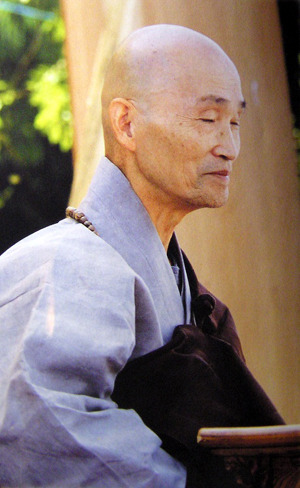
In the meeting venerable Chung-Hwa Sunim was invited to preach a most precious sermon to the congregation. He is one of the most respectable Zen masters in Korea and Patriarch of Tae-An Monastery in Goksung Kun, Chonnam Province.
BBS has recorded his speech. This book is the copy of the recording. We attempted to carry his original voice lest we should scatter his Dharma Pregrance. We think this is not only an epic of truth but also a hearty cry of his to awaken people, and also a simplified and lucid Dharma talk of Buddhism. All errors of presentation in this book are, of course, ours alone.
the Golden Wheel Association of Korean Buddhism.
The Dharma Words on Peace of Mind
Sometimes I have given Dharma talks in a lecture style to my dear monks for three days or seven days. But, this is the first time I have had the chance to give a lecture to monks and nuns as well as laypeople for a whole week. It is my great honor to welcome you, ladies and gentleman of suchness, and to give this Dharma talk before you.
There are many monks of great virtue here, lecturers and abbots.They are very respectable men who have practiced Dharma for more than 20 years. And among the lay people there are several Dharma teachers and scholars of deep learning.
Accordingly, there is not much I could say that you already don’t know. However, because of our usual busyness we often lose touch with the essential Buddhadharma, only to get lost in everyday life. This meeting is about reflecting upon ourselves together in the midst of such insufficiency.
As you all know well, the world faces many kinds of difficulties at this time. While in the past, tension arose from the battle between east and west. Nowadays, more confusion has arisen from the destruction of the communist camp. How in the world can we rescue the human race? Having a sense of basic human value is very important. But where should we look for this?
In fact, the general situation of world confusion up to this point can mainly be attributed to western culture. Therefore, as great scholars predict, western ideology cannot establish a genuine guiding principle for the so-called“new civilization” of the 21st century. Other great people say that we cannot find the guiding principle for this new era except in eastern thought. We Buddhists are very sure of that. Other teachings, other cultural phenomena, have the tendency to examine individual parts, whereas Buddha’s teachings see everything in wholeness.
Buddhism is monism, which sees not only human beings, but also the natural world, or anything at all, as being originally one life, following the “law of equality.” In other words, anything can be incorporated into a single truth. Therefore, this monism of Buddhist thought that observes the law of equality; we are sure that only this teaching can for the first time peacefully unite the world.
Pure Seon
For this reason, the theme of this Dharma meeting is:Pure Seon: Cultivation and Peace of Mind.The copied materials, which were distributed to you, are very poor. If I had asked lecturer monks to do the copying, the condition would have been better, but because they were busy, I did it myself, so there are some wrong words. Please take this into account.
Seon Meditation (參禪) is a very good way to meditate, not only for we Buddhists, but also for those of other religions and people in general. Seon is a very good for our body and mind in handling distractions. Thus, these days some Christians have interest in Seon and people in general really want to practice Seon.
Now, we could have just used the word “Seon” in the title, but why did we use “Pure Seon?” You may wonder why. Because there are some people here who have not practiced Buddhist discipline formally, and would have some difficulty in understanding Buddhist jargon. I will give a full explanation. And actually I think it is important for us to correctly understand this Dharma talk on Pure Seon.
You see there is a reason why I distinguish Pure Seon from Seon. So what is Pure Seon? The period fromBodhidharma, China’s first Seon Patriarch, toHuineng, the Sixth Patriarch, we call “the Pure Seon Period” and we call the Seon of that period “Pure Seon”.
AfterHuinengpassed away, his disciples branched off into five schools, becoming hostile and quarreling with one another. Because of this, Seon practitioners, not to mention non-practitioners lost touch with pure Seon. As I said earlier, this Seon from Bodhidharma to the Sixth PatriarchHuinengwas the purest Seon, which we call “Pure Seon”.
In short, I don’t mean there are actually different Seons: Hwa-du Seon and Muk-jo Seon and the like. What I mean is that themeditationof Pure Seon is to purify our mind just as it is.
Peace of Mind
First of all, we all want to attain the state in which our mind is at peace and we are harmonious with others, living with a pure heart. This applies to any religion, not only Buddhism. All religions seek after peace of mind, the state in which the mind is comfortable and tranquil.
But especially all eighty four thousand Dharmas of Buddhism are about peace of mind. So the Buddha’s teaching is about peace of mind.This means to make our minds tranquil. There is nobody who dislikes their minds to be peaceful. When we feel anxious, our minds cannot be at peace.
To be anxious is that things don’t go our way, or we don’t know who we are, or we don’t know our minds, or we have great distress, or how can we be peaceful when we sometimes hate people.In fact, there are many ways to be anxious.
As we know well, natural catastrophes such as earthquakes, storms, floods and droughts make our life difficult to live. In addition, there are man-made calamities such as political wrongdoings and the negative effects of the modern systems.
We can never shake off anxieties because of all these natural andman-madecalamities. How can we truly live comfortably and without anxiety?
According to the Buddhadharma, we can have peace of mind even when we have failed in business, become ill, our loved ones have passed away, or we have parted with someone.
Where can we access these teaching?Only from pure Seon; only by practicing pure Seon, can we attain such peace of mind. Accordingly, we cannot realize peace of mind apart from Pure Seon.To say this again, whenever we practice Pure Seon, we can obtain peace of mind and live happily. This can be said to be the key to Buddha’s teachings.
Thus, the theme of this Dharma talk isPure Seon: Cultivation and Peace of Mind.This Dharma talk is about how to have peace of mind in all circumstances and live happily everyday through Pure Seonmeditation.
So the main idea here is Pure Seon. Pure Seon transcends all barriers. To use a contemporary common term, it is so-called “Wontong (holistic) Buddhism!” It is also called “Wongtong” ideology or “Whetong” (nonsectarian) ideology. The “Whetong” (nonsectarian) ideology is that one truth resolves everything.
From time immemorial, the teachings of the great saints along with those of the Buddha are based on the Whetong (nonsectarian) ideology. As far as Korea is concerned, Wonhyo, Uisang, Jajang of the Silla period and Daegak, Bojo, and Taego of the Goryo period and the great monk Seosan of the Lee dynasty, all these great monks were drawn toward a Whetong ideology (non-sectarianism).
Why did they follow the Whetong ideology (non-sectarianism)? A saint is one who knows the single truth of the cosmos. Because we sentient beings see everything by appearance, we discriminate between you and me, between good and bad. We can only think this way as far as form is concerned. However, saints see the fundamental base and fundamental nature of all beings.
Accordingly, when we see things from the fundamental nature, everything is one. Jesus and Confucius saw this. They saw the fundamental oneness. Could we not say this “oneness” is God or Buddha? Thus, I’ll try to represent the most precise meaning of Pure Seon.
Samadhi of Ease
We can call this a Dharma talk on peace of mind1), and a Dharma talk on ease of body.Buddhism takes mind and body as one. Therefore, peaceful mind may well result in the ease of body.
The Dharma talk on peace of mind, the Dharma talk on ease of body or calm and precise Samadhi means the dharma talk on “enlightenment first, practice after” or “practice after realization.”
Though the copied materials contain the same contents, I extracted and put them in order again like this for you to have a deeper understanding. The old men like me who belong to the “Chinese characters generation” might not have much difficulty in understanding Chinese characters, but there are many people of the young generation, who have no knowledge of Chinese characters in spite of their Bachelor’s and Doctoral degrees.
Alas, the Dharma talk on peace of mind! Just seeing the characters makes our mind comfortable. So as I say, this dharma talk is on the relief of body.In Buddhism, we never see mind and body as two, only as one. Mind and body are one, nature and humans are also one, and to see the Cosmos as one life is the essential core of Buddha’s teachings.
Therefore if mind is comfortable, so is body. And as far as traditional Seon is concerned, we can call this calm and clear samadhi! This idea is formed by the peaceful ‘An’character, and the clear ‘Sang’ character. This means we don’t need to hurry at all. Hurry comes from anxiety, but in fact there is no need to be hasteful, no need to go ahead, and no need to lag behind.
If we just think of ourselves and we want only to achieve only our good, our minds will not be at ease. We will not have peace of mind. Conversely, if we can be meticulous and attentive, and flexible, this is “Ansang,” calm and clear, Ansang Samadhi. Samadhi means to be absorbed in this.
Samadhi is Sanskrit, and we are normally using ‘Sammae’ in Korean, don’t we? Being absorbed in something is samadhi. Accordingly, no matter if we are sleeping, awake, sitting, standing, moving, or speaking to somebody, our mind is always calm and not in a hurry, this is to be in the state of calm and clear samadhi.
Only in this state, is our mind at peace and our body at ease. Thus, if we are to have this peace of mind and ease of body, our mindset should be enlightenment first, practice after (practicing after realization), firstly having no theoretical conflicts.Our mind will only be at ease if we have no theoretical conflicts.
Even on an ordinary journey, if we don’t know the way well, we could become anxious and lose our way, couldn’t we? If we must know the side roads well in order to go find our way comfortably, how much more should we know with certainty the way of our course in life.
Furthermore, this era of crisscrossed entanglement of information is called the information era. This information era is a good one to live in, but because of the flood of information, how do the people live, who don’t establish their view of life and sense of values.It is confusing to know which information to choose.
Lately, a newspaper reported that three out of five Americans have symptoms of neurosis. It is because they have a troubled mind. They are always nervous and unable to get rid of stress, however much they try. This can be the cause of disease and the seed of domestic discord, national division, and so forth.
Anyhow, how do we live now? What about tomorrow, and our practice? How are those, who have practiced a lot, practicing now? There are some who cannot answer such questions with certainty.
most important thing is by which way are we practicing? That’s the most significant thing. Thus, enlightenment first, practice after (practice after realization)! We should bear this in mind, and make efforts until we can practice like this (practice after realization).
Reciting the Buddha's Name and Seon Meditation
There are various teachings on the cultivation practices (修行精進) that will lead to attaining buddhahood and liberation. The most fundamental meritorious categories of cultivation are reciting the Buddha’s name and Seon meditation, along with cultivation of the precepts, which is the Buddhist moral code. However, these sorts of practices are not independent cultivation methods that are designed to be practiced separately. Rather, only by practicing them together, so that they mutually enhance one other, will one attain the prajñaparamita of supreme wisdom.
Some may quibble and say that in Seon meditation one need not practice reciting the Buddha’s name at all, and in the practice of reciting the Buddha’s name the support of Seon meditation is not crucial. However, originally philosophy behind the practice of reciting the Buddha’s name refers to our own original face, which is the practice of admiring and contemplating on the Buddha, the buddha-nature of true suchness (진여불성,眞如佛性), which is none other than universal life itself. Seon meditation is a practice where one removes all subjective notions and merges with the buddha-nature of true suchness, which is the original self-nature of existence. Ultimately, whether it is reciting the Buddha’s name or Seon meditation, they are both fundamentally superb methods for attaining buddhahood.
Hence in the Prajñaparamita Sutra Spoken by Manjusri (문수설반야경,文殊說般若經), it states, “When one thinks on the Buddha, he is the Buddha (念佛是佛) but when one thinks delusorily, he is an ordinary being (妄念是凡夫)..” Because the original form of all existence is originally buddha, if one recollects the Buddha, one is none other than the buddha; but if one discriminates with an ignorant mind, one is none other than an ignorant sentient being. However, if one merely considers reciting the Buddha’s name to be an expedient means and cultivates while remaining attached to the idea that the Buddha exists separately outside of one’s mind, then this sort of practice that clings to dharmas cannot be authentic recollection of the Buddha’s name. What is more, it cannot be called the Seon of reciting the Buddha’s name.
It has been said that the Seon of reciting the Buddha’s name means “the Amitabha of one’s own nature and the Pure Land of mind-only” (自性彌陀 唯心淨土). Thus, one must always recite the Buddha’s name while not departing from the thought, “the Buddha of the self-nature is the buddha-nature.” Only if one recites the Buddha’s name with the conviction that, when the mind is pure and clear, every moment and every place is the land of Ultimate Bliss (Sukhavati) can it be called the Seon of reciting the Buddha’s name. On the other hand, in referring to Seon meditation, if one either considers the practice of Ganhwaseon (observing the keyword) practice, where one investigates into the hwadu (keyword) or kongan (koan), to be the only true Seon meditation method while others are merely inferior expedient practices; or if one is attached to the idea that only the method of ‘silent illumination’ Seon, where one remains submerged in a state of quiescent contemplation, is the ultimate Seon meditation method; then, those practices cannot be the universal Seon meditation method of the buddhas’ and patriarchs’ orthodox transmission.
Daoxin (Tao-hsin 四祖道信, 580-651, the Fourth Patriarch of Chinese Chan Buddhism), in his “Dharma Gate of the Essential Expedients for Entering the Way and Calming the Mind” (入道安心要方便法門), explained and clarified that the “Pure Seon of the Tathagatas” referred to in the Surangama Sutra (楞伽經) and the “single-characteristic samadhi” and the “single-practice Samadhi” referred to in the Prajñaparamita Sutra Spoken by Manjusri are the essential truths of Son meditation practice. These are all cultivation methods that integrate the practices of reciting the Buddha’s name and Seon meditation. Also, in the Platform Sutra of the Sixth Patriarch, Huineng (慧能, 638-713, the Sixth Patriarch of Chinese Chan Buddhism) recited three times himself, “I take refuge in the three bodies of Buddha” (歸依三身佛), and thereby in a clear and precise manner gave his instruction in the dharma. Then, in the “Transmission Chapter (Buchokpum)” [of the Platform Sutra], he emphasized instead the ‘single-characteristic samadhi’ and the ‘single-practice samadhi.’ These, too, are simply alternate expressions of the ‘reciting the Buddha’s name samadhi.’
Thus, the approach to Seon meditation of reciting the Buddha’s name is a cultivation practice that involves awakening to the buddha, by the buddha inherent in ourselves realizing that he is already a buddha. This is because when we, with all our might, open our minds completely and penetrate to the dharma-gate of the great comprehensive characteristic of the conditioned origination of true suchness, then all the myriad things in existence will originally be free from arising and ceasing and will be none other than the Buddha who is neither defiled nor pure.
Translated from “Kunsunim Beommun,” Gyegan Gwangnyun 3 (November 15, 2002)..