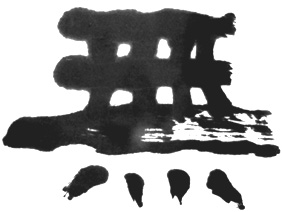
The Gateless Gate 無門關
Wumen's Preface
佛語心爲宗、無門爲法門。
Buddhism makes mind its foundation and no-gate its gate.
既是無門、且作麼生透。
Now, how do you pass through this no-gate?
豈不見道、從門入者不是家珍、從縁得者始終成壞。
It is said that things coming in through the gate can never be your own treasures.
What is gained fromexternal circumstances will perish in the end.
恁麼説話、大似無風起浪好肉抉瘡。
However, such a saying is already raising waves when there is no wind.
It is cutting unblemished skin.
何況滯言句覓解會。掉棒打月、隔靴爬痒、有甚交渉。
As for those who try to understand through other people's words, they are striking at the moon with astick;
scratching a shoe, whereas it is the foot that itches. What concern have they with the truth?
慧開、紹定戊子夏、首衆于東嘉龍翔。因納子請益、遂將古人公案作敲門瓦子、隨機引導學者。
In the summer of the year 1228, Huikai was in Longxiang si Temple and as head monk worked with themonks,
using the cases of the ancient masters as brickbats to batter the gate and lead them on accordingto their respective capacities.
竟爾抄録、不覺成集。
初不以前後敍列、共成四十八則。
The text was written down not according to any scheme, but just to make a collection of forty-eightcases.
通曰無門關。
It is called Wumenkuan, "The Gateless Gate.
"若是箇漢、不顧危亡單刀直入。
A man of determination will unflinchingly push his way straight forward, regardless of all dangers.
八臂那咤、擱他不在。
Then even the eight-armed Nata cannot hinder him.
縦使西天四七、東土二三、只得望風乞命。
Even the four sevens of the West and the two threes of the East would beg for their lives.
設或躊躇、也似隔窓看馬騎、貶得眼來、早已蹉過。
If one has no determination, then it will be like catching a glimpse of a horse galloping past the window:in the twinkling of an eye it will be gone.
Verse 頌曰
大道無門 The Great Way is gateless,
千差有路 Approached in a thousand ways.
透得此關 Once past this checkpoint
乾坤獨歩 You stride through the universe.
Case 1. Zhaozhou's "Wu" 一 趙州狗子
趙州和尚、因僧問、狗子還有佛性也無。 州云、無。
A monk asked Zhaozhou, "Has a dog the Buddha Nature?" Zhaozhou answered, "Wu (無: not have ofnot exist).
Wumen's Comment
無門曰、參禪須透祖師關、妙悟要窮心路絶。
In order to master Chan(Kor. Seon), you must pass the barrier of the patriarchs.
To attain this subtlerealization, you must completely cut off the way of thinking.
祖關不透心路不絶、盡是依草附木精靈。
If you do not pass the barrier, and do not cut off the way of thinking, then you will be like a ghostclinging to the bushes and weeds.
且道、如何是祖師關。
Now, I want to ask you, what is the barrier of the patriarchs?
只者一箇無字、乃宗門一關也。
Why, it is this single word "Wu.
" That is the front gate to Chan.
遂目之曰禪宗無門關。
Therefore it is called the "Wumenkan of Chan.
"透得過者、非但親見趙州、便可與歴代祖師把手共行、眉毛厮結同一眼見、同一耳聞。
If you pass through it, you will not only see Zhaozhou face to face, but you will also go hand in handwith the successive patriarchs, entangling your eyebrows with theirs, seeing with the same eyes, hearingwith the same ears.
豈不慶快。
Isn't that a delightful prospect?
莫有要透關底麼。
Wouldn't you like to pass this barrier?
將三百六十骨節、八萬四千毫竅、通身起箇疑團參箇無字
Arouse your entire body with its three hundred and sixty bones and joints and its eighty-four thousandpores of the skin; summon up a spirit of great doubt and concentrate on this word "Wu.
晝夜提撕、莫作虚無會、莫作有無會。
Carry it continuously day and night.
Do not form a nihilistic conception of vacancy, or a relative
conception of "has" or "has not.
"如呑了箇熱鐵丸相似、吐又吐不出。
It will be just as if you swallow a red-hot iron ball, which you cannot spit out even if you try.
—蕩盡從 前惡知惡覚、久久純熟自然内外打成 片、如唖子得夢、只許自知。
All the illusory ideas and delusive thoughts accumulated up to the present will be exterminated, andwhen the time comes, internal and external will be spontaneously united.
You will know this, but foryourself only, like a dumb man who has had a dream.
驀然打發、驚天 動地。
Then all of a sudden an explosive conversion will occur, and you will astonish the heavens and shake theearth.
如奪得關將軍大刀入手、逢佛殺佛、逢祖殺祖、於生死岸頭得大自在、向六道四生中遊戲三昧。
It will be as if you snatch away the great sword of the valiant general Kuanyu and hold it in your hand.
When you meet the Buddha, you kill him; when you meet the patriarchs, you kill them.
On the brink oflife and death, you command perfect freedom; among the sixfold worlds and four modes of existence,you enjoy a merry and playful samadhi.
且作麼生提撕。
Now, I want to ask you again, "How will you carry it out?"
盡平生氣力擧箇無字。
Employ every ounce of your energy to work on this "Wu."
若不間斷、好似法燭一點便著。
If you hold on without interruption, behold: a single spark, and the holy candle is lit!
Wumen's Verse 頌曰
狗子佛性 The dog, the Buddha Nature,
全提正令 The pronouncement, perfect and final.
纔渉有無 Before you say it has or has not,
喪身失命You are a dead man on the spot.
Case 2 Baizhang's Fox 二 百丈野狐
百丈和尚、凡參次、有一老人常隨衆聽法。
When Ven. Baizhang delivered a certain series of sermons, an old man always followed the monks to themain hall and listened to him.
衆人退、老人亦退。
When the monks left the hall, the old man would also leave.
忽一日不退。
師遂問、面前立者復是何人。
One day, however, he remained behind, and Baizhang asked him, "Who are you, standing here before me?"
老人云、諾。
The old man replied.
某甲非人也。
"I am not a human being.
於過去迦葉佛時曾住此山。
In the old days of Kasyapa Buddha, I was a head monk, living here on this mountain.
因學人問、大修行底人還落因果也無。
One day a student asked me, 'Does a man of enlightenment fall under the yoke of causation or not?'
某甲對云、不落因果。
I answered, 'No, he does not.
'五百生墮野狐身。
Since then I have been doomed to undergo five hundred rebirths as a fox.
今請、和尚代一轉語貴脱野狐。
I beg you now to give the turning word to release me from my life as a fox.
遂問、大修行底人、還落因果也無。
Tell me, does a man of enlightenment fall under the yoke of causation or not?"
師云、不昧因果。
Baizhang answered, "He does not ignore causation.
"老人於言下大悟。
No sooner had the old man heard these words than he was enlightened.
作禮云、某甲、已脱野狐身住在山後。
Making his bows, he said, "I am emancipated from my life as a fox.
I shall remain on this mountain.
敢告和尚。乞、依亡僧事例。
I have a favor to ask of you: would you please bury my body as that of a dead monk."
師、令維那白槌告衆、食後送亡僧。
Baizhang had the director of the monks strike with the gavel and inform everyone that after the middaymeal there would be a funeral service for a dead monk.
大衆言議、一衆皆安、涅槃堂又無人病。何故如是。
The monks wondered at this, saying, "Everyone is in good health; nobody is in the sick ward.
What doesthis mean?"
食後只見師領衆至山後嵒下、以杖挑出一死野狐、乃依火葬。
After the meal Baizhang led the monks to the foot of a rock on the far side of the mountain and with hisstaff poked out the dead body of a fox and performed the ceremony of cremation.
師、至晩上堂、擧前因縁。
That evening he ascended the rostrum and told the monks the whole story.
黄蘗便問、古人錯祗對一轉語、墮五百生野狐身、轉轉不錯合作箇甚麼。
Huangbo thereupon asked him, "The old man gave the wrong answer and was doomed to be a fox forfive hundred rebirths.
Now, suppose he had given the right answer, what would have happened then?"
師云、近前來與伊道。
Baizhang said, "You come here to me, and I will tell you.
"黄蘗遂近前、與師一掌。
Huangbo went up to Baizhang and boxed his ears.
師拍手笑云、將謂、胡鬚赤。更有赤鬚胡。
Baizhang clapped his hands with a laugh and exclaimed, "I was thinking that the barbarian had a redbeard, but now I see before me the red-bearded barbarian himself."
Wumen's Comment
無門曰、不落因果、爲甚墮野狐。
Not falling under causation: how could this make the monk a fox?
不昧因果、爲甚脱野狐。
Not ignoring causation: how could this make the old man emancipated?
若向者裏著得一隻眼、便知得前百丈贏得風流五百生。
If you come to understand this, you will realize how old Baizhang would have enjoyed five hundredrebirths as a fox.
Wumen's Verse 頌曰
不落不昧 Not falling, not ignoring:
兩采一賽 Two faces of one die.
不昧不落 Not ignoring, not falling:
千錯萬錯 A thousand errors, a million mistakes.
Case 3 Juzhi Raises a Finger 三 倶胝堅指
倶胝和尚、凡有詰問、唯擧一指。
Whenever Ven. Juzhi was asked about Chan, he simply raised his finger.
後有童子。因外人問、和尚説何法要。
Once a visitor asked Juzhi's boy attendant, "What does your master teach?"
童子亦堅指頭。
The boy too raised his finger.
胝聞遂以刃斷其指。
Hearing of this, Juzhi cut off the boy's finger with a knife.
童子、負痛號哭而去。
The boy, screaming with pain, began to run away.
胝復召之。童子廻首。胝却 堅起指。
Juzhi called to him, and when he turned around, Juzhi raised his finger.
童子忽然領悟。
The boy suddenly became enlightened.
胝將順世、謂衆曰、吾得天龍一指頭禪、一生受用不盡。
When Juzhi was about to pass away, he said to his assembled monks, "I obtained one-finger Chan fromTianlong and used it all my life but still did not exhaust it."
言訖示滅。
When he had finished saying this, he entered into eternal Nirvana.
Wumen's Comment
無門曰、倶胝並童子悟處、不在指頭上。
The enlightenment of Juzhi and of the boy does not depend on the finger.
若向者裏見得、天龍同倶胝並童子興自己一串穿却。
If you understand this, Tianlong, Juzhi, the boy, and you yourself are all run through with one skewer.
Wumen's Verse
頌曰倶胝鈍置老天龍
Juzhi made a fool of old Tianlong,
利刃單提勘小童
Emancipating the boy with a single slice,
巨靈擡手無多子
Just as a powerful spirit cleaved Mt. Huashan
分破華山千万重
To let the Yellow River run through.
Case 4 The Western Barbarian with No Beard 四 胡子無髭
或庵曰、西天胡子、因甚無髭。
Huoan said, "Why has the Western Barbarian no beard?"
Wumen's Comment
無門曰、參須實參、悟須實悟。
Study should be real study, enlightenment should be real enlightenment.
者箇胡子、直須親見一回始得。
You should once meet this barbarian directly to be really intimate with him.
説親見、早成兩箇。
But saying you are really intimate with him already divides you into two.
Wumen's Verse 頌曰
癡人面前 Don't discuss your dream
不可説夢 Before a fool.
胡子髭無 Barbarian with no beard
惺惺添□ Obscures the clarity.
Case 5 Xiangyan's "Man up in a Tree" 五 香嚴上樹香
嚴和尚云、如人上樹、口啣樹枝、手不攀枝、脚不踏樹。
Ven. Xiangyan said, "It is like a man up in a tree hanging from a branch with his mouth; his hands graspno bough, his feet rest on no limb.
樹下有人問西來意、不對即違他所問、若對又喪身失命。
Someone appears under the tree and asks him, 'What is the meaning of Bodhidharma's coming from theWest?' If he does not answer, he fails to respond to the question.
If he does answer, he will lose his life.
正恁麼時、作麼生對。
What would you do in such a situation?"
Wumen's Comment
無門曰、縱有懸河之辨、惣用不著。
Even if your eloquence flows like a river, it is of no avail.
説得一大藏教、亦用不著。
Though you can expound the whole of Buddhist literature, it is of no use.
若向者裏對得著、活却從前死路頭、死却從前活路頭。
If you solve this problem, you will give life to the way that has been dead until this moment and destroythe way that has been alive up to now.
其或未然、直待當來問彌勒。
Otherwise you must wait for Maitreya Buddha and ask him.
Wumen's Verse 頌曰
香嚴眞杜撰 Xiangyan is truly thoughtless;
惡毒無盡限 His vice and poison are endless
唖却納僧口 He stops up the mouths of the monks,
通身迸鬼眼 And devil's eyes sprout from their bodies.
Case 6 The Buddha Holds Out a Flower 六 世尊拈花
世尊、昔、在靈山會上拈花示衆。
When Shakyamuni Buddha was at Mt. Grdhrakuta, he held out a flower to his listeners.
是時、衆皆默然。
Everyone was silent.
惟迦葉者破顔微笑。
Only MahaKasyapa broke into a broad smile.
世尊云、吾有正方眼藏、涅槃妙心、實相無相、微妙法門、不立文字、教外別傳、付囑摩訶迦葉。
The Buddha said, "I have the True Dharma Eye, the Marvelous Mind of Nirvana, the True Form of theFormless, and the Subtle Dharma Gate, independent of words and transmitted beyond doctrine.
This I have entrusted to MahaKasyapa.
"Wumen's Comment
無門曰、黄面瞿曇、傍若無人。
Golden-faced Gautama really disregarded his listeners.
壓良爲賤、縣羊頭賣狗肉。
He made the good look bad and sold dog's meat labeled as mutton.
將謂、多少奇特。
He himself thought it was wonderful.
只如當時大衆都笑、正方眼藏、作麼生傳。
If, however, everyone in the audience had laughed, how could he have transmitted his True Eye?
設使迦葉不笑、正方眼藏又作麼生傳。
And again, if MahaKasyapa had not smiled, how could the Buddha have transmitted it?
□若道正方眼藏有傳授、黄面老子、誑 閭閻。
If you say the True Dharma Eye can be transmitted, then the golden-faced old man would be a cityslicker who cheats the country bumpkin.
若道無傳授、爲甚麼獨許迦葉。
If you say it cannot be transmitted, then why did the Buddha approve of MahaKasyapa?
Wumen's Verse 頌曰
拈起花來 Holding out a flower,
尾巴已露 The Buddha betrayed his curly tail.
迦葉破顔 Heaven and earth were bewildered,
人天罔措 At MahaKasyapa's smile.
Case 7 Zhaozhou's "Wash Your Bowl" 七 趙州洗鉢
趙州、因僧問、其甲乍入叢林。
A monk said to Zhaozhou, "I have just entered this monastery.
乞師指示。
Please teach me.
"州云、喫粥了也未。
"Have you eaten your rice porridge?" asked Zhaozhou.
僧云、喫粥了也。
"Yes, I have," replied the monk.
州云、洗鉢盂去。
"Then you had better wash your bowl," said Zhaozhou.
其僧有省。
With this the monk gained insight.
Wumen's Comment
無門曰、趙州開口見膽、露出心肝。
When he opens his mouth, Zhaozhou shows his gallbladder.
He displays his heart and liver.
者僧聽事不眞、喚鐘作甕。
I wonder if this monk really did hear the truth.
I hope he did not mistake the bell for a jar.
Wumen's Verse 頌曰
只爲分明極 Endeavoring to interpret clearly,
翻令所得遲 You retard your attainment.
早知燈是火 Don't you know that flame is fire?
飯熟已多時 Your rice has long been cooked.
Case 8 Xizhong the Wheelmaker 八 奚仲造車
月庵和尚問僧、奚仲造車一百輻。
Ven. Yuean said, "Xizhong, the first wheelmaker, made a cart whose wheels had a hundred spokes.
拈却兩頭、去却輻、明甚麼邊事。
Now, suppose you took a cart and removed both the wheels and the axle.
What would you have?"
Wumen's Comment
無門曰、若也直下明得、眼、似流星、機、如掣電。
If anyone can directly master this topic, his eye will be like a shooting star, his spirit like a flash oflightning.
Wumen's Verse 頌曰
機輪轉處When the spiritual wheels turn,
達者猶迷Even the master fails to follow them.
四維上下They travel in all directions, above and below,
南北東西North, south, east, and west.
Case 9 The great Buddha of supreme penetraton and wisdom 九 大通智勝興
陽讓和尚、因僧問、大通智勝佛、十劫坐道場、佛法不現前、不得成佛道時如何。
A monk asked Ven. Xingyang Rang, "The great Buddha of supreme penetraton and wisdom sat in
sitting meditation for ten kalpas and could not attain Buddhahood.
He did not become a Buddha.
Howcould this be?"
讓曰、其問甚諦當。
Rang said, "Your question is quite self-explanatory."
僧云、既是坐道場、爲甚麼不得成佛道。
The monk asked, "He meditated so long; why could he not attain Buddhahood?"
讓曰、爲伊不成佛。
Rang said, "Because he did not become a Buddha.
"Wumen's Comment
無門曰、只許老胡知、不許老胡會。
I allow the barbarian's realization, but I do not allow his understanding.
凡夫若知、既是聖人。
When an ignorant man realizes it, he is a sage.
聖人若會、既是凡夫。
When a sage understands it, he is ignorant.
Wumen's Verse 頌曰
了身何似了心休 Better emancipate your mind than your body;
□了得心 身不愁 When the mind is emancipated, the body is free,
若也身心倶了了 When both body and mind are emancipated,
神仙何必更封候 Even gods and spirits ignore worldly power.
Case 10 Qingshui Is Utterly Destitude 十 清税弧貧
曹山和尚、因僧問云、清税弧貧。
Qingsui said to Ven. Caoshan, "Qingsui is utterly destitude.
乞、師賑濟。
Will you give him support?"
山云、税闍梨。
Caoshan called out, "Qingshui!"
税、應諾。
Qingsui responded, "Yes, sir!"
山曰、青原白家酒、三盞喫了、猶道未沾唇。
Caoshan said, "You have finished three cups of the finest wine in China, and still you say you have notyet moistened your lips!"
Wumen's Comment
無門曰、清税輸機、是何心行。
Qingshui pretended to retreat. What was his scheme?
曹山具眼、深辨來機。
Caoshan had the eye of Buddha and saw through his opponent's motive.
然雖如是、且道、那裏是税闍梨、喫酒處。
However, I want to ask you, at what point did Qingsui drink wine?
Wumen's Verse 頌曰
貧似范丹 Poverty like Fandan's,
氣如項羽 Mind like Xiangyu's;
活計雖無 With no means of livelihood,
敢與鬪富 He dares to rival the richest.
Case 11 Zhaozhou Sees the Hermits 十一 州勘庵主
趙州、到一庵主處問、有麼有麼。
Zhaozhou went to a hermit's cottage and asked, "Is the master in? Is the master in?"
主、堅起拳頭。
The hermit raised his fist.
州云、水淺不是泊舡處。便行。
Zhaozhou said, "The water is too shallow to anchor here," and he went away.
又到一庵主處云、有麼有麼。
Coming to another hermit's cottage, he asked again, "Is the master in? Is the master in?"
主亦堅起拳頭。
This hermit, too, raised his fist.
州云、能縱能奪、能殺能活。便作禮。
Zhaozhou said, "Free to give, free to take, free to kill, free to save," and he made a deep bow.
Wumen's Comment
無門曰、一般堅起拳頭、爲甚麼肯一箇、不肯一箇。
Both raised their fists; why was the one accepted and the other rejected?
□且道、 訛在甚處。
Tell me, what is the difficulty here?
若向者裏下得一轉語、便見趙州舌頭無骨、扶起放倒、得大自在。
If you can give a turning word to clarify this problem, you will realize that Zhaozhou's tongue has nobone in it, now helping others up, now knocking them down, with perfect freedom.
雖然如是爭奈、趙州却被二庵主勘破。
However, I must remind you: the two hermits could also see through Zhaozhou.
若道二庵主有優劣、未具參學眼。
If you say there is anything to choose between the two hermits, you have no eye of realization.
若道無優劣、亦未具參 學眼。
If you say there is no choice between the two, you have no eye of realization.
Wumen's Verse 頌曰
眼流星The eye like a shooting star,
機掣電The spirit like a lighting;
殺人刀A death-dealing blade,
活人劍A life-giving sword.
Case 12 Ruiyan Calls His Master 十二 巖喚主人
瑞巖彦和尚、毎日自喚主人公、復自應諾。
Ven. Ruiyan Yan called to himself every day, "Master!" and answered, "Yes, sir!"
乃云、惺惺着。 □。
Then he would say, "Be wide awake!" and answer, "Yes, sir!"
他時異日、莫受人瞞。 □□。
"Henceforward, never be deceived by others!" "No, I won't!"
Wumen's Comment
無門曰、瑞巖老子、自買自賣、弄出許多神頭鬼面。
Old Ruiyan buys and sells himself.
He takes out a lot of god-masks and devil-masks and puts them onand plays with them.
何故。
What for, eh?
□。一箇喚底、一箇應底。一箇惺惺底、一箇不受人瞞底。
One calling and the other answering; one wide awake, the other saying he will never be deceived.
認着依前還不是。
If you stick to any of them, you will be a failure.
若也傚他、惣是野狐見解。
If you imitate Ruiyan, you will play the fox.
Wumen's Verse
頌曰學道之人不識眞 Clinging to the deluded way of consciousness,
只爲從前認識神 Students of the Way do not realize truth.
無量劫來生死本 The seed of birth and death through endless eons:
癡人喚作本來人 The fool calls it the true original self.
Case 13 Teshan Holds His Bowls 十三 徳山托鉢
徳山、一日托鉢下堂。
One day Teshan went down toward the dining room, holding his bowls.
見雪峰問者老漢鐘未鳴鼓未響、托鉢向甚處去、山便回方丈。
Xuefeng met him and asked, "Where are you off to with your bowls? The bell has not rung, and thedrum has not sounded.
" Teshan turned and went back to his room.
峰擧似巖頭。頭云、大小徳山未會末後句。
Xuefeng mentioned this to Yantou, who remarked, "Teshan is renowned, but he does not know the lastword.
"山聞令侍者喚巖頭來、問曰、汝不肯老僧那。
Teshan heard about this remark and sent his attendant to fetch Yantou.
"You do not approve of me?" heasked.
巖頭密啓其意。
Yantou whispered his meaning.
山乃休去。明日陞座、果與尋常不同。
Teshan said nothing at the time, but the next day he ascended the rostrum, and behold! he was verydifferent from usual!
巖頭至僧堂前、拊掌大笑云、且喜得老漢會末後句。
Yantou, going toward the front of the hall, clapped his hands and laughed loudly, saying,"Congratulations! Our old man has got hold of the last word!
他後天下人、不奈伊何。
From now on, nobody in this whole country can outdo him!"
Wumen's Comment
無門曰、若是未後句、巖頭徳山倶未夢見在。
As for the last word, neither Yantou nor Teshan has ever dreamed of it!
撿點將來、好似一棚傀儡。
When you look into the matter, you find they are like puppets on the shelf!
Wumen's Verse 頌曰
識得最初句 If you realize the first,
便會末後句 You master the last.
末後與最初 The first and the last
不是者一句 Are not one word.
Case 14 Naquan Cuts the Cat in Two 十四 南泉斬猫
南泉和尚因東西堂爭猫兒。
Ven. Naquan saw monks of the Eastern and Western halls quarreling over a cat.
泉乃提起云、大衆道得即救、道不得即斬却也。
He held up the cat and said, "If you can give an answer, you will save the cat.
If not, I will kill it.
"衆無對。泉遂斬之。
No one could answer, and Naquan cut the cat in two.
晩趙州外歸。泉擧似州。
That evening Zhaozhou returned, and Naquan told him of the incident.
州乃脱履安頭上而出。
Zhaozhou took off his sandal, placed it on his head, and walked out.
泉云、子若在即救得猫兒。
"If you had been there, you would have saved the cat," Naquan remarked.
Wumen's Comment
無門曰、且道、趙州頂草鞋意作麼生。
Tell me, what did Zhaozhou mean when he put the sandal on his head?
若向者裏下得一轉語、便見南泉令不虚行。
If you can give a turning word on this, you will see that Naquan's decree was carried out with goodreason.
其或未然險。
If not, "Danger!"
Wumen's Verse 頌曰
趙州若在 Had Zhaozhou been there,
倒行此令 He would have done the opposite;
奪却刀子 When the sword is snatched away,
南泉乞命Even Naquan begs for his life.
Case 15 Dongshan's Sixty Blows 十五 洞山三頓
雲門、因洞山參次、門問曰、近離甚處。
Dongshan came to study with Yunmen.
Yunmen asked, "Where are you from?"
山云、査渡。
"From Zhadu," Dongshan replied.
門曰、夏在甚處。
"Where were you during the summer?"
山云、湖南報慈。
"Well, I was at Baoci monastery ofHunan, south of the lake."
門曰、幾時離彼。
"When did you leave there," Yunmen asked.
山云、八月二十五。
"On August 25" was Dongshan's reply.
門曰、放汝三頓棒。
"I spare you sixty blows," Yunmen said.
山至明日却上問訊。
昨日蒙和尚放三頓棒。
The next day Dongshan came to Yunmen and said, "Yesterday you said you spared me sixty blows.
不知過在甚麼處。
I beg to ask you, where was I at fault?"
門曰、飯袋子、江西湖南便恁麼去。
"Oh, you rice bag!" shouted Yunmen.
"What makes you wander about, now west of the river, now southof the lake?"
山於此大悟。
Dongshan thereupon came to a mighty enlightenment experience.
Wumen's Comment
無門曰、雲門、當時便與本分草料、使洞山別有生機一路、家門不致寂寥。
If Yunmen had given Dongshan the true food of Chan and encouraged him to develop an active Chanspirit, his school would not have declined as it did.
一夜在是非海裏著到、直待天明再來、又與他注破。
Dongshan had an agonizing struggle through the whole night, lost in the sea of right and wrong.
Hereached a complete impasse.
After waiting for the dawn, he again went to Yunmen, and Yunmen againmade him a picture book of Chan.
洞山直下悟去、未是性燥。
Even though he was directly enlightened, Dongshan could not be called brilliant.
且問諸人、洞山三頓棒、合喫不合喫。
Now, I want to ask you, should Dongshan have been given sixty blows or not?
若道合喫、草木叢林皆合喫棒。
If you say yes, you admit that all the universe should be beaten.
若道不合喫、雲門又成誑語。
If you say no, then you accuse Yunmen of telling a lie.
向者裏明得、方與洞山出一口氣。
If you really understand the secret, you will be able to breathe out Chan spirit with the very mouth ofDongshan.
Wumen's Verse 頌曰
獅子教兒迷子訣 The lion had a secret to puzzle his cub;
擬前跳躑早翻身 The cub crouched, leaped, and dashed forward.
無端再敍當頭著 The second time, a casual move led to checkmate.
前箭猶輕後箭深 The first arrow was light, but the second went deep.
Case 16 When the Bell Sounds 十六 鐘聲七條
雲門曰、世界恁麼廣闊。
Yunmen said, "The world is vast and wide.
因甚向鐘聲裏披七條。
Why do you put on your seven-piece robe at the sound of the bell?"
Wumen's Comment
無門曰、大凡參禪學道、切忌、隨聲遂色。
In studying Chan, you should not be swayed by sounds and forms.
縱使聞聲悟道、見色明心也是尋常。
Even though you attain insight when hearing a voice or seeing a form, this is simply the ordinary way ofthings.
殊不知、納僧家、騎聲蓋色、頭頭上明、著著上妙。
Don't you know that the real Chan student commands sounds, controls forms, is clear-sighted at everyevent and free on every occasion?
然雖如是。且道、聲來耳畔、耳往聲邊。
Granted you are free, just tell me: Does the sound come to the ear or does the ear go to the sound?
直饒響寂雙忘、到此如何話會。
If both sound and silence die away, at such a juncture how could you talk of Chan?
若將耳聽應難會、眼處聞聲方始親。
While listening with you ear, you cannot tell
When hearing with your eye, you are truly intimate.
Wumen's Verse 頌曰
會則事同一家 With realization, things make one family;
不會萬別千差 Without realization, things are separated in a thousand ways.
不會事同一家 Without realization, things make one family;
會則萬別千差 With realization, things are separated in a thousand ways
Case 17 the National Teacher Gives Three Calls 十七 國師三喚
國師三喚侍者。侍者三應。
The National Teacher called his attendant three times, and three times the attendant responded.
國師云、將謂吾辜負汝、元來却是汝辜負吾。
The National Teacher said, "I long feared that I was betraying you, but really it was you who werebetraying me.
"Wumen's Comment
無門曰、國師三喚、舌頭墮地。
The National Teacher called three times, and his tongue fell to the ground.
侍者三應、和光吐出。
The attendant responded three times, and he gave his answer with brilliance.
國師年老心孤、按牛頭喫草。
The National Teacher was old and lonely; he held the cow's head and forced it to eat grass.
侍者未肯承當。
The attendant would have none of it;
□美食不中飽人 、且道、那裏是他辜負處。
delicious food has little attraction for a man who is satiated.
Tell me, at what point was the betrayal?
國淨才子貴、家富小兒嬌。
When the country is flourishing, talent is prized.
When the home is wealthy, the children are proud.
Wumen's Verse 頌曰
鉄枷無孔要人擔 He carried and iron yoke with no hole
累及兒孫不等閑 And left a curse to trouble his descendants.
□□欲得 門并 戸 If you want to hold up the gate and the doors,
更須赤脚上刀山 You must climb a mountain of swords with bare feet.
Case 18 Dongshan's "Masanjin" 十八 洞山三斤
洞山和尚、因僧問、如何是佛。
A monk asked Dongshan, "What is Buddha?"
山云、麻三斤。
Dongshan replied, "Masanjin!" [three pounds of flax]
Wumen's Comment
無門曰、洞山老人、參得些蚌蛤禪、纔開兩片露出肝腸。
Old Dongshan attained the poor Chan of a clam. He opened the two halves of the shell a little andexposed all the liver and intestines inside
然雖如是、且道、向甚處見洞山。
But tell me, how do you see Dongshan?
Wumen's Verse 頌曰
突出麻三斤 "Three pounds of flax" came sweeping along;
言親意更親 Close were the words, but closer was the meaning.
來説是非者 Those who argue about right and wrong
便是是非人 Are those enslaved by right and wrong.
Case 19 Naquan's "Ordinary Mind Is the Way" 十九 平常是道
南泉、因趙州問、如何是道。
Zhaozhou asked Naquan, "What is the Way?"
泉云、平常心是道。
"Ordinary mind is the Way," Naquan replied.
州云、還可趣向否。
"Shall I try to seek after it?" Zhaozhou asked.
泉云、擬向即乖。
"If you try for it, you will become separated from it," responded Naquan.
州云、不擬爭知是道。
"How can I know the Way unless I try for it?" persisted Zhaozhou.
泉云、道不屬知、不屬不知。
Naquan said, "The Way is not a matter of knowing or not knowing
知是妄覺、不知是無記。
Knowing is delusion; not knowing is confusion.
若眞達不擬之道、猶如太虚廓然洞豁。
When you have really reached the true Way beyond doubt, you will find it as vast and boundless asouter space.
豈可強是非也。
How can it be talked about on the level of right and wrong?"
州於言下頓悟。
With these words, Zhaozhou came to a sudden realization.
Wumen's Comment
無門曰、南泉被趙州發問、直得瓦解氷消、分疎不下。
Naquan dissolved and melted away before Zhaozhou's question, and could not offer a plausibleexplanation.
趙州縱饒悟去、更參三十年始得。
Even though Zhaozhou comes to a realization, he must delve into it for another thirty years before hecan fully understand it.
Wumen's Verse 頌曰
春有百花秋有月 The spring flowers, the autumn moon;
夏有涼風冬有雪 Summer breezes, winter snow.
若無閑事挂心頭 If useless things do not clutter your mind,
更是人間好時節 You have the best days of your life.
Case 20 The Man of Great Strength 二十 大力量人
松源和尚云、大力量人、因甚擡脚不起。
Ven. Songyuan asked, "Why is it that a man of great strength does not lift his legs?"
又云、開口不在舌頭上。
And he also said, "It is not the tongue he speaks with.
"Wumen's Comment無門曰、松源可謂、傾腸倒腹。
It must be said that Songyuan shows us all his stomach and intestines.
只是欠人承當。
But alas, no one can appreciate him!
縱饒直下承當、正好來無門處喫痛棒。
And even if someone could appreciate him, let him come to me, and I'll beat him severely.
何故。
Why?
□。要識眞金、火裏看。
If you want to find pure gold, you must see it through fire.
Wumen's Verse 頌曰
擡脚踏翻香水海 Lifting his leg, he kicks up the Scented Ocean;
低頭俯視四禪天Lowering his head, he looks down on the fourth Dhyana heaven.
一箇渾身無處著請 There is no space vast enough for his body
—續一句 Now, somebody write the last line here.
Case 21 Yunmen's "Ganshijue" 二十一 雲門屎橛
雲門、因僧問、如何是佛。
A monk asked Yunmen, "What is Buddha?"
門云、乾屎橛。
Yunmen replied, "Ganshijue!" [A dry shit-stick.]
Wumen's Comment
無門曰、雲門可謂、家貧難辨素食、事忙不及草書。
Yunmen was too poor to prepare plain food, too busy to speak from notes.
動便將屎橛來、撑門挂戸。
He hurriedly took up a shit-stick to support the Way.
佛法興衰可見。
The decline of Buddhism was thus foreshadowed.
Wumen's Verse 頌曰
閃電光Lightning flashing,
撃石化Sparks shooting;
貶得眼A moment's blinking,
巳蹉過Missed forever.
Case 22 Kasyapa's "Knock Down the Flagpole" 二十二 迦葉刹竿
迦葉、因阿難問云、世尊傳金襴袈裟外、別傳何物。
Ananda asked Kasyapa, "The World-honored One gave you the golden robe; did he give you anythingelse?"
葉喚云、阿難。
"Ananda!" cried Kasyapa.
難、應諾。
"Yes, sir!" answered Ananda.
葉云、倒却門前刹竿著。
"Knock down the flagpole at the gate," said Kasyapa.
Wumen's Comment無門曰、若向者裏下得一轉語親切、便見靈山一會儼然未散。
If you can give a turning word at this point, you will see that the meeting at Mount Grdhrakuta is stillsolemnly continuing.
其或未然、毘婆尸佛、早留心、直至而今不得妙。
If not, then this is what Vipassin Buddha worried about from remote ages; up to now he has still notacquired the essence.
Wumen's Verse 頌曰
問處何如答處親 Tell me—question or answer—which was more intimate?
幾人於此眼生筋 Many have knit their brows over this;
兄呼弟鷹揚家醜 Elder brother calls, younger brother answers, and they betray the family secret.
不屬陰陽別是春 They had a special spring, not one of yin and yang.
Case 23 Think Neither Good Nor Evil 二十三 不思善惡
六祖、因明上座、趁至大庾嶺。
The Sixth Patriarch was pursued by the monk Huiming as far as Dayu Mountain.
祖見明至、即擲衣鉢於石上云、此衣表信。可力爭耶、任君將去。
The patriarch, seeing Huiming coming, laid the robe and bowl on a rock and said,
"This robe representsthe faith; it should not be fought over.
If you want to take it away, take it now.
"□明遂擧之如山不動、踟 悚慄。明白、我來 求法、非爲衣也。
Huiming tried to move it, but it was as heavy as a mountain and would not budge.
Faltering andtrembling, he cried out, "I came for the Dharma, not for the robe.
願行者開示。
I beg you, please give me your instruction.
"祖云、不思善、不思惡、正與麼時、那箇是明上座本來面目。
The patriarch said, "Think neither good nor evil.
At this very moment, what is the original self of themonk Huiming?"
明當下大悟、遍體汗流。
At these words, Huiming was directly illuminated.
His whole body was covered with sweat.
泣涙作禮、問曰、上來密語密意外、還更 有意旨否。
He wept and bowed, saying, "Besides the secret words and the secret meaning you have just nowrevealed to me, is there anything else, deeper still?"
祖曰、我今爲汝説者、即非密也。
The patriarch said, "What I have told you is no secret at all.
汝若返照自己面目、密却在汝邊。
When you look into your own true self, whatever is deeper is found right there.
"明云、其申雖在黄梅隨衆、實未省自己面目。
Huiming said, "I was with the monks under the Fifth Patriarch for many years but I could not realize mytrue self.
今蒙指授入處、如人飲水冷暖自知。
But now, receiving your instruction, I know it is like a man drinking water and knowing whether it iscold or warm.
今行者即是某甲師也。
My lay brother, you are now my teacher.
"祖云、汝若如是則吾與汝同師黄梅。
The patriarch said, "If you say so, but let us both call the Fifth Patriarch our teacher.
善自護持。
Be mindful to treasure and hold fast to what you have attained.
"Wumen's Comment無問曰、六祖可謂、是事出急家老婆心切。
The Sixth Patriarch was, so to speak, hurried into helping a man in an emergency, and he displayed agrandmotherly kindness.
譬如新茘支剥了殻去了核、送在你口裏、只要你嚥一嚥
It is as though he peeled a fresh sugar apple, removed the seed, put it in your mouth, and asked you toswallow it down.
Wumen's Verse 頌曰
描不成兮畫不就 You cannot describe it; you cannot picture it;
贊不及兮休生受 You cannot admire it; don't try to eat it raw.
本來面目没處藏 Your true self has nowhere to hide;
世界壞時渠不朽 When the world is destroyed, it is not destroyed.
Case 24 Fengxue's Speech and Silence 二十四 離却語言
風穴和尚、因僧問、語默渉離微、如何通不犯。
A monk asked Fengxue, "Both speech and silence are faulty in being li
[離 inward action of mind] orWei [微 outward action of mind].
How can we escape these faults?"
穴云、長憶江南三月裏、鷓鴣啼處百花香。
Fengxue said,
"I always remember the spring in Jiangnan (the south of a river),
Where the partridges sing;
How fragrant the countless flowers!"
Wumen's Comment
無門曰、風穴機如掣電得路便行。
Fengxue's Chan spirit was like lightning and opened a clear passage.
爭奈坐前人舌頭不斷。
However, he was entangled in the monk's words and could not cut them off.
若向者裏見得親切、自有出身之路。
If you can really grasp the problem, you can readily find the way out.
且離却語言三昧、道將一句來。
Now, putting language samadhi aside, say it in your own words.
Wumen's Verse 頌曰
不露風骨句 He does not use a refined phrase;
未語先分付 Before speaking, he has already handed it over.
進歩口喃喃 If you chatter on and on,
知君大罔措 You will find you have lost your way.
------------------------
The Gateless Gate or The Gateless Barrier (Chin. Wumenkuan; Jap. Wumenkan; Kor. Mumugwan)
The author is Chinese Chan master Wumen Huihai (無門慧開 1183-1260).
English Translation
By late Zen master Katsuki Sekida (Two Zen Classics 26-137)Modified by JOKB (japanese-style expressions replaced by chinese-style)
The Chinese and Japanese texts in this web site are taken from the book titled Wumenkan, published in
Japan by Iwanami Bunkõ.
Chinese Characters
Unfortunately a few Chinese characters were not given in this site.
Luckily these characters are less than1% of the text.
Where there was a definition about these ideograms, they are entered them usingChinese system (Big 5).
There are also ideograms that appear as mere black boxes, without anyexplanations.
These are replaced with dummy characters (empty square boxes).
Gateless Gate
The Gateless Gate is a collection of 48 Zen koans compiled in the early 13th century by Chinese monk Wumen (also translated as Mumon or Ummon). Wumen's preface indicates that the volume was published in 1228. Each koan is accompanied by a commentary and verse by Wumen. A classic edition includes a 49th case composed by Anwan (pen name for Cheng Ch'ing-Chih) in 1246. Wu-liang Tsung-shou also supplemented the volume with three poems relating to case number 47, composed in 1230.
Along with the Blue Cliff Record and the oral tradition of Hakuin Ekaku, The Gateless Gate is a central work much used in Rinzai School practice. Five of the koans in the work concern the sayings and doings of Zhaozhou; four concern Ummon.
All 48 Koans With Commentaries, presented by the Wanderling:
CASE 1. JOSHU'S DOG
A monk asked Joshu, "Has the dog the Buddha nature?"
Joshu replied, "Mu"
Mumon's Comment:
For the pursuit of Zen, you must pass through the barriers (gates) set up by the Zen masters. To attain his mysterious awareness one must completely uproot all the normal workings of one's mind. If you do not pass through the barriers, nor uproot the normal workings of your mind, whatever you do and whatever you think is a tangle of ghost. Now what are the barriers? This one word "Mu" is the sole barrier. This is why it is called the Gateless Gate of Zen. The one who passes through this barrier shall meet with Joshu face to face and also see with the same eyes, hear with the same ears and walk together in the long train of the patriarchs. Wouldn't that be pleasant?
Would you like to pass through this barrier? Then concentrate your whole body, with its 360 bones and joints, and 84,000 hair follicles, into this question of what "Mu" is; day and night, without ceasing, hold it before you. It is neither nothingness, nor its relative "not" of "is" and "is not." It must be like gulping a hot iron ball that you can neither swallow nor spit out.
Then, all the useless knowledge you have diligently learned till now is thrown away. As a fruit ripening in season, your internality and externality spontaneously become one. As with a mute man who had had a dream, you know it for sure and yet cannot say it. Indeed your ego-shell suddenly is crushed, you can shake heaven and earth. Just as with getting ahold of a great sword of a general, when you meet Buddha you will kill Buddha. A master of Zen? You will kill him, too. As you stand on the brink of life and death, you are absolutely free. You can enter any world as if it were your own playground. How do you concentrate on this Mu? Pour every ounce of your entire energy into it and do not give up, then a torch of truth will illuminate the entire universe.
Has a dog the Buddha nature?
This is a matter of life and death.
If you wonder whether a dog has it or not,
You certainly lose your body and life!
See also: Regarding Mu
CASE 2. HYAKUJO'S FOX
Whenever Hyakujo delivered a Zen lecture, an old man was always there with the monks listening to it; and when they left the Hall, so did he. One day, however, he remained behind, and Hyakujo asked,"Who are you?"
The old man replied,"Yes, I am not a human being, but in the far distant past, when the Kashapa Buddha (the Sixth Buddha of the Seven Ancient Buddhas) preached in this world, I was the head monk in this mountain area. On one occasion a monk asked me whether an enlightened man could fall again under the law of karma (cause and effect), and I answered that he could not. Thus I became a fox for 500 rebirths and am still a fox. I beg you to release me from this condition through your Zen words."
Then he asked Hyakujo,"Is an enlightened man subject to the law of karma?" Hyakujo answered, "No one is free from the law of Karma."
At the words of Hyakujo the old man was enlightened, and said with a bow, "I am now released from rebirth as a fox and my body will be found on the other side of the mountain. May I request that you bury me as a dead monk?"
The next day Hyakujo had the Karmadana, or deacon, beat the clapper and he informed the monks that after the midday meal there would be a funeral service for a dead monk. "No one was sick or died," wondered the monks. "What does our Roshi mean?" After they had eaten, Hyakujo led them to the foot of a rock on the furthest side of the mountain, and with his staff poked the dead body of a fox and had it ritually cremated.
In the evening Hyakujo gave a talk to the monks and told them this story of the law of Karma. Upon hearing the story, Obaku asked Hyakujo, "You said that because a long time ago an old Zen master gave a wrong answer he became a fox for 500 rebirths. But suppose every time he answered he had not made a mistake, what would have happened then?" Hyakujo replied, "Just come here to me, and I will tell you the answer!" Obaku then went up to Hyakujo--and slapped the teacher's face. Hyakujo, clapping his hands and laughing, exclaimed, "I thought the Persian had a red beard, but here is another one with a red beard!"
Mumon's Comment:
"The enlightened man is not subject to Karma." How can this answer make the monk a fox? "The enlightened man is not free from the law of karma." How can this answer release him from his fox's life? If you have one eye in regard to this, then you understand Hyakujo's (the old man's) dramatic 500 rebirths.
Free from karma or subject to it,
They are two sides of the same die.
Subject to karma or free from it,
Both are irredeemable errors.
See also: Hyakujo's Fox
See also: No Ducks
CASE 3. GUTEI'S FINGER
Gutei raised his finger whenever he was asked a question about Zen. A boy attendant began to imitate him in this way. When a visitor asked the boy what his master had preached about, the boy raised his finger.
Gutei heard about the boy's mischief, seized him and cut off his finger with a knife. As the boy screamed and ran out of the room, Gutei called to him. When the boy turned his head to Gutei, Gutei raised up his own finger. In that instant the boy was enlightened.
When Gutei was about to die, he said to the assembled monks,"I received this one-finger Zen from Tenryu. I used it all my life and yet could not exhaust it" and then he passed away.
Mumon's Comment:
Where Gutei and the boy attained enlightenment is not at the tip of the finger itself. If this simple truth is not comprehended, Tenryu, Gutei, the boy and you also will be bound together once and for all.
Gutei made a fool of old Tenryu,
With the sharp blade he did simply harm the boy.
That's nothing compared to the Mountain Spirit when he raised his hand
And split Kasan (the great mountain) in two.
CASE 4. WAKU'AN'S "WHY NO BEARD?"
Waku'an (looking at Bodhidharma's picture) complained, "Why has that Barbarian no beard?"
Mumon's Comment:
If you study Zen, you must study it with all your heart. When you attain enlightenment, it must be true enlightenment. When you really meet Bodhidharma face to face, then you finally have gotten it right. However when you start explaining it with words, you have fallen into duality.
Do not explain your dream
Before a fool.
The barbarian has no beard,
How could you add obscurity to clarity?
CASE 5. KYOGEN'S MAN HANGING IN THE TREE
Kyogen said, "It (Zen) is like a man (monk) hanging by his teeth in a tree over a precipice. His hands grasp no branch, his feet rest on no limb, and under the tree another man asks him, 'Why did Bodhidharma come to China from the West (India)?' If the man in the tree does not answer, he misses the question, and if he answers, he falls and loses his life. Now what shall he do?"
Mumon's Comment:
(In such a predicament) though your eloquence flows like a river, it is all to no avail. Even if you can explain all of the Buddhist sutras, that also is useless. If you can rightly answer the question, you walk the road of killing the living and reviving the dead. But if you cannot answer, you should wait for ages and ask Maitreya, the future Buddha.
Kyogen had really bad taste,
And spreads the poison everywhere,
He stuffs with it the monks' mouths,
And lets their tears stream from their dead eyes.
CASE 6. THE BUDDHA'S FLOWER
Once upon a time when Shakyamuni Buddha was in Grdhrakuta mountain, he twirled a flower in his finger and held it before his congregation. Everyone was silent. Only Maha Kashapa wholeheartedly smiled. Buddha said, "I have the eye of the true teaching, the heart of Nirvana, the formless form, the mysterious gate of Dharma. Beyond the words and beyond all teachings to be transmitted, I now pass this on to Maha Kashapa."
Mumon's Comment:
Golden-faced Gautama impudently forced the good people into depravity. He sold dog meat under the name of mutton. And he thought he made it! What if all the audience had laughed together? How could he have handed the eye of the true teaching or if Kashapa had not smiled, how could he have transmitted the teaching? If you say it could be transmitted, he is like a golden-faced old huckster swindling at the city gate, and if you say it cannot be transmitted, how does he hand it on to Maha Kashapa?
At the turning of a flower,
The snake (his disguise) shows his tail.
Maha Kashapa smiles,
Every monk does not know what to do.
CASE 7. JOSHU'S WASHING THE BOWL
A monk told Joshu, "I have just entered this monastery. I beg you to teach me." Joshu asked, "Have you eaten your rice porridge?" The monk replied, "I have." "Then," said Joshu, "Go and wash your bowl."
At that moment the monk was enlightened.
Mumon's Comment:
Joshu opened his mouth, showed his gall-bladder (true mind) and the depth of his heart. If this monk did not really listen to and grasp the truth, he indeed mistook the bell for a pitcher.
He made it so simple and clear,
It might take a long time to catch the point,
If one realizes that it's stupid to search for fire with a lantern light,
The rice would not take so long to be done.
CASE 8. KEICHU'S WHEEL
Gettan asked a monk, "If Keichu (the ancient mythological wheel maker) made one hundred carts, and if we took off the wheels and removed the hub uniting the spokes, what would then become apparent?
Mumon's Comment:
If anyone can answer this question instantly, his eyes will be like a meteor and his mind like a flash of lightning.
When the hubless wheel turns,
Even the master would be at a loss what to do,
It turns above heaven and beneath earth,
South, north, east, and west.
CASE 9. DAITSU CHISHO BUDDHA
A monk asked Seijo, "Daitsu Chisho Buddha did zazen (meditated) for ten kalpas in a Meditation Hall, could not realize the highest truth, and so could not become fully emancipated. Why was this?" Seijo said, "Your question is a very appropriate one!" The monk asked again, "Why did he not attain Buddhahood by doing zazen in the Meditation Hall?" Seijo replied, "Because he did not."
Mumon's Comment:
You may know the Old Indian, but you are not allowed to have an understanding of Him. If an ordinary man attains enlightenment, he is a sage. When the sage is concerned about an understanding, he is only an ordinary man.
Rather than putting the body to rest, let the heart rest.
When the mind is realized, then one need not worry about the body.
If the mind and the body have completely become one,
This is the perfect life of sage, and praise is utterly meaningless.
CASE 10. SOZAN AND POOR SEIZAI
A monk named Seizai said to Sozan, "I am alone and poor. I beg my teacher to bestow upon me the alms of salvation." Sozan said, "Acarya Seizai!" "Yes, Sir?" replied Seizai. Sozan said, "Someone has drunk three bowls of the wine of Haku of Seigen, but says that he has not yet even moistened his lips."
Mumon's Comment:
Seizai overplayed his hand. Then what is his real state of mind? Sozan with his one eye sees through the recesses of his mind and comprehends what he really meant. However this may be so, where did Acarya Seizai drink the wine?
The poorest like Hanzen,
His spirit like that of Kou.
He could barely make his living,
And yet wishes to rival the wealthiest.
CASE 11. JOSHU'S HERMIT
Joshu went to a hermit's and asked, "What's up? What's up?"(="Have you any Zen?") The hermit lifted up his fist. Joshu said, "The water is too shallow to anchor here," and went away. Joshu visited the hermit once again a few days later and said, "What's up? What's up?" The hermit raised his fist again. Then Joshu said, "Well given, well taken, well killed, well saved." And he bowed to the hermit.
Mumon's Comment:
The raised fist was the same both times. Why was one accepted, the other rejected? Just say, where is the confusion between the two?
If you can answer this by a word of true comprehension, then you realize that Joshu's tongue has no bone and that he can absolutely freely use it. Even though this is so, the hermit might have seen through Joshu both times. If you wonder whether the first hermit be superior (or inferior) to the second, then you have no one eye.
His eye is a meteor,
Zen's movement is like lightning.
The sword that kills the man,
is the sword that saves the man.
CASE 12. ZUIGAN CALLS HIMSELF "MASTER"
Every day Zuigan used to call out to himself, "Master!" and then he answered himself, "Yes, Sir!" And he added, "Awake, Awake!" and then answered, "Yes, Sir! Yes, Sir!"
"From now onwards, do not be deceived by others!" "No, Sir! I will not, Sir!"
Mumon's Comment:
The master, Zuigan, sells out and buys himself. He has a lot of puppets of gods and devils that he plays with. Why is this so? With one mask he asked, and with another he answered. With another mask he said, "Awake!" and another, "Don't be cheated by others!"
If you adhere to any one of these, you are totally mistaken. If, however, you imitate Zuigan, then all these are no other than the fox's disguises.
Some who search the Way of Zen do not realize true self,
For they recognize only the ego-soul.
This ego-soul is the seed of birth and death,
Foolish people take it for the true original self.
CASE 13. TOKUSAN'S BOWL
One day Tokusan came to the dining room from the Meditation Hall, holding his bowl. Seppo saw him coming and asked, "The dinner drum is not yet beaten. Where are you going with your bowl?
Tokusan went back at once to his room. Seppo told about this incident to Ganto, who said, "Tokusan as he is, has not penetrated into the ultimate truth of Zen."
Tokusan heard of this and sent an acolyte to ask Ganto to come to him. "I have heard," told Tokusan, "you are not approving my Zen." Ganto whispered to Tokusan what he meant. Tokusan said nothing, leaving Ganto there.
Next day, ascending the rostrum, Tokusan delivered an entirely different sermon to the monks. Ganto went forward in the Hall, clapped his hands, laughed and said, "What a happy thing! The old man has got hold of the ultimate truth of Zen. From now on, no one in heaven and on earth can surpass him."
Mumon's Comment:
As for the ultimate truth of Zen, neither Tokusan nor Ganto even dreamt of such a thing. When you look into the matter, they are only a set of dummies how about puppets- dummies sounds like stupid..
Whoever understands the first truth
Understands the ultimate truth.
The last and the first
Are they not one and the same?
CASE 14. NANSEN CUTS THE CAT IN TWO
Nansen saw the monks of the eastern and western halls fighting over a baby cat. He seized the cat and said, "If (any of) you can say (a word of Zen), you can spare the cat. Otherwise I will kill it." No one could answer. So Nansen cut the cat in two .
That evening Joshu returned and Nansen told him what had happened. Joshu thereupon took off his sandals and, placing them on his head, walked away. Nansen said, "If only you had been there, you could have saved the cat."
Mumon's Comment:
Why did Joshu put his sandals on his head? If you can answer this question with one word, you understand Nansen's efforts. If not, you are utterly in danger.
Had Joshu been there,
The opposite would have been done.
Joshu would have snatched the knife,
And Nansen would have begged for his life.
See also: Cutting the Cat Into One
See also: Who Is Arguing About the Cat?
CASE 15. TOZAN'S SIXTY BLOWS
Tozan went to Ummon and Ummon asked him where he had come from. Tozan answered, "From Sato!" Then Ummon asked, "Where were you then during the Summer?" Tozan answered, "At Hoji Temple in Konan Province." Ummon further asked Tozan, "When did you leave there?" Tozan replied, "I left on August 25." Un-mon told Tozan, "You deserve 60 blows, but I will forgive you today!"
The next day Tozan knelt and deeply bowed to Ummon and said, "Yesterday you forgave me the 60 blows, but I still do not understand in what respect I was wrong." Then Un mon told Tozan, "You are really a good-for-nothing rice eater! No wonder you wandered around Konan and Kosei for nothing!" At this very moment, Tozan was awakened.
Mumon's Comment:
Ummon had Tozan feed on the genuine fodder of Zen, showed him the one way of living activity, and helped him from becoming extinct. All night long Tozan swam in the waves of Yes and No until he got nowhere. When the dawn broke, again Tozan went to Ummon to be awakened. After all Tozan was not so seasoned.
Now I will ask you: Did Tozan deserve 60 blows? If you say Yes, then not only Tozan, but everyone also deserves 60 blows! If you say No, Ummon is a swindler. If therefore you understand this clearly, Tozan and you breathe the same air!
The lion roughly teaches her cubs,
She kicks them away and the cubs jump.
Ummon's thrown words hit right on Tozan's heart,
While Ummon's first arrow is light, the second arrow hits deep.
CASE 16. UMMON'S SEVEN-FOLD ROBE
Ummon said, "The world is vast and wide; for what is it you put on your seven-piece robe at the sound of the bell?"
Mumon's Comment:
When one meditates and studies Zen, one extinguishes the attachment to sound and color. Even though some have attained enlightenment by hearing a sound, or an awakening by seeing a color, these are ordinary matters. Those who intend to master Zen freely master sounds or colors, see clearly the nature of things and every activity of mind. Even though this is so, now tell me: Does the sound come to the ear, or does the ear go to the sound? But when both sound and silence are forgotten, what would you call this state? If you listen with your ear, it is hard to hear truly, but if you listen with your eye, then you begin to hear properly.
If you are awakened, all things are one and the same,
If you are not awakened, all things are varied and distinguished.
If you are not awakened, all things are one and the same,
If you are awakened, all things are varied and distinguished.
CASE 17. ECHU'S THREE CALLS
Echu, called Kokushi, the teacher of the emperor, called his attendant, Oshin, three times and three times Oshin answered, "Yes!" Kokushi said, "I thought that I had offended you, but in reality you offended me!"
Mumon's Comment:
Kokushi called Oshin three times. His tongue fell to the ground (from talking too much). Oshin answered three times and revealed his harmony with the Tao. Echu, getting old and lonely, attempted even to hold the cow's head down to feed on the grass. Oshin did not trouble to show his Zen, for his satisfied stomach had no desire to eat. When the nation is prosperous, everyone is too proud (to eat plain food), now just say who offended which one?
When prison canga is iron and has no hole,
(Echu's) followers have neither peace nor rest.
When you intend to uphold the teaching of Zen,
You must climb a mountain of swords with bare feet.
CASE 18. TOZAN'S THREE POUNDS OF FLAX
A monk asked Tozan, "What is the Buddha?"
Tozan answered, "Three pounds of flax!"
Mumon's Comment:
Tozan's Zen is like a clam. When the two halves of the shell open, you can see the whole inside. However, now tell me, "What is Tozan's real insides?"
Just "Three pounds of flax!" pops up,
His words are close, and yet his heart is closer.
Anyone who explains this or that, yes and no,
is himself the man of yes and no.
CASE 19. NANSEN'S ORDINARY MIND
Joshu asked Nansen, "What is the Way?" Nansen answered, "Your ordinary mind--that is the Way." Joshu said, "Can it be grasped (for study)?" Nansen replied, "The more you pursue, the more does it slip away." Joshu asked once more, "How can you know it is the Way?" Nansen responded, "The Way does not belong to knowledge, nor does it belong to non knowledge. Knowledge is illusion. Non knowledge is beyond discrimination. When you get to this Way without doubt, you are free like the vastness of space, an unfathomable void, so how can you explain it by yes or no?" Upon hearing this, Joshu was awakened.
Mumon's Comment:
The question Joshu asked Nansen was dissolved by a stroke. After being enlightened, Joshu must further his pursuit 30 more years to exhaust that meaning.
Hundred flowers in Spring, the moon in Autumn,
The cool wind in Summer and Winter's snow.
If your mind is not clouded with things,
You are happy at any time.
CASE 20. SHOGEN'S STRONG MAN
Shogen said,"Why is it that a man of strength cannot lift up his own legs and stand up (for Zen)?" And again, "It is not with our tongue that we speak."
Mumon's Comments:
Shogen said it by turning his heart inside out, and no one was there to receive it. If anyone should comprehend Shogen, then come to me and receive my blows. To know the genuine gold, you must see it through fire.
Raising my foot I turn upside down the Scented Ocean,
Bowing my head I look down on the Four Dhyana Heavens.
Such a body of full strength has no place to rest,
Please finish this verse yourself!
CASE 21. UMMON'S DRIED DUNG
A monk asked Ummon,"What is Buddha?" Ummon answered him, "Dried dung."
Mumon's Comments
We must say that being so poor, Ummon cannot appreciate plain food, or he is so busy that he cannot even scribble properly. He is disposed to support his school with dry dung. Look at how devastated the Buddhist teaching has been!
Lightning flashes,
Sparks of striking flint.
In a blink of your eyes,
You have passed by (and missed it).
See also: Zen Can Be Found In Any Activity.
CASE 22. KASHAPA'S FLAG POLE
Ananda asked Maha Kashapa, "Buddha gave you the golden woven robe of successorship. What else did he give you?"
Kashapa said, "Ananda!"
"Yes!" answered Ananda.
"Knock down the flagpole at the gate!" said Kashapa.
Mumon's Comments:
If you can give a "turning word" (a momentous word for awakening), you will see the meeting at Mount Grdhrahuta? still in session. If not, no matter how much you make struggles to study from the age of Vipasyin, you cannot attain enlightenment.
How is Ananda's question, compared to Kashapa's answer of heart.
How many people have since then opened their eyes.
Elder brother calls and younger brother answers--the family disgrace.
This spring does not belong to Yin and Yang.
CASE 23. ENO'S GOOD AND EVIL
Eno, the Sixth Patriarch of Chinese C'han (Zen), was pursued by Monk Emyo up to Daiyurei. The patriarch, seeing Emyo coming, laid the robe and the bowl on a rock, and said to him, "This robe represents the faith. Is it to be fought for by force? You may take them now." Emyo went to move the bowl and the robe and yet they were as heavy as mountains. He could not move them. Hesitating and trembling, Emyo asked the patriarch, "I come for the teaching, not for the robe. Please enlighten me!" The patriarch said, "What is primordially Emyo (i.e., your true self), if you do not think this is good nor do you think this is evil?" At that moment Emyo was greatly awakened. His whole body was covered with sweat. Emyo cried, bowed, and said, "Is there or is there not any other (deep) significance (in Zen) than your secret words and teachings a minute ago?" The patriarch answered, "What I have told you is no secret at all. Once you have realized your own true self, the depth (in Zen) rather belongs to you!" Emyo said, "When I was at Obai with the other monks, I never realized what my true self was. Now you have dispersed the clouds of my ignorance to realize it, just like a man capable of discerning warm and cold by tasting water. From now on you are my teacher!" The patriarch said, "We both have Obai for our teacher. Guard your own self!"
Mumon's Comments:
We should say that the sixth patriarch was in an emergency. This revelation of his, however, resembles the deed of an overly protective grandmother, who peeled a fresh lichi (a dessert fruit), removed its stone and put it to her grandchild's mouth ready for him to swallow.
You describe it in vain, you picture it to no avail,
Praising it is useless, cease to worry about it at all.
It is your true self, it has nowhere to hide,
Even if the universe is annihilated, it is not destroyed.
CASE. 24 FUKETSU'S SILENCE AND WORDS
A monk asked Fuketsu, "Without words or without silence transgressing, how can one be unmistakably one with the universe?"
Fuketsu said, "I often think of March in Konan (Southern China). The birds sing among hundreds of flagrant flowers."
Mumon's Comments:
Fuketsu's mind was quick as lightning, snatching the road and walking on it. Regrettably Fuketsu was not able to sit on the words of the "ancestors." If anyone should penetrate into this, he would be absolutely free. Without words, without phrases, now say what Zen is.
Fuketsu did not say such a fine phrase,
Without uttering words, he already let it be known.
If Fuketsu had become talkative,
You do not know what to do.
CASE 25. KYOZAN'S SERMON FROM THE THIRD SEAT
In a dream Kyozan went to Maitreya's Pure Land and sat in the third seat. A monk there beat the gavel and said, "Today the one in the third seat will give a sermon." Kyozan arose, hit the gavel and said,"The truth of Mahayana is beyond any verbal expression!! Listen, listen!"
Mumon's Comments:
You tell me, did Kyozan preach, or did he not? If he opens his mouth, he is lost. If he seals his mouth, he is lost, too. Whether he opens or seals his mouth, Kyozan is 108 thousand miles away from truth.
In the bright daylight,
And yet in a dream he talks a dream.
Indeed a possessed word, a possessed word,
He is deceiving the entire crowd.
CASE 26. TWO MONKS ROLL UP THE BLINDS
Hogen of Seiryo came to the hall to speak to the monks before the midday meal. He pointed with his finger to the bamboo blinds. At this moment two monks rose and rolled the blinds up. Hogen observed, "One has it, the other hasn't it."
Mumon's Comments:
Now tell me, which one has it and which one has not? If any one of you has one eye, he will see through the failure on Hogen of Seiryo. However, never be concerned about the gain or the loss.
When the blinds are rolled up, the great sky is bright and clear,
The great sky is not yet in accord with Zen.
It's better to throw everything away from the sky,
And make sure to have not even a draft blow through.
CASE 27. NANSEN'S NO MIND, NO BUDDHA
A monk asked Nansen, "Is there any teaching no master has ever preached before?"
Nansen replied, "Yes, there is." "What is it?" asked the monk. Nansen answered, "It is not mind, it is not Buddha, it is not things."
Mumon's Comments:
Being asked a question, Nansen gave away his entire treasure (words) and suffered a run of bad luck.
Nansen was too kind and lost his treasure,
Verily words have no power.
Even if a mountain may become a blue ocean,
Nansen will never make it comprehensible to you.
CASE 28. RYUTAN'S CANDLE
One night Tokusan went to Ryutan to ask for his teaching. After Tokusan's many questions, Ryutan said to Tokusan at last, "It is late. Why don't you retire?" So Tokusan bowed, lifted the screen and was ready to go out, observing, "It is very dark outside." Ryutan lit a candle and offered it to Tokusan. Just as Tokusan received it, Ryutan blew it out. At that moment the mind of Tokusan was opened. "What have you realized?" asked Ryutan to Tokusan, who replied, "From now on I will not doubt what you have said."
The next day Ryutan ascended the rostrum and declared to the monks, "Among you there is one monk whose teeth are like the sword tree, his mouth is like the blood bowl. Strike him with a stick, he won't turn his head to look at you. Some day he will climb the highest peaks and carry out my teaching there."
On that day, in front of the lecture hall, Tokusan burned to ashes his commentaries on the sutras and declared, "In comparison to this awareness, all the most profound teachings are like a single hair in vast space. However deep the complicated knowledge of the world, compared to this enlightenment it is like one drop of water in the ocean." Then he left the monastery.
Mumon's Comments:
Before Tokusan passed through the barrier, his mind was eager, his mouth was anxious, with a purpose in his mind, he went south, to refute the doctrine of "A special transmission outside the sutras." When he got on the road to Reishu (near Ryutan's monastery) he asked an old woman to let him have something to "point his mind" (literally a snack, then something to put the mind at ease at the same time).The old woman asked Tokusan, "What is all that writing you are carrying?" Tokusan replied, "That's the manuscript of my notes and commentary on the Diamond Sutra." Then the old woman said, "That Sutra says, the past mind cannot be held, the present mind cannot be held, the future mind cannot be held. All of them are but unreal and illusory. You wish to have some refreshments. Well then, with which of your minds do you want to have the refreshments?" Tokusan found himself quite dumb. Finally he asked the woman, "Do you know of any Zen master around here?" "About five li away lives Ryutan," said she. Tokusan arrived at Ryutan's monastery with all humility, quite different from when he had started his journey. Ryutan in turn was so kind he forgot his own dignity. It was like pouring muddy water over a drunken man to sober him. After all, it was an unnecessary comedy.
Rather than hearing the name, seeing the face is better,
Rather than seeing the face, hearing the name is better.
But how much you help the nostrils,
Look what you have done to the eyes!
CASE 29. ENO'S FLAG
The wind was flapping a temple flag, and two monks were arguing about the flag. One said, "The flag is moving." The other said, "the wind is moving." They could not agree, no matter how hard they debated. The sixth patriarch, Eno, happened to come by and said, "Not the wind, not the flag. It is the mind that is moving!" The two monks were struck with awe.
Mumon's Comments:
It is not the wind that moves, it is not the flag that moves, it is not the mind that moves. How shall we understand the sixth patriarch? If you gain an intimate grasp of its meaning, you will see how the two monks, intending to buy iron, got gold. The patriarch could not repress his compassion for the two monks, and so we have this disgraceful scene.
Wind, flag, and mind moves,
All confirm!ed as guilty of error.
Only we know our mouth is opened,
we do not know our speech went wrong.
CASE 30. BASO'S VERY MIND
Daibai asked Baso, What is the Buddha?"
Baso answered, "The mind is the Buddha."
Mumon's Comments:
If you fully understand Baso's meaning, you are wearing Buddha's clothes, eating Buddha's food, speaking Buddha's words, doing Buddha's deeds, that is to say, you are Buddha himself. But Baso misled not a few people into erroring the principles of Zen. He does not realize that if we explain the word "Buddha" we must rinse our mouths for three days afterwards. If he is a man of understanding, he would cover his ears and run away hearing Baso say, "The mind is the Buddha!"
Under blue sky, in bright sunlight,
One need not search around,
Asking around what Buddha is,
is liking the stolen goods in one's pocket and declaring oneself innocent.
CASE 31. JOSHU INVESTIGATES AN OLD WOMAN
A traveling monk asked an old woman the way to Taizan. The old woman said, "Go straight ahead." When the monk proceeded a few steps, she said to herself, "This monk with such spirit also goes off like that!" Afterwards, another monk told Joshu about this, and Joshu said, "Wait until I go and investigate the old woman." The next day off Joshu went and asked the same question and the old woman gave the same answer. Upon his return, Joshu told the congregation of monks, "I have investigated the old woman of Taizan."
Mumon's Comments:
The old woman sat in the tent and planned the campaign, but she did not know that there was the famous bandit who knew how to take the enemy commander prisoner. Old Joshu sneaked into her tent and menaced her fortress, but he wasn't a real general. Indeed both had their faults. Now I would like to ask you: "What was the point of Joshu's investigating the old woman?"
The question was the same,
The answer was the same.
Sand in the rice,
Thorns in the mud.
See also: The Old Woman of Taishan
CASE 32. A "PAGAN" ASKS BUDDHA
A "pagan" asked Buddha, "With words, with silence, will you tell me (the Way)?" Buddha silently kept meditating. The "pagan" bowed and thanked the Buddha, saying, "With the compassion you have cleared away the clouds of my mind and have made me enter into the awakening." After he left, Ananda asked the Buddha what he had attained. The Buddha said, "A good horse runs even a shadow of the whip."
Mumon's Comments:
Ananda was Buddha's disciple but his understanding was not like that pagan. Now tell me, "How afar are the disciple and the non-disciple?"
Treading on the sharp edge of a sword,
Running over jagged ice.
Not climbing on the ladder,
Letting your hands off the cliff.
CASE 33. NEITHER MIND NOR BUDDHA
A monk asked Baso, "What is the Buddha?" Baso replied, "Not mind, not Buddha."
Mumon's Comments
If anyone understands what Baso said, he has mastered Zen.
If you meet a sword master on the road, give him the sword.
Unless you meet a poet on the road, do not offer a poem.
If you meet a man, tell him the three quarters of the Way,
and never tell him the rest.
CASE 34. NANSEN'S NO WAY
Nansen said, "Mind is not Buddha. Knowledge is not the Way."
Mumon's Comments:
Growing old, Nansen forgot to be ashamed. With his stinking mouth open he spread the scandal of his own house (such as knowledge is not the Way) to others. However, few appreciate their indebtedness to him.
When the sky is clear the sun appears,
when rain falls, the earth becomes moistened.
How wholeheartedly he explains,
how few have faith in him and his words.
CASE 35. TWO SOULS
Goso asked a monk, "Sei, the Chinese girl, who was separated from her soul. Which was the real Sei?"
Mumon's Comments:
If you obtain genuine awareness of reality, you will know that the soul passes from one husk to another as travellers lodged in an inn. But if you have not obtained the awareness, you should not run around in confusion when the four elements are suddenly ready to become separated (i.e., to die), like a crab with its seven arms and eight legs thrown into the boiling water. Never say that I did not warn you.
The moon in the clouds is one and the same,
Valleys and mountains are various.
Fortunes above fortunes,
Is it one, or is it two?
CASE 36. GOSO'S NO WORDS, NO SILENCE
Goso said, "When you meet a Man of the Way on the road, greet him not with words, nor with silence. Tell me, how will you greet him?"
Mumon's Comments:
If you can answer Goso exactly, it will be extremely heartening. If you cannot answer properly yet, then you must do your best to watch out everything.
Meeting the man of the Way on the road,
Greeting him not with words, nor with silence.
Give him an uppercut,
Then he will understand you at once.
CASE 37. JOSHU'S OAK TREE IN THE GARDEN
A monk asked Joshu, "With what intention did Bodhidharma come to China?" Joshu answered, "The oak tree in the front garden."
Mumon's Comments:
If you grasp Joshu's answer precisely, there is no Shakyamuni Buddha before you and no Maitreya Buddha after you.
Words do not express fact,
Phrases do not reveal the delicate motion of mind.
He who accepts words is lost,
He who adheres to phrases is deluded.
CASE 38. GOSO'S BUFFALO
Goso asked, "A water buffalo goes out of his "enclosure." The head, the horns, and the four legs go through, but why doesn't the tail, too?"
Mumon's Comments:
If you can open your one eye (to the question) and say an awakening word, you will be able to repay the Four Obligations and help the Three Bhava being saved. If you still have not gotten it, take a close look on the tail and awake yourself.
If the buffalo goes through, he will fall into the abyss,
If he retreats into the enclosure, he will be butchered.
This little bit of a tail,
that is a strange thing indeed!
CASE 39. UMMON AND TRAP INTO WORDS
As soon as a monk stated Ummon, "The radiance of the Buddha quietly and restlessly illuminates the whole universe", Ummon asked him, "Are these you are reciting not the words of Chosetzu Shusai?" The monk replied, "Yes, they are." Ummon said, "You are trapped in words!" Afterwards Shishin brought up the matter once more and said, "Tell me, how was the monk trapped in words?"
Mumon's Comments:
If you are able to grasp Un-mon's unapproachable accomplishments and follow through the monk's corruption (of being trapped into words), you will be the leader of humans and Devas. If not, you cannot even save yourself.
A fish meets the fishhook in a rapid stream,
Being too greedy for the bait, the fish wants to bite.
Once his mouth widely opens,
His life is already lost.
CASE 40. KICKING THE DRINKING WATER JAR
During his stay under Master Hyakujo, Isan was a cooking monk. As Master Hyakujo wished to send a monk to found the new monastery called the Great Mount I, Maser Hyakujo told the chief monk and all other monks that he would choose the one who would demonstrate himself as the best among them. Then Master Hyakujo brought out a drinking water jar, put it down and said, "You cannot call it a water jar. Then, what will you call it?" The chief monk said, "One cannot call it a wooden stick." Then, when Master Hyakujo turned to Isan, Isan kicked the jar and walked away. Master Hyakujo laughed and said, "The chief monk lost it to Isan." He made Isan the founder of the Great I-san Monastery.
Mumon's comments:
Master Isan had indeed rare courage, but he could not jump out of Master Hyakujo's trap. After examination of the outcome, Isan took over the heavier burden for the easier job. Why? Look, Isan took off the cook's headband and put himself in steel cuffs (of the founder of the monastery).
Throwing away strainers and cooking spoon,
Isan kicks the jar and settles the disputes.
Unhindered by the multiple hurdles,
He gives a kick on the toe,
Even Buddha becomes pieces.
CASE 41. BODHIDHARMA'S PEACE OF MIND
Bodhidharma sat facing the stone wall. The Second Patriarch of Chinese C'han (Zen), Suika, stood long in the thick snow. Finally, he severed his own arm and presented it to Bodhidharma. He said, "Your student cannot pacify his mind. You, the First Patriarch, please, give me peace of mind!" The First Patriarch replied, "Bring that mind, I will calm it down!" The Second Patriarch said, "I search for it everywhere, but I cannot find it!" Bodhidharma replied, "I have already pacified it for you!"
Mumon's Comments:
That toothless old chap from India proudly travelled ten thousand li over the ocean (to China). This was indeed as if he deliberately raised waves where there was no wave. At last, he got only one disciple, who was maimed by cutting off his own arm. Alas, he was a fool indeed.
The First Patriarch from India taught straight forward,
A series of all the troubles has initiated from him.
The one who disturbed the calm world,
Is Boddhidharma, you indeed!
CASE 42.A WOMAN COMES OUT OF MEDITATION
When the wisest Bodhisattva Manjusuri, who is supposed to be next in order to Shakyamuni Buddha, found that the Buddha' gathering was adjourned and each was going back to his/her land. Observing one woman still deep in meditation near Shakyamuni, Manjusuri properly bowed and asked Shakyamuni Buddha, "That woman has been able to reach that state of Enlightenment and why have I not?"
Shakyamuni replied, "Bring her from the Samadhi and ask her yourself!"
Manjusuri went round the woman three times and snapped his fingers and yet she was undisturbed in meditation. So Manjusuri held her high up in his hand and brought her to the first of three meditative heavens (totally detached from any lust) and exhausted all his mystical powers in vain (to awaken her). Observing this, Shakyamuni said, "Even a hundred thousand Manjusris could not awaken her from Samadhi. There resides Mo-myo (Avidya) Boddhisattva, the lowest of all, below this place past twelve hundred million lands. He alone can raise her from her deep meditation." No sooner had the Shakyamuni spoken than that Boddhisattva sprang up out of the earth, bowed and paid his homage to Shakyamuni. By Shakyamuni order, Mo-myo Boddhisattva snapped his fingers. Instantly the woman came out of meditation and stood up.
Mumon's Comments:
The old chap, Shakyamuni, is extraordinary indeed, able to produce such a village theatre stage. Now then, tell me:
"Why was Manjusri, the highest and wisest of the seven Boddhisattva, unable to bring her out of meditation? Why was Mo-myo Boddhisattva, the lowest of all, able to do so? Should you obtain and live this complete understanding of it, you will attain the great samadi within this mundane world of delusion and attachment."
Whether the one who could bring her out of meditation, or the other who could not,
Both of them obtained freedom.
The one wore the mask of god, the other, a devil's mask in that theatre,
Even the failure is artistic indeed.
CASE 43. SHUZAN'S BAMBOO SPATULA
Master Shuzan held out his bamboo spatula and asked, "If you call this a bamboo spatula, you give umbrage (to the principle of Zen). If you call this no bamboo spatula, you violate the law (of common-sense). What will all of you call this?"
Mumon's Comments:
Should you call this a bamboo spatula, you would give umbrage. Should you call this no bamboo spatula, you would betray the law. Both to speak out will not do, and no word will be of any use either. Quickly say, quickly say!"
Bringing out the bamboo spatula,
Shuzan demanded the order?? of life or death.
Being put to either the umbrage, or the betrayal,
Even Buddha and Patriarchs would beg for their lives.
CASE 44. BASHO'S STAFF
Master Basho said to his disciples, "If you have the staff, I will give it to you. If you have no staff, I will take it away from you!"
Mumon's Comments:
This staff helps you to cross the river with the shattered bridge. The staff leads you back to your village in the moonless dark night.
If you call it the staff, then you will go right into hell like an arrow.
Whether one is deep or shallow,
It lies in the palm of the hand which holds the staff.
The staff supports the heaven and maintains the earth,
Wherever the staff freely goes,
It will propagate the true teaching.
CASE 45. WHO IS HE?
To Tozan, Master Hoen the Fifth Patriarch said, "Shakyamuni and Maitreya Boddhisattva, both are His slaves. Well, tell me: Who is He?"
Mumon's Comments:
Should you be able to clearly realize who he is, it would be as if you met your own father at the crossroads, as you do not have to ask your own father who he is.
Do not use another's bow and arrow.
Do not ride somebody else's horse.
Do not discuss someone else's faults.
Do not try to know some other person's business.
CASE 46.PROCEED BEYOND THE TOP OF THE 100 FOOT HIGH POLE
Master Sekiso said, "You are at the top of the 100 foot high pole. How will you make a step further?" Another Zen Master of Ancient Times said, "One who sits on top of the 100 foot pole has not quite attained true enlightenment. Make another step forward from the top of the pole and throw one's own body into the 100,000 universes."
Mumon's Comments:
Should there be any who is able to step forward from the top of the 100 foot pole and hurl one's whole body into the entire universe, this person may call oneself a Buddha. Nevertheless, how can one step forward from the top of the 100 foot pole? Know thyself!
Should one be content and settle on top of the 100,000 foot pole,
One will harm the third eye,
And will even misread the marks on the scale.
Should one throw oneself and be able to renounce one's life,
Like one blind person leading all other blind persons,
One will be in absolute freedom (unattached from the eyes).
CASE 47. TOSOTSU'S THREE BARRIERS
Master Tosotsu, setting up the three barriers, always tried the pursuer of the Way:
"To search for the Way, the Zen student tries to grasp one's own nature and be enlightened."
"Now where is your true nature?"
Secondly,
"Once having grasped one's own nature, one is free from birth and death. If then, one's eyeballs have dropped dead, how can one be free from life?"
Thirdly,
"Being free from birth and death, one instantly knows where to go after death."
"Being dead and the body dispersed into the four elements, where then does one go?"
Mumon's Comments:
Whoever can pass these three barriers will be a master anywhere. Whatever happens, this person should be able to become the founder of Zen. Should one be not yet capable of answering these three questions, this person must diligently chew them well to finally comprehend them. Humble meals fill one's stomach, and chewing them well, one will never starve.
To instantly realize is to see endless time.
Endless time is this very moment.
If one sees through the thought of this very moment,
At this very moment, one can see through the one who sees through.
CASE 48. THE ONE ROAD OF KEMPO
A student monk asked Master Kempo, "I understand that all Buddha of the whole universe enter the one road into Nirvana. Where is this one road?
Kempo raised his walking stick, drew the figure "one" and said, "Here it is."
Later, this monk went to Umon to ask the question. Umon, turning around his fan, said, "This fan will reach the thirty-third heaven and hit the nose of Sakra Devendra, the highest deity in these heavens. It is like the giant carp of the Eastern Sea tipping over with its tail a rain cloud to have the rain pour down."
Mumon's Comments:
The one master walks on the deep ocean and raises dust. The other, standing on the tip of the high mountain, fills the heaven with white waves. The one holds the point, while the other liberates everything, together each supports the profound teaching with one hand. Kempo and Umon are dangerous, like two equally powerful camels colliding. No one in the world equals them. Seen from the truth, however, even Kempo and Mumon did not know where this one road really is.
They reach the goal before taking the first step.
They complete the speech before their tongue moves.
Even if they have had foresight long before, the origin of the road lies away ahead of their foresight.
THE EPILOGUE BY MUMON
The words and the actions left by Buddha and the patriarchs in these forty-eight Koans are as precise as laws and judgements, and therein nothing superfluous is contained. They turn the student monk's brain upside down and hollow out his eyeballs. They are here in order that each one of you will immediately grasp truth and must not try to obtain it vicariously from others. Should there be anyone who thoroughly appropriates everything, the person would seize the true meaning of all Forty-eight Koans, as listening to a small portion of them. To such a person, there is no gate to enlightenment, nor steps to the search. He may go through the gate with no concern of the gatekeepers, as Gensho said, "It is the gateless that is every entrance to realization, and to be aimless is the genuine aim of the master." Haku-un also said, "Why can one not go through this very gate, although it is so obvious?" Such stories are indeed as meaningless as mixing milk with red clay. If you can pass these Forty-eight Koans through the Gateless Gate you will step on me, Mumon, under your foot. If you cannot pass through the Gateless Gate, you will betray yourself. As often said, it is easy to illuminate the realization that everything is empty, but it is difficult indeed to elucidate the knowledge of distinctions. If you are able to edify the wisdom of differences, the universe will be well at peace.
Back