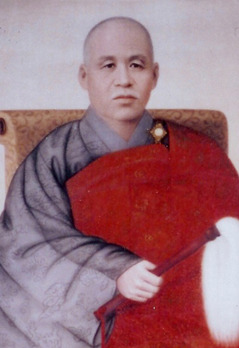
Yongseong Jinjong ( 1864 ~ 1940 )
I shall analyze this in two explanations. First, the things we commonly comprehend as the biggest things around us are the sky, the earth, the sea, the air, and the like. But what we call “big” in Buddhism are not those things. When we refer to the "bigness" of the original and natural mind in Buddhism, it is not big in the sense that the sky, the earth, sea or air can be compared with it; in fact, is it so big that nothing can become a thing that can be contrasted with it. Enlightenment is not something that can be stated, like "I am enlightened" or "I am becoming enlightened." Therefore, it is impossible to teach the fundamental mind of enlightenment with words or writings, or to show it with any concrete shape.
Even though the air is full of electric currents and the sea is full of salt, it's impossible to listen to the electric current in the air with our ears, or see the salinity of the sea with our eyes. Likewise, though there is definitely an essential nature of Supreme Enlightenment (daegak), since it doesn't have any specific name or form, you cannot see it with your eyes, hear it with your ears, or think about it with your mind.
Though it is said this essential nature of Supreme Enlightenment originally doesn't exist because it has no name or form, it doesn't mean that is really nonexistent. Because there's nothing, neither is it mind, nor Buddha, Dharma, or Sangha, nor is it a ghost, nor is it any thing, nor the sky or the earth. At the same time it is both immensely big, immensely small, immensely empty, immensely spiritual, immensely firm and strong, but immensely soft at the same time, so it's not analyzable through thinking.
Though this nature has no name or form, it links the past and the present, surrounds the universe, exists as a subject of the sky, the earth, and humans. As a king of all the laws, it is so big and broad that there's nothing comparable; so lofty that there is no equal. Also, it has been even before the heaven and earth, so there is no beginning, and it will exist even after the end of days, so there is no ending. This big and round essential nature of enlightenment shows that heaven and earth and the self have the same root and the universe and the self are the same body.
This nature is equal in every body. Just because some are sages, it doesn't mean they have more of this nature than ordinary men. Also, since there is no becoming, dying, any particular shape, or name for this nature, when it's in the sky it becomes a part of the sky, in the earth it becomes a part of the earth, and in humans it becomes a part of humans. This is the fundamental mind of attaining divine enlightenment.
Second, attaining divine enlightenment for oneself, then guiding other people to the way of enlightenment, are not two things but one, so it is called the final enlightenment. Every person is pure and undefiled just where s/he is, and it shows that the enlightenment itself is always there, inside of them. Even though enlightenment always exists inside of them, if s/he doesn't realize it, s/he is ordinary. Even though they realize it's there, if they don't strive, they also are ordinary. Why is that?
Even if something is gold, if it is not tempered several times, it cannot become pure gold. But after it becomes pure gold there is no change. Attaining the true mind through striving is like becoming pure gold. This is called actualizing enlightenment.
The original enlightenment (Buddhahood) and actualizing enlightenment are not two things, so it is the final enlightenment, and if somebody realizes everything mentioned above, now they can be said to have attained divine enlightenment.
The Way to Investigate the Hwadu
One student once asked,
"You told us to investigate and doubt the hwadu, but how should we investigate it?"
"You told us to investigate and doubt the hwadu, but how should we investigate it?"
Yongseong answered,
"A person suddenly lost a treasure he had carefully carried on his person and cherished for a long time. At first, he didn't know he had lost his valuable thing, but one day he felt with his hands where he usually carried the treasure and noticed it missing. Thus, he wondered in suspicion and doubt where the treasure was. Your investigation into the hwadu should be like this.
"A person suddenly lost a treasure he had carefully carried on his person and cherished for a long time. At first, he didn't know he had lost his valuable thing, but one day he felt with his hands where he usually carried the treasure and noticed it missing. Thus, he wondered in suspicion and doubt where the treasure was. Your investigation into the hwadu should be like this.
Another person picked up a strange object from the ground near dawn, before sunlight had fully illuminated the world. Although he examined it closely, it was yet too dark to see clearly, so he was not sure what to make of it; stuck in a boundary between knowing and not knowing what it is, he is full of suspicion and doubt. The manner of one who investigates the hwadu is like this.
When you investigate the hwadu, it is sometimes like trying to force a donkey to drink, sometimes defilements arise like hot fire, sometimes the mind doesn't move at all as if it were a solid block of ice, sometimes it goes as well as a sailing boat in a favorable wind. But, whether your studying goes well or not, do not bear thoughts of joy or dissappointment at it; you ought to think only of your hwadu.
Also, do not take up practice for the clear and calm that arises when you sit; nor should you take exercise, speech, movement, or being calm as your practice. Do not practice with your mind like the thin air, nor should you make your mind like a wall; for studying with these attitudes is a heretical path that lead to emptiness and ruin, and the people who study thusly are dead even though they still breathe.
Therefore instead focus your investigation and doubt on this one thing that you don't fully understand. If you study hard with a consistently focused mind, the state of sight and hearing naturally become calm; forgetting both the thing and the self, the mountains, rivers, and the great earth dissappear, and the empty space melts down. When you reach this state, you will naturally destroy ignorance [chiltong, literally, pitch-black container]."
Another student asked Yongseong, "How can I get rid of the delusions that keep appearing to me?"
Yongseong answered,
"Whether delusions arise or not, leave them alone and do not try to get rid of them. Delusions have a tendency to arise all the more when you try to get rid of them. For example, when a cow tries to run away, if you draw the rein firmly toward you, the cow follows you by its own will. Like this, if you investigate the hwadu without being bothered whether a delusion arises or not, the delusion will disappear by itself.
"Whether delusions arise or not, leave them alone and do not try to get rid of them. Delusions have a tendency to arise all the more when you try to get rid of them. For example, when a cow tries to run away, if you draw the rein firmly toward you, the cow follows you by its own will. Like this, if you investigate the hwadu without being bothered whether a delusion arises or not, the delusion will disappear by itself.
Also, do not try to get rid of delusions using the hwadu; if delusions overcome you even though you focus only on the hwadu, immediately let go of the hwadu and relax your mind to its natural state. Then, if you resume the investigation, your mind will be new and clean.
When you investigate the hwadu, question it clearly with an always relaxed and comfortable mind and body. If you start on the hwadu in a hurry, because the mind that arises from bodily desire is shaken; you will feel pressure on your chest and have a headache, and bleed from your nose. These symptoms occur because your mind was too hurried.
On the other hand, if you are off your guard, you are likely to lose your hwadu. Neither should you investigate the hwadu too excessively and tensely, nor should you be too lax. If the strings of a lute are too loose, its sound is not right, and also it the strings of a lute are too tight, its sound is also not right; thus studying is the same way.
Figuratively speaking, it is as if when someone wanders into the deep mountains, when all of a sudden the mountain and river comes to an end. Facing this situation, if you set one foot forward with the strength to courageously sever your ties, you will be able to see a new world where the flowers are bright and the blossoms are emerald.
While all the other studies of the world are investigated with an analytical, categorizing mind that tries to know all things, this study consists of the questioning and investigation with a focused mind of this one thing that you do not know. If you try to approach this study with a categorizing and analyzing mind, you will be unable to know anything even after 10,000 years of questioning. When you investigate the hwadu, you should not seek fun in it, but rather keep an unceasing attitude, like a mosquito sitting on a cow made of iron. For if the mosquito breaks through the iron cow with life and limb in abandon, even its body will dive straight in.
Only investigate and doubt the hwadu with a focused mind, never bearing a mind of knowing or a mind of seeking. Like when the warm spring comes back, flowers bloom and leaves spread out, so when your study ripens you will naturally seek and know."
From the Susimjeongno (The Right Path to Cultivating the Mind)