Preface
Grottos in th caitya style were later adopted by the chinese in the hundreds of caves stretching over a mile along the cliffs of Dunhuang and the sandstone hills of Yungang. Seokguram, with a rectangular antechamber leading to a circular domed main chamber, resembles ancient Indian cave temples.
Though inspired by the cave temples of ancient India and China, Seokguram differs in construction to its prototypes which were mostly built by digging into hillsides and carving on natural rocks. korea's topographical features comprising solid rock beds probably made it impossible to import the idea of the sculptors of Karle or Ajanta, who carved thousands of figures, stupas and apse ends out of the soft conglomerate rock and clay. Instead, an incredible artificial cave was assembled with granite on the heights of a mountain some 750meters above sea level, an architectural technique without precedent the world over.
Apex of Korean Buddhist Sculpture
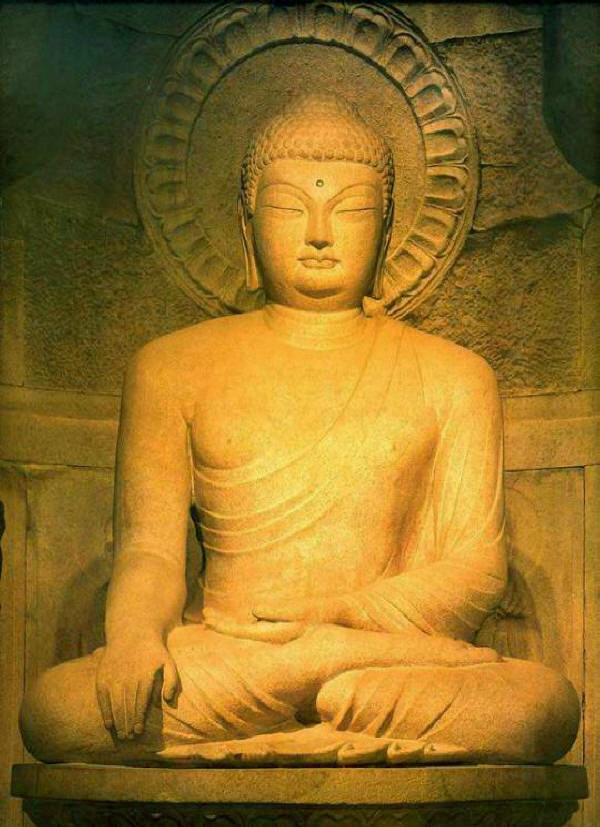
Highlighted by the majestic seated Buddha with a serene, all-knowing expression as the primary object of worship, Seokguram enshrines an impressive assembly of 40 different divinities embodying various aspects of Buddhist teaching. The grotto chapel, in spite of the diversity of the icons ensconced, has a unique feeling of peace and unity resulting in an intense spiritual impression. The prominent skill for handling solid granite aside, modern scientists investigating the source of this rare sensation of sacred harmony discovered that the Silla architects employed the geometric theories of the golden rectangle and symmetry. Seokguram is meticulously designed to guide the faithful into the holy and of the Buddha, a mysterious spiritual journey to the realm of nirvana in a limited span of time and space. In ancient times when there was no transportation, everybody was supposed to walk up the rugged, serpentine mountain path. The journey was to begin at the foot of Mt.Tohamsan which was considered a holy mountain by the people of Silla, or, symbolically, it begin from Bulguksa which straddles the mountain's western midslope. After climbing up the mountain for an hour or so, the pilgrim was to quench his thirst with the icy cold water gushing up from a fountain in front of the shrine Passing the arched entrance into the rectangular antechamber and proceeding through a slightly narrower corridor, their walls decorated with a legion of bas-relief images of various guardian deities, the worshiper would leave the secular world behind and abe prepared to face to Buddha in the main rotunda. An image of serenity and power, the Buddha is seated cross-legged on a lotus throne, with his eyes half-closed in meditation and a faint smile on his lips. The Buddha is surrounded by bodhisattvas, arhats and ancient Indian gods carved in high relief on the wall of the circular hall. Here the ancient Silla architects probably borrowed the concept of the early Indian stupas and the mounded graves of Gyeongju but in a reversed form to create a "hollowed stupa." Inside the shrine, with the dim light making subtle changes to the texture of the granite carvings as he moves, the worshiper could walk around the Buddha and possibly face himself and experience nirvana to realize that life and death can be one in the void of nothingness. The construction method of Seokguram remains a wonder for modern architects. Hundreds of granite pieces of various shapes and sizes were assembled to form the cave. No mortar was used; the stones are held together by stone rivets. Natural ventilation was provided to control the temperature and humidity inside the cave, though the wisdom of ancient architects failed to be conveyed in the process of its preservation in modern times. The main rotunda, believed to stand for heave in contrast to the earth which is represented by the rectangular antechamber, measures 6.84 to 6.58 meters in diameter. It has a drum built of 10 granite slabs, upon which 15 granite panels with sculpted images of bodhisattvas, arhats and ancient Indian gods form the circular wall. Above these icons and separated by lintel, there are 10 niches, each containing miniature statues of seated bodhisattvas and faithfuls. Slightly tilted toward the back from the center of the rotunda is a round lotus pedestal, on which th Buddha sits facing the antechamber across the corridor. The domed ceiling is capped with a round granite plate decorated with a lotus design.
The Buddha and Other Deities
Highlighted by the majestic seated Buddha with a serene, all-knowing expression as the primary object of worship, Seokguram enshrines an impressive assembly of 40 different divinities embodying various aspects of Buddhist teaching. The grotto chapel, in spite of the diversity of the icons ensconced, has a unique feeling of peace and unity resulting in an intense spiritual impression. The prominent skill for handling solid granite aside, modern scientists investigating the source of this rare sensation of sacred harmony discovered that the Silla architects employed the geometric theories of the golden rectangle and symmetry. Seokguram is meticulously designed to guide the faithful into the holy and of the Buddha, a mysterious spiritual journey to the realm of nirvana in a limited span of time and space. In ancient times when there was no transportation, everybody was supposed to walk up the rugged, serpentine mountain path. The journey was to begin at the foot of Mt.Tohamsan which was considered a holy mountain by the people of Silla, or, symbolically, it begin from Bulguksa which straddles the mountain's western midslope. After climbing up the mountain for an hour or so, the pilgrim was to quench his thirst with the icy cold water gushing up from a fountain in front of the shrine Passing the arched entrance into the rectangular antechamber and proceeding through a slightly narrower corridor, their walls decorated with a legion of bas-relief images of various guardian deities, the worshiper would leave the secular world behind and abe prepared to face to Buddha in the main rotunda. An image of serenity and power, the Buddha is seated cross-legged on a lotus throne, with his eyes half-closed in meditation and a faint smile on his lips. The Buddha is surrounded by bodhisattvas, arhats and ancient Indian gods carved in high relief on the wall of the circular hall. Here the ancient Silla architects probably borrowed the concept of the early Indian stupas and the mounded graves of Gyeongju but in a reversed form to create a "hollowed stupa." Inside the shrine, with the dim light making subtle changes to the texture of the granite carvings as he moves, the worshiper could walk around the Buddha and possibly face himself and experience nirvana to realize that life and death can be one in the void of nothingness. The construction method of Seokguram remains a wonder for modern architects. Hundreds of granite pieces of various shapes and sizes were assembled to form the cave. No mortar was used; the stones are held together by stone rivets. Natural ventilation was provided to control the temperature and humidity inside the cave, though the wisdom of ancient architects failed to be conveyed in the process of its preservation in modern times. The main rotunda, believed to stand for heave in contrast to the earth which is represented by the rectangular antechamber, measures 6.84 to 6.58 meters in diameter. It has a drum built of 10 granite slabs, upon which 15 granite panels with sculpted images of bodhisattvas, arhats and ancient Indian gods form the circular wall. Above these icons and separated by lintel, there are 10 niches, each containing miniature statues of seated bodhisattvas and faithfuls. Slightly tilted toward the back from the center of the rotunda is a round lotus pedestal, on which th Buddha sits facing the antechamber across the corridor. The domed ceiling is capped with a round granite plate decorated with a lotus design.
Legend of a Filial son
In the small village of Moryang-ri on the western outskirts of Gyeongju, there lived a poor woman named Gyeongjo who had an odd-looking son. The villagers made fun of the child as he had a big head and a flat forehead, that looked like a wall. They called him Dae-seong, meaning "big wall."
The boy's mother was too poor to feed him so she gave him to a rich neighbor named Bogan as a farm hand. Dae-seong worked so hard that his master was moved and gave him a small piece of a rice paddy. About this time , a virtuous monk named Jeomgae from Heungnyongsa temple, visited Bogan and asked for a donation for a big ceremony at his temple. As Bogan handed him fifty rolls of hemp cloth, the monk bowed in appreciation and said that the Buddha would repay his generosity by blessing him ten thousand times the worth of his donation.
Dae-seong overheard this and ran home and told his mother, "Now we are poor, and if we do not give something to the temple, we will be poorer in our next lives. Why don't we give our little rice field for the ceremony so that we may have a great reward in our afterlives?" His mother readily consented and donated their rice field to the temple.
Dae-seong died a few months later. On the night of his death, a voice from heaven was heard above the house of Prime Minister Kim Mun-ryang. The voice said that Dae-seong, a good boy from Moryang-ri, would be born to Kim's family. Kim's wife conceived at the time the heavenly voice was heard and gave birth to a boy. The child kept his left hand tightly clenched for seven day after his birth. When he opened his fist at last, they found the two characters for Dae-seong written in gold on his palm. They gave him his old name and invited his mother of his previous life to take care of him.
Dae-seong grew up into a strong man who loved hunting. One day he climbed Mt.Tohamsan and there he killed a big bear. As he was sleeping in a village at the foot of the mountain that night, the bear's ghost appeared in his dream and threatened to kill and eat him unless he built a temple for him. Dae-seong built a temple on the spot where he killed the bear and named it Jangsusa, meaning the Temple of Long Life. From that time he gave up hunting.
Dae-seong was moved by the heavenly grace. He built the beautiful Bulguksa in memory of his parents of the present life and the wonderful cave temple of Seokguram for his parents of the previous life. He invited the two distinguished monks Sillim and Byohun to supervise these temples. He had his fathers and mothers represented among the icons at these temples in gratitude for bringing him up as a useful man.
After the great stone Buddha for Seokguram was finished, Dae-seong was working on a large piece of stone for the ceiling of the main hall when it suddenly broke into three pieces. He wept bitterly over this and fell into sleep. During the night, gods descended from heaven and restored the stone to its original condition. Dae-seong awoke with joy and climbed the southern peak of Mt.Tohamsan, where he burned incense and worshiped the deities. People called the place Hyangnyong, or Incense peak, thereafter.
The erudite monk historian lryeon(1206-1289) had the wondrous skill of interweaving legend and fact in his book which serves as an invaluable source of information for students of early Korean history. While most readers of his book today would find it difficult to believe in the reincarnation of Kim Dae-seong, visitors to Seokguram can see crack dividing the round capstone on the main rotunda's domed ceiling clearly into three pieces. South of the temple, there also exists a peak called Hyangnyong.
Another important history book, Samguk Sagi(History of the Three Kingdoms), compiled by Kim Bu-sik in 1145, identifies the founder of Bulguksa and Seokguram as Kim Dae-seong who served as prime minister in 745-750 under King Gyeongdeok. He was the son of Kim Mun-ryang who was also prime minister in 706-711 under King Seongdeok, according to the oldest extant book on Korean historyl.
The Unsolved Questions of Preservation
Seokguram has had its share of turmoil in Korea's history over the centuries. It lost much of its religious and artistic splendor during the Joseon period (1392-1910) when its Confucianoriented rulers suppressed Buddhism. The remote mountain grotto was left seriously damaged toward the turn of the century. It underwent repair three times earlier this century under the japanese colonial government.
The first round of repairs was carried out from 1913 to 1915. Without sufficient study of its structure, the cave was almost completely dismantled and reassembled and a fatal mistake was committed in the process. The entire structure was encase with cement about two meters thick, which resulted in water leaks and erosion of the sculptures because the cave could no longer "breathe."
Seokguram went through considerable "torture" in the name of preservation in the following decades. In 1917, drainage pipes were buried above the dome to channel rainwater out of the cave. As the leaks continued in spite of the pipes, however, another round of repair was conducted in 1920 to 1923. Waterproof asphalt was applied to the surface of the concrete mass this time. But water continued to leak and dew formed, and in 1927 the Japanese government-general eventually employed the unthinkable method of spraying hot stem on the granite surface to get rid of moss.
As the preservation of Seokguram continued to pose serious problems with high humidity inside the shrine, the government of the late President Park Jeong-hui instructed an in-depth investigation of its structure to be carried out in the early 1960s. Extensive renovation was undertaken based on the study from 1962 to 1964. The problem of temperature and humidity control was resolved to a remarkable extent by using mechanical systems.
Nevertheless, the wooden superstructure built over the antechamber remains a mind-boggling question for many who believe Seokguram originally did not have such a structure blocking the magnificent sunrise over the East Sea from the view of Seokgamoni, aside from cutting off the air flow into the cave. A glass wall keeping the visitors from the main chamber is another point of debate regarding the contradiction concepts of the preservation of the shrine and its availability for religious worship and aesthetic appreciation.
Two statues in the niches of the wall of the main chamber and a miniature marble pagoda which is believed to have stood in front of the Eleven-faced Avalokitesvara at the back of the Buddha image remain missing. They disappeared in the early years of Japanese occupation.
geographically removed from China by Goguryeo to the north and Baekje to the west, Silla was the last of the three ancient Korean Kingdoms to accept Buddhism. But as soon as King Beopheung recognized it as the state religion in 528, it spread quickly through out the country, The 13th century historian monk, lryeon, wrote that, by the mid-sixth century in Gyeongju and its vicinity, "the golden roofs of temples glittered against the sky like the Milky Way and lotus-crowned pagodas stood in unending lines like flights of wild geese."
All these temples vanished in the turbulent course of history, but the description vividly conveys how enthusiastically the early Buddhists erected temples and pagodas around the capital of their thriving kingdom. Today, Bulguksa offers a glimpse of the splendor of Silla's state temples, although all of its present wooden shrines are in the much later Joseon style and much of its antique flavor was lost in massive rehabilitation work carried out in the 1970s.
Amithabha Buddha
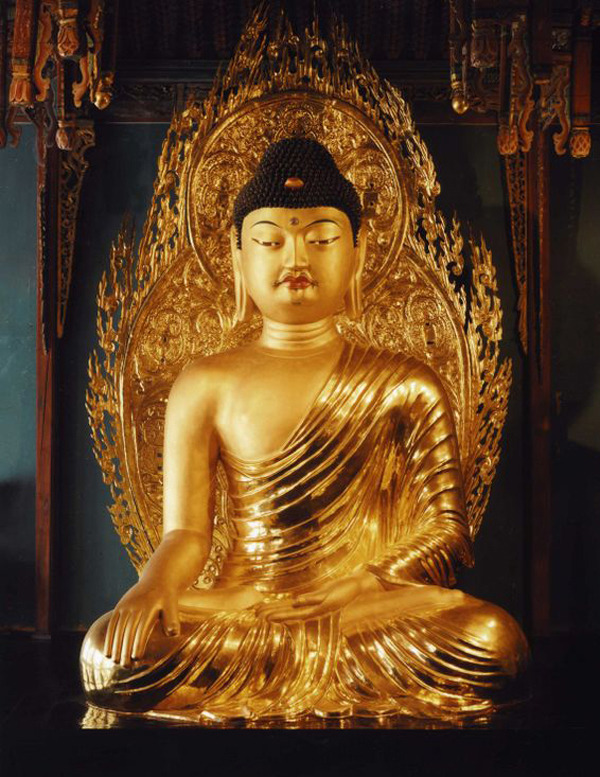
National Treasure no. 45. Seated Amitabha, clay, 2.78 m. Buseok Temple.
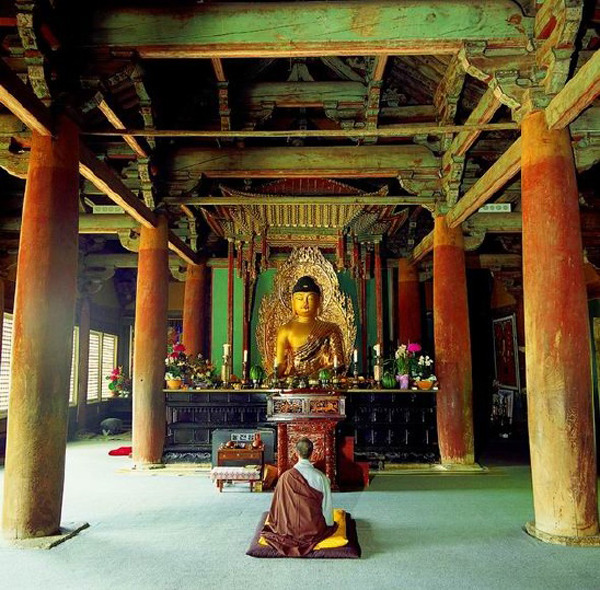
Amithabha Buddha (아미타불; Amita-bul in Korean) is the Buddha of infinite light and governs the pure land, the Western Paradise. Because the faces of Amithabha and Sakyamuni are so similar and their symbolic hand gestures are the same, it is difficult to distinguish between them. One way to identify Amithabha Buddha is that he is associated with Avalokitesvara and Mahastamprapta (Taesaeji Bosal, in Korean), two important bodhisattvas.