Preface
Invitation to Ganhwaseon
A Way to a Joyful Life Free from Troubles
“Who am I? Where am I going?”
Sometimes, these questions arise in our mind spontaneously and sometimes other people ask them – suddenly in a moment of deep reflection.
Well, let’s try and ask very seriously for once; and then answer very clearly just for once. Try, now, for a moment, to find out who you really are, what you are made of and or where you are going. Most probably you will fail to answer; most probably you will fail 100%! Such fundamental questions are not solved by rational thinking because logic has limitations. Moreover, these questions are ones that your knowledge and experience cannot give you any insight into. They need some other dimension, some other methodology.
Let’s ask again from another view point.
“How and what can I do so as to live really well? What can I do to be truly free and peaceful? How can I live in eternal happiness and with unshakable confidence? Can I be content with myself, with my ability to share with others? Can I live without hurting others or without being hurt by someone else? Where on this earth can I find a way to learn to live in a natural and gentle way?”
Ganhwaseon, the Korean system of meditation, gives a short, clear answer to these questions. It suggests a way to live in confidence, with vigor and in freedom. It is a way to live – like a Buddha.
Look at the world! Open your eyes! Most people hanging on to worldly life look so weary and tired in all that hustle and bustle. Look! There are students giving their lives for studying; lovers giving their lives for love; people giving their lives for money; employees of companies giving their lives for the company; members of families giving their lives for the family.
So let us speculate about what could happen in the future. It is possible to imagine that everything you are familiar with becomes other, it becomes strange and this strangeness is difficult to understand. When your expectations are not realized then you are hurt by the person or the situation; you suffer. The cold reality of uncertainty may be the cause of your disappointment. The cause of this suffering is due to your lack of awareness about who you are and why you are alive. Because you have lived continually without – beside – yourself and have relied on external objects, the result is that your mind, your heart is hurt.
You should center yourself and live depending on yourself without becoming attached to external objects, without being pulled in different directions by different people. You should find value in yourself and create a worthy and a worthwhile existence. You should make of yourself a firm and confident person, one that is not easily changeable. Of course this requires that serious search for yourself and the need to know yourself. Only then you can center yourself. Once in the center, you do not follow external objects but you find that they follow you instead. As Master Chao-chou said, “Live 24 hours by yourself!” It is actually sad and regretful that the reality is that you live with yourself all the time but do not see or know yourself!
“I should decide now to find out who I am; I should decide to see myself.”
You already know, “The way to find myself is impossible just by using rational thinking and words. If I insist on trying this method, I will fail as I have in the past.”
A western philosopher, Rene Descartes, said the famous words, “I think, therefore I am.” He seemed to have found a clear answer and felt his existence firmly understandable. Thinking is the result of becoming conscious of thinking. Descartes opined that only the action of thinking is clear evidence of our existence.
But thinking is a rational action and rational consciousness always appears in the form of the “self.” This “self” likes to distinguish between things, to discriminate and to cling to what it perceives as mine. It likes to separate one thing from another, to differentiate and to judge right from wrong. It always sees things in this way, by judging and comparing with other things. Due to this, reality is obscured and only narrow, limited physical forms are seen and then these are called “the truth.” You may even find yourself claiming that this is the true “I” and so find yourself further away from the true nature of things.
This is why we say that our True Nature, who we really are, cannot be found by rational thinking or the use of words. There is simply no way to find an answer to the question in this way.
After this realization, you come to the point where you cut out words and thinking from the range of possible answers to the questions. And, if you are lucky and persevere, you will see your True Nature and so know who you are. Then you will find yourself totally alive. And being clearly alive yourself everything follows on. Suddenly your emotions become more genuine and comprehensible, and you can see the real you.
For, the self doesn’t think. The thing that makes you move thinks and that should be your center, you should feel that movement. Then, by being together with that; you can really love, really study, really work, and really sing. From that moment on, obstacles don’t arise any more and you feel free from hindrances.
Ganhwaseon is a meditation practice which involves investigating a hwadu. The hwadu is the main line, the punch line in an ancient story of attainment. It is an enigmatic question which puts to an end our rational thinking. It is therefore a word before the words that result from thought. It is a thought before thought. It is beyond words and beyond thinking. Hwadu cuts through the way of thinking and it cuts through any resulting words. In this way it prevents rational thinking and lets you return to the realm of the Buddha. Therefore, as hwadu is solved, the truth is discovered.
Investigating hwadu involves the entire body and the entire mind: they must both be constantly full of hwadu. When you and your hwadu become one, all differentiated thoughts and illusions disappear. Thus, if you find the answer to your hwadu, you come to enlightenment immediately. You can then clearly identify who is the Buddha and then you and I become one, and we both together unite with empty space.
In daily life you will find that, as you have your hwadu in your mind, you do not waver even in front of difficult situations. You do not shake with emotion and are not ruled by pure rational thinking. You do not distinguish one thing from another or compare one thing to another. You do not get hurt nor do you get angry.
Thus, your daily life becomes peaceful and happy. And ultimately if you solve your hwadu, you can see yourself clearly as never before. The aim of your life becomes clear and you no longer worry about where to go or what to do because you are centered in the present moment. Thus, wherever you go it is with confidence that you confront life and you can now truly stand alone in the universe.
Now you have finally become yourself and you can see your True Nature. So liberated from previous pressures and obstacles, your spirit remains free and, though your body may suffer, you yourself do not.
So please take a hwadu, and investigate it with all your power. As you progress free from any rational thinking, the moment you solve your hwadu, you will be a Buddha here and now. Every one of your actions is the action of a Buddha -- no trace remains in a Buddha’s actions. Just as birds leave no trace in the sky; they are simply beautiful.
Korea has carefully preserved the tradition of Ganhwaseon practice. The material that you have just read comes from the teachings of Seon masters as they have always taught in the Seon halls.
If you are able to come and join us in practice, then you will experience a new world which is like the truth of the blue sky.
Again question...
“Who am I?”
Answer immediately, without hesitation, without your rational thinking.
Just answer…
PART 1: The Stage of basic
Chapter 1: Patriarchal seon and its historical development
The Meaning and Currents of Patriarchal Seon
The Meaning of Patriarchal Seon
Patriarchal Seon is the Dharma Gate (teaching) that immediately shows one the world of enlightenment that was originally attained fully by all of the patriarchs. If one stands at this gate, the path of language and thought is cut off, and one is clearly enlightened that one is originally Buddha (awakened) and enjoys a free life where one is not trapped anywhere.
There is a phrase, “physically naked golden wind.” This phrase tells of the original form of trees nakedly displayed when all the leaves have fallen in the autumnal wind. When one is enlightened the true form of the Dharma-realm that has eliminated the egoistic way of existence that is language and thought is thus itself revealed. Patriarchal Seon is just like this.
The Buddha, by means of transmitting from mind to mind the world of enlightenment that he himself had experienced, transmitted it to the Venerable Mahākāśyapa. The opportune condition (occasion) for this was as follows:
One day the Buddha held up a lotus flower and showed it to a great assembly of many people. Only Mahākāśyapa of that assembly broke into a smile. When the Buddha held up that lotus to show his mind, Mahākāśyapa was immediately enlightened to that mind and responded with a smile.
That is exactly the meaning of “when a flower was lifted up he smiled with laughter” or yeomhwa miso.
Seon was born on the occasion of the profound meaning of “held up a flower and smiled.” This Dharma that was transmitted from the Buddha to Mahākāśyapa was later also passed on from master to disciple without a break.
Patriarch Bodhidharma was the twenty-eighth in the Indian lineage who received this Dharma. Bodhidharma traveled to China and transmitted the Buddha’s genuine Seon Dharma, and he became the first patriarch of the East.
The Currents of Patriarchal Seon
The Chinese Seon (Chan) School began with Bodhidharma, the twenty-eighth patriarch of India and the first patriarch of China. In this way the Seon Dharma that the Buddha transmitted was continuously inherited through the Seon Masters; the First Patriarch Bodhidharma (n.d.), the Second Patriarch Huike (487-593), the Third Patriarch Sengcan (?-606), the Fourth Patriarch Daoxin (580-651), the Fifth Patriarch Hongren (594-674), and the Sixth Patriarch Huineng (638-713). Thus the great current of the Seon School was formed.
Patriarch Bodhidharma saw his mind-nature by sitting for nine years facing a wall at Shaolin Monastery, and through the generations the patriarchs passed it on from mind to mind. This was why it was called Patriarchal Seon.
It was the Sixth Patriarch, Huineng who substantially grounded Patriarchal Seon in China. Seon Master Huineng elucidated the dono gyeonseong that is the perfect awakening immediately to that nature by direct pointing at the self-nature that all people originally possess. That the Seon School could flow uninterrupted in China was because Seon Master Huineng fully unfolded this Seon Dharma of sudden enlightenment.
The person who firmly established the Seon Dharma of Huineng was his pupil, Seon Master Heze Shenhui (670-762). Shenhui greatly highlighted Huineng’s sudden-enlightenment method of seeing the nature that directly enters the mind. After Shenhui, those who made Patriarchal Seon flourish were the excellent teachers, Seon masters Mazu Daoyi (709-788) and Shitou Xiqian (700-790). They promoted the Patriarchal Seon style centered on Jiangxi and Hunan to the south of the Yangzi River. Seon masters Mazu and Shitou spread Patriarchal Seon widely and gathered many distinguished pupils, which rooted the Seon School firmly into the soil of history.
For example, among Seon Master Mazu’s pupils was Seon Master Baizhang Huaihai (749-814). Baizhang instituted the pure rules for the Seon cloister and made the very first Seon collective practice monastery (chongnim). Moreover, he personally practiced the lifestyle principle of, “if one does not work for a day, one does not eat for a day,” and instituted a key of the Seon cloister community that concentrated on practice while living self-sufficiently. This made the Seon School stand tall on the rock of history.
Many of the good pupils of Seon masters Mazu and Shitou produced many Seon masters themselves and they spread the Seon Dharma widely, not only in China, but also in north-east Asia.
By the middle of the twelfth century, Seon Master Hongzhi Zhengjue (1091-1152) fostered silent-illumination Seon and Seon Master Dahui Zonggao (1089-1163), while criticizing this silent-illumination, systematized Ganhwa Seon (Ch. Kanhua Chan) and spread it widely. So Patriarchal Seon was divided between the methods of practice of silent illumination and Ganhwa Seon.
The Ganhwa Seon systematized by Dahui Zonggao is a method of practice that best maintains the core of Patriarchal Seon. In other words, not only is Ganhwa Seon heir to the experience of seeing the nature that was emphasized by Patriarchal Seon, but also the patriarchal monks standardized the form of the words called hwadu that cut off the path of words and which directly showed the mind’s original face. Through this hwadu, from this point on, it was a method of practice that awakens the mind.
The Meaning and Currents of Patriarchal Seon
The Meaning of Patriarchal Seon
Patriarchal Seon is the Dharma Gate (teaching) that immediately shows one the world of enlightenment that was originally attained fully by all of the patriarchs. If one stands at this gate, the path of language and thought is cut off, and one is clearly enlightened that one is originally Buddha (awakened) and enjoys a free life where one is not trapped anywhere.
There is a phrase, “physically naked golden wind.” This phrase tells of the original form of trees nakedly displayed when all the leaves have fallen in the autumnal wind. When one is enlightened the true form of the Dharma-realm that has eliminated the egoistic way of existence that is language and thought is thus itself revealed. Patriarchal Seon is just like this.
The Buddha, by means of transmitting from mind to mind the world of enlightenment that he himself had experienced, transmitted it to the Venerable Mahākāśyapa. The opportune condition (occasion) for this was as follows:
One day the Buddha held up a lotus flower and showed it to a great assembly of many people. Only Mahākāśyapa of that assembly broke into a smile. When the Buddha held up that lotus to show his mind, Mahākāśyapa was immediately enlightened to that mind and responded with a smile.
That is exactly the meaning of “when a flower was lifted up he smiled with laughter” or yeomhwa miso.
Seon was born on the occasion of the profound meaning of “held up a flower and smiled.” This Dharma that was transmitted from the Buddha to Mahākāśyapa was later also passed on from master to disciple without a break.
Patriarch Bodhidharma was the twenty-eighth in the Indian lineage who received this Dharma. Bodhidharma traveled to China and transmitted the Buddha’s genuine Seon Dharma, and he became the first patriarch of the East.
The Currents of Patriarchal Seon
The Chinese Seon (Chan) School began with Bodhidharma, the twenty-eighth patriarch of India and the first patriarch of China. In this way the Seon Dharma that the Buddha transmitted was continuously inherited through the Seon Masters; the First Patriarch Bodhidharma (n.d.), the Second Patriarch Huike (487-593), the Third Patriarch Sengcan (?-606), the Fourth Patriarch Daoxin (580-651), the Fifth Patriarch Hongren (594-674), and the Sixth Patriarch Huineng (638-713). Thus the great current of the Seon School was formed.
Patriarch Bodhidharma saw his mind-nature by sitting for nine years facing a wall at Shaolin Monastery, and through the generations the patriarchs passed it on from mind to mind. This was why it was called Patriarchal Seon.
It was the Sixth Patriarch, Huineng who substantially grounded Patriarchal Seon in China. Seon Master Huineng elucidated the dono gyeonseong that is the perfect awakening immediately to that nature by direct pointing at the self-nature that all people originally possess. That the Seon School could flow uninterrupted in China was because Seon Master Huineng fully unfolded this Seon Dharma of sudden enlightenment.
The person who firmly established the Seon Dharma of Huineng was his pupil, Seon Master Heze Shenhui (670-762). Shenhui greatly highlighted Huineng’s sudden-enlightenment method of seeing the nature that directly enters the mind. After Shenhui, those who made Patriarchal Seon flourish were the excellent teachers, Seon masters Mazu Daoyi (709-788) and Shitou Xiqian (700-790). They promoted the Patriarchal Seon style centered on Jiangxi and Hunan to the south of the Yangzi River. Seon masters Mazu and Shitou spread Patriarchal Seon widely and gathered many distinguished pupils, which rooted the Seon School firmly into the soil of history.
For example, among Seon Master Mazu’s pupils was Seon Master Baizhang Huaihai (749-814). Baizhang instituted the pure rules for the Seon cloister and made the very first Seon collective practice monastery (chongnim). Moreover, he personally practiced the lifestyle principle of, “if one does not work for a day, one does not eat for a day,” and instituted a key of the Seon cloister community that concentrated on practice while living self-sufficiently. This made the Seon School stand tall on the rock of history.
Many of the good pupils of Seon masters Mazu and Shitou produced many Seon masters themselves and they spread the Seon Dharma widely, not only in China, but also in north-east Asia.
By the middle of the twelfth century, Seon Master Hongzhi Zhengjue (1091-1152) fostered silent-illumination Seon and Seon Master Dahui Zonggao (1089-1163), while criticizing this silent-illumination, systematized Ganhwa Seon (Ch. Kanhua Chan) and spread it widely. So Patriarchal Seon was divided between the methods of practice of silent illumination and Ganhwa Seon.
The Ganhwa Seon systematized by Dahui Zonggao is a method of practice that best maintains the core of Patriarchal Seon. In other words, not only is Ganhwa Seon heir to the experience of seeing the nature that was emphasized by Patriarchal Seon, but also the patriarchal monks standardized the form of the words called hwadu that cut off the path of words and which directly showed the mind’s original face. Through this hwadu, from this point on, it was a method of practice that awakens the mind.
The History and Tradition of Korean Seon
Korean Buddhism breathes a vivid life with the practice of Patriarchal Seon House style of Ganhwa Seon. This is something really rare that cannot be found in other Buddhist domains.
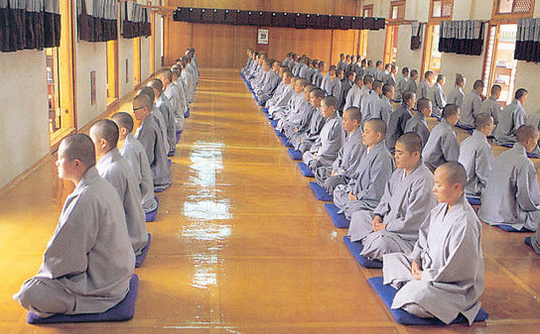
Each year in Jogye Order, over 2,000 meditation monks and over 100 Seon cloisters enter the summer or winter retreats for three months at a time. Retreat means that the monk refrains completely from leaving or entering the gate of the Seon cloister and vigorously practices (jeongjin or vīrya, strenuous effort, zealous practice) meditation. For the period of the retreat the practitioners of the cloister rise from their sleeping places at the get-up time of the monastery, which is 3.00 am, or even earlier, at 2.00 am. After getting up, at the sound of a bamboo clapper the assembly of the Seon cloister gathers and wordlessly worships the Buddha with three bows. In the Seon cloister, with the exception of the times when they gather to eat, the gongyang time, and when they work together physically, according to the pure regulations of each Seon cloister, they devote themselves solely to the zealous pursuit of sitting in meditation from the getting-up time until 9.00 or 10.00, and sometimes 11.00 pm in the evening. The times of a Seon cloister’s zealous practice differs because the custom for that practice differs according to the cloister. The customs for zealous practice of meditation in Seon cloisters are usually divided into three types:
The first is the normal zealous practice. The daily zealous practice is to sit in meditation for eight or ten hours per day.
The second is the additional zealous practice, which is to spur on even more than the everyday zealous practice, with the aim of exerting oneself even more and practicing meditation for twelve or even fourteen hours per day.
The third is ferocious zealous practice. One practices zealously without sleeping day or night for twenty-four hours, and one practices meditation for eighteen hours or more. In the majority of Seon cloisters, for seven days all the assembly practices this, and in some Seon cloisters this even lasts for one month.
Besides vigorous zealous practice, there is also jangjwa bulwa (long sitting and no lying down), which is sitting in meditation without lying down for a set period of three months or even longer, and there is also the practice of the gateless barrier (mumun-gwan) in which one zealosly practices meditation alone without going outside of a locked door and staying alone in a single room. This practice of mumungwan can last six months, a year, three years or at most six years. In addition there is the formation of fraternities (gyeolsa) for fifteen months or three years etcetera, in which all of the assembly is banned from going beyond the monastery gate, and one practices zealously for a set period of time in the Seon cloister.
When the retreat ends, the Seon monks leave for manhaeng (various supplementary practices). These Seon monks are called unsu (cloud and water) monks in the sense that they are practitioner monks who drift like clouds and river water. The reason for departing for manhaeng is this is where they will see spread out in the field of concrete life the state that is caused by the zealous practice of meditation during the period of the retreat. And they also receive an examination of the condition of their practice or their own enlightenment from the keen-eyed masters they seek out. Manhaeng also is a practice of seeking the Way, in that they consistently hold the hwadu during the various aspects of life. Again, some meditation monks also pursue zealous practice in the monastic retreat, which is not a set period retreat, but continues even in the period of freedom, along with their practice in the Seon cloister.
In each of the secluded and pristine mountains of Korea there are Seon cloisters and small hermitages. In such places are gathered unsu meditation monks who are trying to illuminate the eternal darkness, entering into the samādhi of single-mindedly seated in meditation and not budging in the slightest from their hwadu. Also, many lay Buddhists hold their hwadu and zealously practice Seon meditation in citizen’s Seon rooms in the city centers, trying to illuminate their own mind-nature.
The House Style of Korean Patriarchal Seon
Korean Buddhism breathes a vivid life with the practice of Patriarchal Seon House style of Ganhwa Seon. This is something really rare that cannot be found in other Buddhist domains.
Each year in Jogye Order, over 2,000 meditation monks and over 100 Seon cloisters enter the summer or winter retreats for three months at a time. Retreat means that the monk refrains completely from leaving or entering the gate of the Seon cloister and vigorously practices (jeongjin or vīrya, strenuous effort, zealous practice) meditation. For the period of the retreat the practitioners of the cloister rise from their sleeping places at the get-up time of the monastery, which is 3.00 am, or even earlier, at 2.00 am. After getting up, at the sound of a bamboo clapper the assembly of the Seon cloister gathers and wordlessly worships the Buddha with three bows. In the Seon cloister, with the exception of the times when they gather to eat, the gongyang time, and when they work together physically, according to the pure regulations of each Seon cloister, they devote themselves solely to the zealous pursuit of sitting in meditation from the getting-up time until 9.00 or 10.00, and sometimes 11.00 pm in the evening. The times of a Seon cloister’s zealous practice differs because the custom for that practice differs according to the cloister. The customs for zealous practice of meditation in Seon cloisters are usually divided into three types:
The first is the normal zealous practice. The daily zealous practice is to sit in meditation for eight or ten hours per day.
The second is the additional zealous practice, which is to spur on even more than the everyday zealous practice, with the aim of exerting oneself even more and practicing meditation for twelve or even fourteen hours per day.
The third is ferocious zealous practice. One practices zealously without sleeping day or night for twenty-four hours, and one practices meditation for eighteen hours or more. In the majority of Seon cloisters, for seven days all the assembly practices this, and in some Seon cloisters this even lasts for one month.
Besides vigorous zealous practice, there is also jangjwa bulwa (long sitting and no lying down), which is sitting in meditation without lying down for a set period of three months or even longer, and there is also the practice of the gateless barrier (mumun-gwan) in which one zealosly practices meditation alone without going outside of a locked door and staying alone in a single room. This practice of mumungwan can last six months, a year, three years or at most six years. In addition there is the formation of fraternities (gyeolsa) for fifteen months or three years etcetera, in which all of the assembly is banned from going beyond the monastery gate, and one practices zealously for a set period of time in the Seon cloister.
When the retreat ends, the Seon monks leave for manhaeng (various supplementary practices). These Seon monks are called unsu (cloud and water) monks in the sense that they are practitioner monks who drift like clouds and river water. The reason for departing for manhaeng is this is where they will see spread out in the field of concrete life the state that is caused by the zealous practice of meditation during the period of the retreat. And they also receive an examination of the condition of their practice or their own enlightenment from the keen-eyed masters they seek out. Manhaeng also is a practice of seeking the Way, in that they consistently hold the hwadu during the various aspects of life. Again, some meditation monks also pursue zealous practice in the monastic retreat, which is not a set period retreat, but continues even in the period of freedom, along with their practice in the Seon cloister.
In each of the secluded and pristine mountains of Korea there are Seon cloisters and small hermitages. In such places are gathered unsu meditation monks who are trying to illuminate the eternal darkness, entering into the samādhi of single-mindedly seated in meditation and not budging in the slightest from their hwadu. Also, many lay Buddhists hold their hwadu and zealously practice Seon meditation in citizen’s Seon rooms in the city centers, trying to illuminate their own mind-nature.
Chapter 2: An outline of Ganhwa seon
What is Ganhwa Seon?
The Nature of Ganhwa Seon
Seon Master Dahui maintained that in illuminating the mind one “be enlightened immediately at the conclusion of a word.” Seon Master Yongjia Xuanjue (665-713) also, in his “Song of Enlightenment,” the Zhengdao ge, said, “Be clearly enlightened at the end of a word, and leap over at a jump the billions of Dharma-gates.”
Ganhwa Seon then is a method of practice that directly reaches enlightenment by leaping over the billions of Dharma-gates at the end of a brief action that is displayed in a moment, at a single word spoken by the Buddha or the generations of patriarchs. This is similar to the principle of when a light is turned on in a pitch-black room. In a moment everything is illuminated at a switch. Ganhwa Seon likewise leaps over immediately and directly enters the domain of the Tathāgata.
Again, Ganhwa Seon is "a Seon method to directly see one’s original nature by looking at (gan) the critical phase (hwadu)." If one sees one’s original nature that is enlightenment. This original nature is one’s self-nature that possesses everything. If one sees the nature and is enlightened, that is seeing the nature and becoming Buddha (gyeonseong seongbul).
Ganhwa Seon is the most developed of all the meditation methods that enlighten one to one’s own nature that came through India and China all the way from the Sakya Muni Buddha. The excellence of Ganhwa Seon is due to the fact that it conquers the various hwadu of the Seon masters that directly show that place of the mind, and where one sees the nature and becomes Buddha. This is because one sees the nature and becomes Buddha then and there. Hwadu is a word that cuts off the paths of language and thought. In having cut off the paths of language and thought, as soon as a person of superior ability has received the hwadu, they will at once be enlightened in that very place.
However, the majority of people cannot do this and have to take up the hwadu and begin to doubt. If so, they should take up an example of a hwadu and somehow investigate the hwadu and try to examine its meaning.
The following is the mu-character hwadu of the monk Zhaozhou (779-897):
A monk asked Seon Master Zhaozhou, “Does a dog have Buddha-nature?”
The Seon Master replied, “It does not” (mu, no).
Here the practitioner is saying that “the Buddha said that all sentient beings have the Buddha-nature,” to which Zhaozhou said, “Why can’t you say they do not?”, thereby saying that one must entertain doubts. This is the gist of investigating the hwadu of the character mu.
Hwadu thus make the practitioner stir up a great doubt. And so the mind of the practitioner is totally made into a ball of doubt and is lead to a state in which that mass of doubt is finally exploded with a bang.
Hwadu also completely cuts off all conceivable exits. One cannot do this or that. That being so, one cannot settle down. Blocked on all sides by a silver mountain and iron walls, not even a puff of wind can pass through, and it is just as if one is standing inside an iron curtain.
One cannot affirm or deny. This won’t do and that won’t do. And so, even having something else won’t do. Ultimately there is no way to approach it. No path is permitted in any direction. Therefore it is the path of language cut off (eoneododan) and is the simhaengcheomyeol (action of the mind extinguished) in which the traces of the mind are also severed. In this place the hwadu that is a mass of doubt is vividly revived.
Why is Doubt Emphasized in Ganhwa Seon?
The life of Ganhwa Seon is in enlightenment through a thorough-going doubt. The hwadu burns up the ordinary, everyday discriminative consciousness and enlightens one to one’s own basic nature. When the discriminative consciousness of people, being tainted by one’s own colored glasses, sees an object it therefore makes a cognitive judgment and so is totally inadequate. So having this blind spot that cannot see reality as it is, daily one also gets used to this inadequacy.
This is because our everyday consciousness centered round the idea of “I,” tries to judge the world this way and that with a cleverness that still squirms endlessly. Our structure of reason that eats, drinks, considers and leads life seems to be originally like that. The question is whether one’s own original nature is hidden in such a discriminating consciousness, or whether its correct form is clearly displayed.
If one is to illuminate the original face, one has to take up the hwadu, become one with it, and enter into an earnest and piercing doubt. If one tries thus to become extremely skeptica and only the hwadu remains vividly, at that time when one meets some opportune condition and one smashes the hwadu, finally that is being enlightened immediately to one’s own original form.
This is just like a blind person while wandering around in the pitch black sincerely hoping that his eyes will be opened, meets with a certain opportunity, and in a flash has his eyes opened. However, if the eyes explore, one merely confirms that one originally was furnished with that enlightenment. And so the newly acquired thing also is not enlightenment.
What is Ganhwa Seon?
The Nature of Ganhwa Seon
Seon Master Dahui maintained that in illuminating the mind one “be enlightened immediately at the conclusion of a word.” Seon Master Yongjia Xuanjue (665-713) also, in his “Song of Enlightenment,” the Zhengdao ge, said, “Be clearly enlightened at the end of a word, and leap over at a jump the billions of Dharma-gates.”
Ganhwa Seon then is a method of practice that directly reaches enlightenment by leaping over the billions of Dharma-gates at the end of a brief action that is displayed in a moment, at a single word spoken by the Buddha or the generations of patriarchs. This is similar to the principle of when a light is turned on in a pitch-black room. In a moment everything is illuminated at a switch. Ganhwa Seon likewise leaps over immediately and directly enters the domain of the Tathāgata.
Again, Ganhwa Seon is "a Seon method to directly see one’s original nature by looking at (gan) the critical phase (hwadu)." If one sees one’s original nature that is enlightenment. This original nature is one’s self-nature that possesses everything. If one sees the nature and is enlightened, that is seeing the nature and becoming Buddha (gyeonseong seongbul).
Ganhwa Seon is the most developed of all the meditation methods that enlighten one to one’s own nature that came through India and China all the way from the Sakya Muni Buddha. The excellence of Ganhwa Seon is due to the fact that it conquers the various hwadu of the Seon masters that directly show that place of the mind, and where one sees the nature and becomes Buddha. This is because one sees the nature and becomes Buddha then and there. Hwadu is a word that cuts off the paths of language and thought. In having cut off the paths of language and thought, as soon as a person of superior ability has received the hwadu, they will at once be enlightened in that very place.
However, the majority of people cannot do this and have to take up the hwadu and begin to doubt. If so, they should take up an example of a hwadu and somehow investigate the hwadu and try to examine its meaning.
The following is the mu-character hwadu of the monk Zhaozhou (779-897):
A monk asked Seon Master Zhaozhou, “Does a dog have Buddha-nature?”
The Seon Master replied, “It does not” (mu, no).
Here the practitioner is saying that “the Buddha said that all sentient beings have the Buddha-nature,” to which Zhaozhou said, “Why can’t you say they do not?”, thereby saying that one must entertain doubts. This is the gist of investigating the hwadu of the character mu.
Hwadu thus make the practitioner stir up a great doubt. And so the mind of the practitioner is totally made into a ball of doubt and is lead to a state in which that mass of doubt is finally exploded with a bang.
Hwadu also completely cuts off all conceivable exits. One cannot do this or that. That being so, one cannot settle down. Blocked on all sides by a silver mountain and iron walls, not even a puff of wind can pass through, and it is just as if one is standing inside an iron curtain.
One cannot affirm or deny. This won’t do and that won’t do. And so, even having something else won’t do. Ultimately there is no way to approach it. No path is permitted in any direction. Therefore it is the path of language cut off (eoneododan) and is the simhaengcheomyeol (action of the mind extinguished) in which the traces of the mind are also severed. In this place the hwadu that is a mass of doubt is vividly revived.
Why is Doubt Emphasized in Ganhwa Seon?
The life of Ganhwa Seon is in enlightenment through a thorough-going doubt. The hwadu burns up the ordinary, everyday discriminative consciousness and enlightens one to one’s own basic nature. When the discriminative consciousness of people, being tainted by one’s own colored glasses, sees an object it therefore makes a cognitive judgment and so is totally inadequate. So having this blind spot that cannot see reality as it is, daily one also gets used to this inadequacy.
This is because our everyday consciousness centered round the idea of “I,” tries to judge the world this way and that with a cleverness that still squirms endlessly. Our structure of reason that eats, drinks, considers and leads life seems to be originally like that. The question is whether one’s own original nature is hidden in such a discriminating consciousness, or whether its correct form is clearly displayed.
If one is to illuminate the original face, one has to take up the hwadu, become one with it, and enter into an earnest and piercing doubt. If one tries thus to become extremely skeptica and only the hwadu remains vividly, at that time when one meets some opportune condition and one smashes the hwadu, finally that is being enlightened immediately to one’s own original form.
This is just like a blind person while wandering around in the pitch black sincerely hoping that his eyes will be opened, meets with a certain opportunity, and in a flash has his eyes opened. However, if the eyes explore, one merely confirms that one originally was furnished with that enlightenment. And so the newly acquired thing also is not enlightenment.
The Characteristics Ganhwa Seon has as Patriarchal Seon
Though Patriarchal Seon and Ganhwa Seon differ in name, essentially they are identical structures. So Patriarchal Seon and Ganhwa Seon can also be seen merely as divisions in name only, as historically given meanings. Being merely divided by history in this way, the spirit and principle of Patriarchal Seon is entirely contained within Ganhwa Seon. But because it emphasized the holding of the hwadu and its investigation as a method of practice it was called Ganhwa Seon. So then, what are the features that can distinguish Patriarchal Seon from other methods of practice?
The Characteristics of Patriarchal Seon
1. Emphasis that originally one had become Buddha (bollae seongbul).
Everybody originally is Buddha. All things of the universe are originally Buddha. All are already perfected as they are. Since everything seen is already perfected, they are called Buddha, and as they are are paradise. But as we are all hidden in the delusions of discrimination, we simply cannot see that original buddhahood. If we look from that original buddhahood, because we ourselves had become Buddha, frustrations (kleśa) and wisdom (bodhi) were divided and there was no need for the removal of frustration.
Patriarchal Seon is not a study to remove frustrations from wisdom (bodhi) and divide wisdom from frustrations in the place of the original Buddha. Kleśa are bodhi, and sentient beings, as they are, are Buddha.
2. There is no difference between the enlightenment of the Buddha and that of the Patriarchs.
In Patriarchal Seon, patriarch means an enlightened teacher. There is not the slightest difference between the world of enlightenment of the patriarchs and the Buddha. The yulu (recorded sayings) that contain the words of the patriarchs were also considered to be like the sutras of the Buddha. A representative example of this is the Platform Sutra of the Sixth Patriarch that contains Seon Master Huineng’s Dharma.
The reason the words Buljo (Buddha and Patriarch), and also Jobul (Patriarch and Buddha) are widely used is because in Patriarchal Seon the Buddha and Patriarchs are identical.
3. The enlightenment through the Seon dialogues of master and disciple or the staff (blow) and the shout, and other opportune conditions.
In Patriarchal Seon one directly sees the mind and is enlightened through actions such as the master preaching the Dharma, yelling, raising an eyebrow or beating with a staff. So like Seon Master Cheongheo Hyujeong (1520-1604), there were those who were enlightened by hearing a cock crow.
All such actions and opportune conditions depart from language and considered judgment and are Dharma-gates (beommun, formal lectures on enlightenment by the master) that directly show the site of the living mind. The practitioners who are properly aware of this will be immediately enlightened. This is called “directly pointing at the mind and being enlightened, directly seeing the original nature.”
4. Emphasis on being awakened at a word (eonha byeono)
The second patriarch of Patriarchal Seon, Huike, as soon as the First Patriarch, Bodhidharma said, “Bring your unsettled mind,” was enlightened then and there. The Sixth Patriarch, Huineng, the moment he heard the line of the Diamond Sutra, “Bring me that mind that naturally has no place to reside,” was enlightened. This “being immediately enlightened at the end of a word” is called eonha byeono. Besides, the masters of Seon also were enlightened at the end of a word hearing a Seon dialogue or a sermon. One cannot hesitate. Now directly, then and there one must be immediately enlightened at the end of a word.
Ganhwa Seon is a Restoration of the Original Spirit of Patriarchal Seon
In the Song period, the climate that understood and discriminated through musing on the Seon dialogues and Dharma words of the Patriarchs deepened. As a result the Songgo (praise of ancients) literature that gave independent interpretations of the sayings of the patriarchs became popular. Among the gentry of the period there were an increasing number of people who had an interest in Seon or who practiced Seon. Accordingly the tendency to express through verses (gatha) the understanding of the meaning and principle of the Seon dialogues between the patriarchs appeared. This lost the original sense of reaching enlightenment by exciting doubt and was said to have fallen into the tendency of EuriSeon, the Seon of principle and meaning that understood hwadu through considered judgment.
Seon Master Dahui confronted this abuse of his age and spread a more active Seon Dharma in the world called ganhwa, which he newly organized in a framework to attain enlightenment through the hwadu that were the words of the past patriarchs. That is, he vigorously established it by systematizing the Seon method that proceeded through an investigation of the hwadu by a thorough doubt. These hwadu were thus standardized in a distinctive style called the barrier gate (gwanmun) of the enlightenment to the Seon dialogues of mind transmission of the past patriarchs. So the Seon dialogues of Patriarchal Seon that had been events of everyday life were systematized into a lively escape-route hwadu that opened one’s eyes to one’s own nature if one entered into Ganhwa Seon. It is just this point that produces a difference, even if only formally, between Patriarchal Seon and Ganhwa Seon.
Even in Patriarchal Seon, in cases where one could not be directly enlightened to the end of a phrase tossed out by a patriarch, one invariably doubted over and over the words of the patriarch monk. In Ganhwa Seon also enlightenment in a moment was emphasized. In this way there were no essential differences in the methods of practice between Patriarchal Seon and Ganhwa Seon.
The significance of the foundation of Ganhwa Seon is in the restoration of the spirit of the generations of patriarchs. The words and actions of the patriarchs that in the Song period had been interpreted in terms of reason were freshly revived as the original life of the generations of patriarchs.
The Reason for the Emphasis in Ganhwa Seon on Originally Being Buddha
What is “Originally Being Buddha”?
Oh the imposing Great Way! It is bright and clear. Every person is originally furnished with it, each and every one has accomplished it. (Hymns by Yefu, in Geumganggyeong ogahae (Five Seon Explanations of the Platform Sutra))
This is a hymn by Seon Master Yefu that means, “Sentient beings, as they are, are Buddha.” This is exactly the meaning of originally become Buddha. If so, then am I really originally Buddha? Furthermore, if I am Buddha, then shouldn’t there be no need for practice?
Patriarchal Seon does not maintain that “Sentient beings are enlightened through practice and become Buddha.” It says that sentient beings are not to practice meditation in order to become Buddha. This is because, “We, as we originally are, are simply Buddha.” The nature that originally one possessed is not refined and so obtained. If it is obtained through practice that would mean it is broken. Also, just as the truth cannot be lost, so too the original nature is not lost and then found. The nature thus is furnished from the beginning and being universal, it is said to be originally fully provided (bollae gujok). One only needs to see that one is oneself the Buddha (to know) that it is originally fully provided.
So Seon emphasizes directly see one’s own nature that is originally Buddha, and that it is not a matter of emptying out frustrations (kleśa) and revealing the Buddha-nature. “You are originally perfect. So look, look at yourself.” Seon is a way of making one confirm this. Nothing else is sought.
Seon Master Dahui said,
If one is enlightened (to the fact that) this mind is originally become Buddha, everything will be at ease within an unimpaired freedom. Since the marvelous functions do not come from outside, this therefore is due to the fact that one originally possesses it from the very start. (Reply to Chen Shaoqing in Shuzhuang (Letters))
Śākya Mūni Buddha also clearly stated that all people are originally the completely perfected Buddha. The Buddha said, “Those who see the Dharma see conditional production (pratitya-samutpada), and those who see conditional production see the Dharma.” Moreover, this conditional-production Dharma was only discovered by the Buddha, he did not create it; for this world existed eternally without any connection with the Buddha. And so this conditional production Dharma originally exists inside and outside us, and in everybody and every thing without exception.
In the “Tathāgata Eternal Life Chapter” of the Avatamsaka Sūtra it says, “There is no differentiation between the three items of mind, Buddha and sentient beings.” Our pure mind is the mind of the Buddha. This theoretically and systematically is Tathāgatagarbha thought. The Tathāgatagarbha is also called the Buddha-nature. Buddha-nature thought is the teaching that all sentient beings originally all had the Buddha-nature. That is, sentient beings clarify that their own mind is a pure mind, that that original nature is fundamentally pristine. The Buddha-nature, or Tathāgatagarbha, means the pure Tathāgata Dharmakāya (Body of Corpus of the Dharma of the Tathāgata).
How is “Originally Being Buddha” Revealed?
In Buddhist practice it is an extremely important question as to whether one “commences with the understanding that practice is a process to become Buddha” or whether one “commences from the reality that one is originally a perfected Buddha.” The method of gradually refining frustrations through practice so that sentient beings will become Buddha is called the gradual method of cultivation. The meditation method of sectarian Buddhism and of the Northern Seon School of Seon Master Shenxiu are all a part of this.
However, the meditation method inherited by Seon Master Huineng was a Seon that took the position that “everyone is originally Buddha.” The meditation method of Huineng, the Southern Seon School, was the marrow of the Patriarchal Seon transmitted by Patriarch Bodhidharma. It formed the core of Ganhwa Seon. Let us examine the difference between the Northern Seon School and the Southern Seon School through the verses of Shenxiu and Huineng as recorded in the Platform Sutra:
Shenxiu’s verse was:
The body is the bodhi-tree,
The mind is the clean mirror.
Continually strive to wipe it,
So that no dust sticks to it.
The basic nature of the mind is compared to a mirror. This means that one cannot be enlightened when the dust of frustrations soil the bright original nature that is like a mirror. If one wipes away that dust assiduously, the true mind can be attained.
Huineng’s verse was:
Originally there is no bodhi-tree,
And no mirror or frame.
As the Buddha-nature is always pristine,
Where can there be any dust?
Huineng’s verse reveals a different world from that of Shenxiu. As the pristine Buddha-nature was originally fully provided, all one needs to do is to be directly awakened to that. Moreover, this mind is not some form, and since “there originally was not even a single thing” (bollae muilmul), there isn’t any dust here to soil it, and so it is not an object to be wiped (practiced).
Why must one practice if originally one is Buddha?
If one is originally Buddha, why must one practice? It is because one has fallen into the illusion of the existence of ‘I’ and is ignorant of the fact that one is originally Buddha, and so cannot see that. As one is not able to see that one is originally Buddha, one practices in an attempt to see that feature. The generations of Seon masters did not say never practice and just loaf about doing nothing. If one does not practice, one is the same as a common person. So they emphasized an intense practice. Why? When saying there is no need to practice, how could they then say one should practice?
This is because in reality sentient beings cannot even revive and make full use of their own nature that is originally Buddha. However, although the current situation is like this, because our original nature is the Buddha, we have to practice desperately. But in practicing, let us commence from the position that we are Buddha.
Practice means believing that one’s everyday mind itself is the Buddha, and that one does not discriminate or pick and choose. This is not an invented practice. However, being confused, sentient beings cannot believe this, and so suffer in the midst of frustrations.
The mind that does not invent this or that is important. Therefore Seon Master Mazu (709-788) spoke as follows:
There is no need to practice the Way. Just do not be polluted. What is pollution? Inventing, aiming for and going towards (something) with the mind of birth and death, all of this is pollution. What about if one wants to know the Way? The everyday mind is the Way. Why do you say the everyday mind is the Way? It is because there is no creation, no right or wrong, no choosing, no discontinuity/annihilation or eternity, and no commoner or saint. (Jingde chuandeng lu)
The departure from creation and right or wrong is in order that cleverness disappears. Mazu replied to the question, “How must one practice the Way so that one can be enlightened?” with the following reply: “One’s own nature is originally pristine. And so one must not be stuck in the realm of discrimination in which something is good or evil. Such people are the persons who practice the Way.”
Not being stuck with good and evil means that one has not fallen into discrimination or picking and choosing. Likewise, our investigation and practice of the hwadu is the firm belief that oneself is originally Buddha and that one experiences and confirms that fact. The holding of the hwadu is removing it together with creation and the discrimination of right and wrong.
Why is Ganhwa Seon the Supreme Vehicle Dharma?
The reason Ganhwa Seon is the Supreme Dharma
Why is Ganhwa Seon called the practice method of the Supreme Vehicle?
Firstly, because Ganhwa Seon retained the tradition of Patriarchal Seon. Patriarchal Seon is an excellent method of practice that elucidates sudden awakening and seeing the nature, which overcame the gradual cultivation method through śamatha vipaśyanā (ji-gwan) that was popular at that time. In other words, Patriarchal Seon is the direct pointing at the mind of a person apart from words and reason, and there it directly enlightens one to the true face of the mind. So Seon masters of the past said, “If one points at the moon, one has to look at the moon; why look at the finger tips?” Again, Seon Master Seosan wrote as follows in the Seon Gyo gyeol:
Seon is the mind of the Buddha; Gyo (Teaching) is the words of the Buddha. Teaching attains the place of no words with words, and Seon reaches the place of no words without words. If one reaches the wordless without words, since one cannot name it as anything, that which forcibly names it is called mind. (Seong Gyo gyeol)
Secondly, Ganhwa Seon is where all is provided and all actions are achieved, and where there are no entanglements. Appropriately there is nowhere to reside, which is the Seon that brings forth the mind. Huineng said the following:
Where all Dharmas are mastered and all actions are provided, and while not apart from everything, still one is apart from the characteristics of dharmas, not attaining anything from deeds; that is the Dharma of the Supreme Vehicle. (Platform Sutra of the Sixth Patriarch)
Thirdly, Ganhwa Seon, although it has faithfully inherited this Patriarchal Seon, possesses a surpassing power of cutting the flow of discriminating consciousness by the investigation of the hwadu that is the most developed form of Patriarchal Seon.
Ganhwa Seon is called gyeongjeolmun, the fastest shortcut to enlightenment through the examination of the hwadu. This means it occupies a position as the highest method of practice and the most developed in Buddhism and Seon School history. The shortcut gate means “that as the source that has cut away all multiple and circuitous expedient means, it is the most direct, fastest, most concise and appropriate path.” Thus Ganhwa Seon, compared to other methods of practice, being the surest and fastest meditation method for enlightenment, is called the Supreme Vehicle Dharma/method.
In his “Letters” (Shuzhuang), Seon Master Dahui wrote, “Even though one studies for a long time, if one cannot gain the strength, then one must seek a method that concisely gains one power,” and so he emphasized the importance of the short-cut gate. In Korea, all the great Seon teachers such as Seon masters Bojo, Jin-gak, Naong, Taego, Seosan and Pyeon-yang clearly showed that the short-cut gate of Ganhwa Seon was the Supreme Vehicle method of practice.
Can anyone practice Ganhwa Seon?
If so, then can anyone practice this Supreme Vehicle method of practice that is Ganhwa Seon? In the Platform Sutra of the Sixth Patriarch it states that a person possessed of excellent and superior ability can practice this Patriarchal Seon practice. If so, can a person who is not of superior ability practice this Patriarchal Seon or Ganhwa Seon?
Certainly not. A person of low ability means a person who is deluded of themselves, and by seeking only externally for the Buddha, cannot be enlightened to their own nature. However, even though a person has such a low ability, if they hear the teaching of Patriarchal Seon that immediately enlightens, cease the aim of rushing towards the outside and at that moment and then and there they sight their own original nature, such people directly become people of superior ability. If one is such a person, then anyone of them can enter into the gate of Ganhwa Seon.
Again, in the practice of Seon there is no distinction between a monastic and a layperson. It does not matter whether one is male or female, old or young, rich or poor, aristocrat or plebe. Seon Master Huineng clearly spoke of this in the Platform Sutra of the Sixth Patriarch:
Teachers! If you wish to practice, since lay persons may do so, there is no need to try to practice in a monastery. If one does not practice even while in a monastery that is akin to a person of an evil mind being in the Western Pure Land. If one practices even while at home (as a lay person), that is like a person of the mundane world of the east cultivating good. But if one vows that one will cultivate purity even at home, that place is the Western Pure Land. (Platform Sutra of the Sixth Patriarch)
In this way, Huineng said that in practice there is no distinction between layperson and monastic, or village home or monastery. He emphasized that wherever one is, it is important to genuinely decide and earnestly cultivate the mind. Even in the Ganhwa Seon that genuinely continues this, there is no distinction between layperson and monastic.
On the other hand, sometimes among those practicing meditation there are cases of those who stoop to other methods of practice, but one must bear in mind that this is a path that falls into conceit, the thing most warned against for practitioners.
A reason the practitioners of Seon often fall into self-conceit is that they cannot distinguish the moon from the finger. To regard sitting only as the good, or the supremacism of seeing the nature in which if one is enlightened there is nothing more, can become a poison that fosters conceit. A practitioner who has firmly established correct views and is genuinely resolved (balsim) to attain enlightenment, only being humble, cannot even seek the shadow of that conceit. The very feature of the practitioner who has lost all arrogance is the attitude and quality of the warmest and honest practitioners that they all must possess.
The Content of Seeing the Nature as seen from Ganhwa Seon
The direct seeing of one’s own nature is enlightenment. That is, when all around, inside and out, is bright, and our original mind is clearly illuminated, that direct seeing of that nature, is gyeonseong (seeing the nature). Seeing the nature is enlightenment.
In Patriarchal Seon, that enlightened person is called a mindless person of the Way (musim doin). Gyeonseong (seeing the nature) is the enlightenment to no mind (musim), and that no-mind achieves the content of seeing the nature. Seon Master Huangbo in his Chuanxin fayao (Esssential Dharma of Transmission of the Mind) said the following about the mind of the mindless person of the Way:
There are no minds at all in no-mind. Being a constitution of thusness, internally it is like a tree or a stone, it has no movement; externally it is like open space, there are no borders to block or catch it. Here there is not even the characteristic of a fixed space-time, nothing to be gained or lost.
Huangbo compared the state of no-mind of the mind of a person who had seen the nature to space. The characteristic of space is the mind of that enlightened person. Space has no increase or decrease, no coming or going, no birth or extinction. It, as mind, is inconceivably boundless and apart from all value judgments.
Similarly, our self-nature also is originally pristine, vacant and empty, and the myriad dharmas are held within it. Inside the mind of sentient beings and the mind of the Buddha there is provided the wisdom of prajñā, which illuminates everything everywhere. Although it is such a light of wisdom, the mind of sentient beings is hidden by the clouds of frustration and is attached to the realms that appear as reality. This is delusion. We are hidden by this delusion and cannot see directly the pristine self-nature.
If we see the nature and become enlightened, what will become of us? In the Platform Sutra of the Sixth Patriarch it says that if we see the nature we will live a life through no-thought. No-thought is not an i-nyeom (apart from thought) that is no thinking at all. No-thought is while one is thinking one is not caught up in thought.
A person of the Way who sees the nature in this way, even though he thinks, sees the nature because he lives through no-thought that is not entangled in that thought, and can only be different to lives that cannot (see the nature). Sentient beings who cannot see the nature are trapped in thought and objects, and although they lead a life restrained by being attached to them, the person of the Way who sees the nature lives a life of genuine freedom without any obstacles.
An enlightened person is one who is free and autonomous anywhere and at anytime. Although they live a life all day long in which there is an image of the self that discriminates I and you, they were not caught up in that fact. An enlightened person is not a person who has the power to willfully change external conditions or the surrounding environment, or use miraculous powers or the most fantastic force of the Way. They also, like ordinary people, eat, sleep and act. However, because there is a difference in appreciation before seeing the nature and after seeing it, their life must be different from that of ordinary people. This is because the eye that looks at life and the world has changed.
Chapter 3: The teaching of the buddha and ganhwa seon
The Words and Mind of the Buddha and Ganhwa Seon
The Words of the Buddha and Seon
The monk Seosan said,
The transmission of the mind by the Buddha in three places was the gist of Seon and the words that he preached throughout his life are the gate of the Teaching. So Seon is in the mind of the Buddha, and the Teachings are the words of the Buddha (Seon-ga gwi-gam).
Seon is based on the Dharma the Buddha was enlightened to and his teaching of that Dharma. From the ideological viewpoint it has a root in the words of the Buddha, and from the practical viewpoint it has succeeded to the Dharma of the transmission from mind to mind.
Although Ganhwa Seon is an excellent teaching, its aim is to be enlightened to the Buddha’s truth. That truth is no different in the slightest from the teaching the Buddha offered to us and to which the Buddha was enlightened.
The Buddha expressed the real characteristics of existence that he himself was enlightened to as the Middle Way, conditional production, no-self and emptiness. Seon is a path that plainly shows or suddenly embodies at this place here and now the truth that the Buddha illuminated. Seon Master Huineng in the Platform Sutra of the Sixth Patriarch stressed prajñā, saying, “If one has been released, that is prajñā-samādhi.” Prajñā-samādhi is the practice of prajñā and the ground of the realization of emptiness. And so he repeated this:
Prajñā is wisdom. Every thought not foolish, always putting into practice wisdom, that is the conduct of prajñā. (Platform Sutra of the Sixth Patriarch)
The enlightenment spoken of in Seon is the conduct of prajñā that has its foundation in emptiness and is based in that prajñā as well as conditional production and no-self.
The Buddha-mind and Seon, and the three places of mind transmission
The Buddha did not only teach through language, he also transmitted the Buddha- mind that is the original face of sentient beings through the Seon Dharma that is teaching apart from language. The Buddha transmitted the Dharma in three places through transmission from mind to mind to Venerable Kāśyapa, and this is called the three sites of mind transmission. Patriarchal Seon and Ganhwa Seon are said to have their origins in these three sites of mind transmission.
The content of the three sites of mind transmission, although a representative hwadu that constantly appears in Seon yulu (Kor. eo-rok, recorded sayings), the words of the three sites of mind transmission can also be seen in the Buddha’s scriptures. While these facts that appear in the sutras were developed in the Seon School, they were further emphasized.
Here we shall look at the three sites of mind transmission that are based in the scriptures and the logia of the patriarchs and try to see what its meaning is.
1) The raising and showing of the flower at the Mt Gŗdhrakūta (Yeongsan) Assembly.
The Gŗdhrakūta Assembly is the name given to the scene of the Dharma assembly of Mt Gŗdhrakūta where the Buddha unfolded the Dharma. The first opportune condition came to be known widely in the world through the words “yeomhwa miso,” that is, “when the Buddha lifted up a flower to show it, Venerable Kāśyapa smiled.” Raising the flower and smiling is recorded in the Dafan tianwang wen Fo jueyi jing (The Sutra in which Brahma asked the Buddha to Dispel his Doubts). The content is as follows:
At that time the Buddha was seated on the Dharma seat when suddenly he lifted up a flower and showed it to the assembly. When he did so, none of the billions of humans and gods in the assembly could grasp his intention and so were silent. But among that gathering one venerable alone, Māhakāśyapa showed a smile quietly on his face. And then he rose from his seat, put his hands together, stood upright and silently displayed a gentle visage.
At this the Buddha said the following to Māhakāśyapa, “The Tathāgata has the eye of enlightenment and the marvelous mind of nirvana, and the formless, marvellous form of truth. This cannot be expressed in letters and since it is transmitted outside of the teaching, if there is a causation with or without wisdom, it will be realized. Today, as I confer this on Māhakāśyapa, in future ages he will receive all the Buddhas’ predictions and will beome Buddha.”
(Dafan tianwang wenFo jueyi jing)
Seon began from the deeply meaningful opportune condition in which, “When the Buddha raised a flower to show it, only Kāśyapa laughed smilingly.” This is the Buddha wordlessly raising a lotus flower to show it, transmitting his mind, and there Kāśyapa was enlightened to that news and wordlessly smiled. This is the raising of the flower and the smile of the transmission from mind to mind.
2) They divided the seat and sat in front of the Pahuputraka Stupa.
The Buddha dividing his seat and sitting down with Kāśyapa is called the “divided shared seat.” This is recorded in an early scripture of the Jātaka Section, the Foshuo zhongben qi jing:
When the World-Honored (Buddha) was preaching the Dharma for the assembly in the garden of Jetavānānāthapinda in the city of Śrāvastī, Māhakāśyapa approached the Buddha with a shabby appearance. Then the World-Honored, seeing him from afar, said with praise, “Welcome, Kāśyapa,” and in anticipation, divided his Dharma seat into half and ordered him to sit there. Kāśyapa retreated, knelt and spoke:
“I am the last of the Tathāgata’s disciples and since you divided your seat and told me to sit, how can I comply?”
As he said this, a number of the assembly members thought, “What special virtue does this elder have that the World-Honored divides his seat and orders him to sit there? Is he an excellent person? Only let the Buddha clarify it.”
At that time the Buddha discerned the thoughts of the assembly and to resolve their doubts, said, “Discuss (the idea) that Kāśyapa’s great deeds are the same as those of a saint.” He also said, “I have cultivated the four dhyānas and rested the mind, and from the beginning to end have not lost anything, and bhikşu Kāśyapa also has the four dhyānas and through meditation has gained the mind of samādhi…” (Foshuo zhongben qi jing 1, Chapter 12, Māhakāśyapa’s First Coming)
The above scripture treats the fact that the Buddha divided his seat and had Venerable Kāśyapa sit there as an important event. In Seon recorded sayings this event is held to have taken place in front of the Prahuputraka Stupa and is called “The division of the seat in half in front of Prahuputraka Stupa.” If we are to summarize the material contained in the Seon recorded sayings, it would be as follows. When the Buddha was preaching in front of the Prahuputraka Stupa, the Venerable Kāśyapa came to that place. The site of the Dharma assembly was tightly packed, without a gap, and no-one would give Kāśyapa a place to sit. Then the Buddha called Venerable Kāśyapa, divided his seat and had him share it. None of the assembly members understood this and although they were bewildered, Kāśyapa alone grasped the intention.
3) Two feet shown outside the coffin beneath the pair of sala trees.
“Two feet are put out of the coffin and displayed” is called gwaksi ssang-bu (coffin displays two feet). On the river-side slope of the Ajitavatī River where the Buddha entered nirvana there were two sala trees. The Buddha entered nirvana beneath these two sala trees. After the Buddha had entered nirvana, he thrust his two feet outside of the coffin that was beneath these trees. This incident is called “Two feet are shown from the coffin beneath the twin sala trees.” This incident is recorded as follows in the early scripture, the Māhaparinirvāņa Sūtra:
Venerable Kāśyapa (who had been late in arriving for the Buddha’s entry into nirvana) was even more saddened, and together with the disciples circled (the coffin) to the right seven times, with eyes brimming with tears. They then knelt, put their hands together and sadly lamented with verses of praise. (Kāśyapa said,) “How painful, it is so painful! He was a saintly Venerable! Now my breast is as pained as if it is being lacerated. Oh World-Honored, how could you pass into extinction so rapidly? Being so vastly compassionate, couldn’t you wait just a little for me?” . . . .
Kāśyapa was choked with grief and wept, and when he finished this verse, the Buddha, with great compassion, thrust forth his two feet, with marks on them in the form of wheels with a thousand spokes, outside of the coffin, turning them around to show Kāśyapa.
(Daban niepan jing houfen, last fascicle)
In the same way that the Buddha held up and showed a flower to the Venerable Kāśyapa or divided his seat and had him share it, the event in which the Buddha thrust both feet from out of the coffin is news that the Buddha wordlessly transmitted his original mind to the Venerable Kāśyapa.
In this way, the three sites of the transmission of the mind of the Buddha, when they came to the Gate of Patriarchal Seon, all became archetypes of the hwadu. It seems that the transmission of the mind to Kāśyapa on Mt Gŗdhrakūta, the “holding up of a flower and the smile” was the very first hwadu. Of course, because the hwadu revealed the place of the Buddha consistently, one cannot attach the modifier first or last to them. But, if we are to enlist the earliest historical authority, then we would say that is so.
The Words and Mind of the Buddha and Ganhwa Seon
The Words of the Buddha and Seon
The monk Seosan said,
The transmission of the mind by the Buddha in three places was the gist of Seon and the words that he preached throughout his life are the gate of the Teaching. So Seon is in the mind of the Buddha, and the Teachings are the words of the Buddha (Seon-ga gwi-gam).
Seon is based on the Dharma the Buddha was enlightened to and his teaching of that Dharma. From the ideological viewpoint it has a root in the words of the Buddha, and from the practical viewpoint it has succeeded to the Dharma of the transmission from mind to mind.
Although Ganhwa Seon is an excellent teaching, its aim is to be enlightened to the Buddha’s truth. That truth is no different in the slightest from the teaching the Buddha offered to us and to which the Buddha was enlightened.
The Buddha expressed the real characteristics of existence that he himself was enlightened to as the Middle Way, conditional production, no-self and emptiness. Seon is a path that plainly shows or suddenly embodies at this place here and now the truth that the Buddha illuminated. Seon Master Huineng in the Platform Sutra of the Sixth Patriarch stressed prajñā, saying, “If one has been released, that is prajñā-samādhi.” Prajñā-samādhi is the practice of prajñā and the ground of the realization of emptiness. And so he repeated this:
Prajñā is wisdom. Every thought not foolish, always putting into practice wisdom, that is the conduct of prajñā. (Platform Sutra of the Sixth Patriarch)
The enlightenment spoken of in Seon is the conduct of prajñā that has its foundation in emptiness and is based in that prajñā as well as conditional production and no-self.
The Buddha-mind and Seon, and the three places of mind transmission
The Buddha did not only teach through language, he also transmitted the Buddha- mind that is the original face of sentient beings through the Seon Dharma that is teaching apart from language. The Buddha transmitted the Dharma in three places through transmission from mind to mind to Venerable Kāśyapa, and this is called the three sites of mind transmission. Patriarchal Seon and Ganhwa Seon are said to have their origins in these three sites of mind transmission.
The content of the three sites of mind transmission, although a representative hwadu that constantly appears in Seon yulu (Kor. eo-rok, recorded sayings), the words of the three sites of mind transmission can also be seen in the Buddha’s scriptures. While these facts that appear in the sutras were developed in the Seon School, they were further emphasized.
Here we shall look at the three sites of mind transmission that are based in the scriptures and the logia of the patriarchs and try to see what its meaning is.
1) The raising and showing of the flower at the Mt Gŗdhrakūta (Yeongsan) Assembly.
The Gŗdhrakūta Assembly is the name given to the scene of the Dharma assembly of Mt Gŗdhrakūta where the Buddha unfolded the Dharma. The first opportune condition came to be known widely in the world through the words “yeomhwa miso,” that is, “when the Buddha lifted up a flower to show it, Venerable Kāśyapa smiled.” Raising the flower and smiling is recorded in the Dafan tianwang wen Fo jueyi jing (The Sutra in which Brahma asked the Buddha to Dispel his Doubts). The content is as follows:
At that time the Buddha was seated on the Dharma seat when suddenly he lifted up a flower and showed it to the assembly. When he did so, none of the billions of humans and gods in the assembly could grasp his intention and so were silent. But among that gathering one venerable alone, Māhakāśyapa showed a smile quietly on his face. And then he rose from his seat, put his hands together, stood upright and silently displayed a gentle visage.
At this the Buddha said the following to Māhakāśyapa, “The Tathāgata has the eye of enlightenment and the marvelous mind of nirvana, and the formless, marvellous form of truth. This cannot be expressed in letters and since it is transmitted outside of the teaching, if there is a causation with or without wisdom, it will be realized. Today, as I confer this on Māhakāśyapa, in future ages he will receive all the Buddhas’ predictions and will beome Buddha.”
(Dafan tianwang wenFo jueyi jing)
Seon began from the deeply meaningful opportune condition in which, “When the Buddha raised a flower to show it, only Kāśyapa laughed smilingly.” This is the Buddha wordlessly raising a lotus flower to show it, transmitting his mind, and there Kāśyapa was enlightened to that news and wordlessly smiled. This is the raising of the flower and the smile of the transmission from mind to mind.
2) They divided the seat and sat in front of the Pahuputraka Stupa.
The Buddha dividing his seat and sitting down with Kāśyapa is called the “divided shared seat.” This is recorded in an early scripture of the Jātaka Section, the Foshuo zhongben qi jing:
When the World-Honored (Buddha) was preaching the Dharma for the assembly in the garden of Jetavānānāthapinda in the city of Śrāvastī, Māhakāśyapa approached the Buddha with a shabby appearance. Then the World-Honored, seeing him from afar, said with praise, “Welcome, Kāśyapa,” and in anticipation, divided his Dharma seat into half and ordered him to sit there. Kāśyapa retreated, knelt and spoke:
“I am the last of the Tathāgata’s disciples and since you divided your seat and told me to sit, how can I comply?”
As he said this, a number of the assembly members thought, “What special virtue does this elder have that the World-Honored divides his seat and orders him to sit there? Is he an excellent person? Only let the Buddha clarify it.”
At that time the Buddha discerned the thoughts of the assembly and to resolve their doubts, said, “Discuss (the idea) that Kāśyapa’s great deeds are the same as those of a saint.” He also said, “I have cultivated the four dhyānas and rested the mind, and from the beginning to end have not lost anything, and bhikşu Kāśyapa also has the four dhyānas and through meditation has gained the mind of samādhi…” (Foshuo zhongben qi jing 1, Chapter 12, Māhakāśyapa’s First Coming)
The above scripture treats the fact that the Buddha divided his seat and had Venerable Kāśyapa sit there as an important event. In Seon recorded sayings this event is held to have taken place in front of the Prahuputraka Stupa and is called “The division of the seat in half in front of Prahuputraka Stupa.” If we are to summarize the material contained in the Seon recorded sayings, it would be as follows. When the Buddha was preaching in front of the Prahuputraka Stupa, the Venerable Kāśyapa came to that place. The site of the Dharma assembly was tightly packed, without a gap, and no-one would give Kāśyapa a place to sit. Then the Buddha called Venerable Kāśyapa, divided his seat and had him share it. None of the assembly members understood this and although they were bewildered, Kāśyapa alone grasped the intention.
3) Two feet shown outside the coffin beneath the pair of sala trees.
“Two feet are put out of the coffin and displayed” is called gwaksi ssang-bu (coffin displays two feet). On the river-side slope of the Ajitavatī River where the Buddha entered nirvana there were two sala trees. The Buddha entered nirvana beneath these two sala trees. After the Buddha had entered nirvana, he thrust his two feet outside of the coffin that was beneath these trees. This incident is called “Two feet are shown from the coffin beneath the twin sala trees.” This incident is recorded as follows in the early scripture, the Māhaparinirvāņa Sūtra:
Venerable Kāśyapa (who had been late in arriving for the Buddha’s entry into nirvana) was even more saddened, and together with the disciples circled (the coffin) to the right seven times, with eyes brimming with tears. They then knelt, put their hands together and sadly lamented with verses of praise. (Kāśyapa said,) “How painful, it is so painful! He was a saintly Venerable! Now my breast is as pained as if it is being lacerated. Oh World-Honored, how could you pass into extinction so rapidly? Being so vastly compassionate, couldn’t you wait just a little for me?” . . . .
Kāśyapa was choked with grief and wept, and when he finished this verse, the Buddha, with great compassion, thrust forth his two feet, with marks on them in the form of wheels with a thousand spokes, outside of the coffin, turning them around to show Kāśyapa.
(Daban niepan jing houfen, last fascicle)
In the same way that the Buddha held up and showed a flower to the Venerable Kāśyapa or divided his seat and had him share it, the event in which the Buddha thrust both feet from out of the coffin is news that the Buddha wordlessly transmitted his original mind to the Venerable Kāśyapa.
In this way, the three sites of the transmission of the mind of the Buddha, when they came to the Gate of Patriarchal Seon, all became archetypes of the hwadu. It seems that the transmission of the mind to Kāśyapa on Mt Gŗdhrakūta, the “holding up of a flower and the smile” was the very first hwadu. Of course, because the hwadu revealed the place of the Buddha consistently, one cannot attach the modifier first or last to them. But, if we are to enlist the earliest historical authority, then we would say that is so.
The Investigation Method, Conditional Production, and the Structure of the Middle Way
Even though Ganhwa Seon was a method of practice perfected in the Song, this method itself was not completely new. Hwadu has a strong power that blocks the exits for all thinking. The structures of such hwadu are closely connected with the structure of the Middle Way and the conditional production preached by the Buddha.
To the question, “Does a dog have the Buddha-nature,” Zhaozhou replied, “It does not (mu).” This mu reply understood in the speculative formula of the four alternatives of 1) it has, 2) it has not, 3) it does and does not have, and 4) it neither has nor does not have, is mistaken. The form of the above four sorts of thinking are called the tetralemma. Not only are not even one of these forms of thinking recognized by the hwadu of mu, but also thinking itself is not permitted.
In this respect, Seon Master Dahui said,
If one is not attached to existence, then you are attached to non-existence (mu), and if you are not attached to either, then you are discriminating and comparing existence and non-existence. Even if one senses this disease, one soon ends up being attached to neither existence nor non-existence. For this reason former saints said, “Get rid of the tetralemma, put an end to the hundred denials. Directly break a sword into two pieces and do not think again of fore and aft, and just cut off the forehead of the thousand saints.” The tetralemma refers to the four (propositions) of existence, non-existence, neither existent nor non-existent, and while existent is non-existent. (Shuzhuang, Reply to Judicial Commissioner Zhang).
Seon Master Dahui asserted that practice must transcend the tetralemma. Also, the words “one hundred denials,” being applied as an extension of this concept of the tetralemma, means something similar to the tetralemma. Not only Seon Master Dahui, but also various Seon recorded sayings strongly assert one should transcend the tetralemma and hundred denials.
Let us look at the words of Mazu.
A monk requested the teaching, “Seon Master, tell me the meaning of the Patriarch coming from the West without using the tetralemma.” (Mazu yulu)
The practitioners of Ganhwa Seon sit and face a hwadu like silver mountains and iron walls that block all the exits of tetralemma-like discrimination. If so, let us examine how being apart from the tetralemma and the hundred denials can be in agreement with the structure of the Middle Way and conditional production.
The principle of conditional production is no different to the principle of the Middle Way. The Middle Way is a direct viewpoint about the universe and life that looks at them as being this and that as they are from the position that has abolished this and that. So the Middle Way is nothing more than the concept that means something between this and that. This way is wrong and that way is wrong. We cannot express this through speech or writing. At that time, our thoughts fall into the condition where it cannot be like this and cannot be like that. It means one cannot budge in the least, just like a mouse in a pitch-black box.
The Middle Way are words that inform one of the proper features of the Dharma-realm which is apart from this or that simultaneously. It is not easy to be enlightened to the principle of this Middle Way. The principle of the Middle Way cannot be realized through any cogitative discrimination that something is or is not.
The bodhisattva Nagārjuna (ca.150-ca. 250) was a Buddhist patriarch who wrote the Mahyamikakārika in order to re-clarify the essential doctrines of the Buddha-dharma. This Mahyamikakārika never approved of a tetralemma-like reply to the questions that it posed.
Therefore, the practice-method of Ganhwa Seon is the same in content and structure as the Middle Way and conditional production preached by the Buddha, and the tetralemma discrimination and eight-fold negation Middle Way of the Mahyamikakārika. All of these have the same aim, from the point of leading us towards the world of enlightenment by the cutting off of our discriminatory thinking.
Besides the Sixth Patriarch, Huineng and Seon Master Dahui, many other patriarchal monks consistently said one should to stand directly in the Middle Way and apart from the two sides.
Seon Master Dazhu Huihai said, “If one is not attached to existence and non-existence that is seeing the Buddha.”
Not establishing letters and a separate transmission apart from the Teachings, and Ganhwa Seon.
What are ‘not establishing letters’ and ‘a separate transmission apart from the teachings’?
Seon Master Huangbo said,
When one reaches here, one will then know that the Patriarch’s coming from the West, directly pointing at the mind, seeing the nature and being enlightened, is not in words. (Chuanxin fayao).
Directly seeing the mind and being enlightened is Seon. “Directly pointing at the human mind and seeing the nature and becoming Buddha,” shows this principle very well. Seon is separate from all language and letters (do not establish letters). The genuine Buddha-dharma cannot be put into scriptures. The practical content that transcends the scriptures and steps forth towards the world of enlightenment without obstruction (see the nature and become Buddha) is Seon.
Here the most important thing is directly pointing at and seeing the mind (directly pointing at the human mind). If one sees that mind, that is seeing the nature and becoming Buddha. However, because these four phrases of “not establishing letters, a separate transmission outside of the teachings, directly pointing at the human mind, and seeing the nature and becoming Buddha,” are the common foundations that show the true face of Seon, they are joined together. These four phrases were expressed in one standard verse in the recorded sayings, the Zuting shiyuan composed by Seon Master Muan Shanqing:
When the patriarchs transmitted the Dharma, at first they did so together with the Tripitaka (three collections) of sutra, vinaya and śāstra, but Patriarch Bodhidharma after transmitting mind only, tried to smash attachment and elucidate the fundamental meaning. This is the so-called, “transmission of the teaching apart from the teaching, do not depend on letters, directly point at the mind, and see the nature and be enlightened.” (Zuting shiyuan, fascicle 5)
The teaching of a “separate transmission outside of the teaching and not establishing letters” (gyo-oe byoljeon bullip munja) clearly shows that Seon is the practice that sees the moon and not the finger. In this the Seon practitioners transcend the limits that bind one to the finger and so cannot see the moon. They must directly enter into that core by the shortcut.
Incidents such as Seon Master Danxia burning a Buddha-statue or Seon Master Deshan burning the sutras can only be found in the tradition of Seon practice. This is the state of beyond the bounds that transcends the frame of thought. However, despite saying that it is transmitted separately outside of the scriptures, this does not mean that the attitude of ignoring the scriptures is correct. Here the words, “outside of the scriptures” means do not be attached to the letters in the scriptures. Really this is because for a person who sees the moon, all things become the truth.
Seon is the awakening to the original place of the real-life mind that precedes letters. It is not explanation or a method of understanding, but directly seeing the true reality of the mind as it is. If one sees, one is enlightened at that point. The directly pointing at the mind, seeing that nature and becoming Buddha of “directly pointing at the human mind, seeing the nature and becoming Buddha” speaks of this principle. As a means of directly pointing at the human mind, generations of patriarchs used Seon dialogue, twisted noses, slapped cheeks, yelled and struck with staffs. Ganhwa Seon stands in this tradition of not establishing letters.
The reason for not listening to the words of the Buddha or of the generations of patriarchs when inv..
The reason in Ganhwa Seon for saying, do not look at or listen to the words of the Buddha or the patriarchs can be divided broadly into two. The first is due to something coming between the experience of Seon and the language of the scriptures, in that the experience of enlightenment transcends all language. The second is because of a reflection concerning abuses of the Seon style of the Song Dynasty.
The experience of Seon
Let us begin by looking at the first reason. In the tradition of Seon practice, all Seon practitioners were endowed with an individuality of experience. For any of them, their individual actions that could not be followed were extremely important. This was so because they thought and acted where thought and words were cut off. In having cut off the paths of thought and speech, originally only the person concerned could exactly realize that state?? So the approach via language was not permissible in informing one about the world of this experience in its ultimate state.
Seon Master Dazhu Huihai said as follows:
A disciple asked, “Why don’t you allow us to chant the scriptures? And why do you call the scriptures the words of others?”
The Master replied, “It is like a parrot that can learn the words of humans but does not know the meaning the person gives to the words. Even though the scriptures transmit the intentions of the Buddha, one cannot obtain the Buddha’s intent and so if one only chants them then one is only a person who learns the Buddha’s words. It is for that reason I do not permit it.” (Zhufang menren zanmen yulu, Manji Zokuzō 110; Dunwu rudao yaomen).
This dialogue makes it clear that the scriptures are records of the experience of the Buddha, or if not those of the said person are the words of others. That is, this speaks of the point that there is an independent world of experience that cannot be understood through language. If one falls into the words of others and not into one’s own experience, one does not only forget one’s own lineage teacher, but also becomes devoted to the confused mind. And so what the Buddha says, one must experience that true meaning oneself.
The study of scriptures that only remembers language, to the extent that it is not an subjective awakening, is “another’s affair” and so cannot provide any help with one’s own original share (in enlightenment). Although scriptures or the words of patriarchal teachers sometimes are guides for practitioners, if one clings only to them, one’s mind will be trapped and bound, and one will be deeply entangled.
In the Ganhwa Seon tradition, greater importance was placed on experience of an encounter with one’s own orgininal share (of enlightenment) rather than on the words of the Buddha or the patriarchal teachers. This means that the subjective experience by oneself was more important than the experience of the Buddha or Bodhidharma.
Overcoming the Song Dynasty Seon that had fallen into inertia
The Song Dynasty climate of study that had excessively formalized the investigation of the hwadu for reasons other than denying the words of the scriptures and the recorded sayings of the patriarchal teachers also had other faults. The gongan is to be self-aware of one’s own original face through the subjective experience of patriarchal teachers of the past, and the practitioners of the time, without such experience just fell into the letters of the gongan and composed stereotypical Seon-like realms in verse. The person who warned against such bad habits most was Seon Master Dahui. He burnt the Biyanlu, the work of his own teacher, Yuanwu Keqin (1063-1125), because contemporary practitioners were intoxicated only with the Seon words of the Biyanlu and disregarded the essence of Seon practice.
Chapter 4: The fundamental practice of ganhwa seon
The Reason for Giving Importance to Correct Views in Ganhwa Seon
As long as one has resolved the mind (for the Way) according to the Buddha’s teaching, anyone can practice Ganhwa Seon. If there is a clear-eyed teacher who possesses the believing mind and genuine mental resolution, and possesses the correct views, such a person can directly enter into the practice of Ganhwa Seon without the necessity of basic or preparatory types of practice.
However, in the condition where there was no mental resolution and correct views about the Buddha’s Dharma, no matter how much one has taken up the hwadu, even if one has made great efforts, one cannot give rise to sincere doubt about that hwadu. So before the beginner enters into the hwadu, they have to establish a tremendous power of vows and a determined, believing mind, and initiate a genuine mind that has a direct sense of insight into the Dharma.
A correct view means the establishment of a sense of values that are properly based on the Dharma. These are the theses of the world-view and view of human life seen directly from the conditional production of the Middle Way. Only then can one faithfully possess the basis that one must have as a Buddhist practitioner for such things as, “What is Buddhism? What teaching is it?” or “Why must one study” and “Why must one practice?”
There was a traveler walking along a road. What was his objective in going along that road? If he knows his certain aim in going along the road, the traveler will be able to travel confidently along it without hesitation. Master Seosan had a verse on this topic:
A traveler tramping through the snow along a path
Should not walk in confusion.
Today your footprints
Become the mileposts for later people.
The snow-veiled plain means the present life circumstances. One must walk directly with a consciousness of the aim of the path one is going along in that snow-covered wilderness. One can be running about here and there in confusion. The firm establishment of correct views is therefore important. On the basis of these correct views, when one ventures into Ganhwa Seon, one must proceed directly and not wander.
The establishment of correct views begins from the understanding of the core teachings of Buddhism; conditional production, no-self, emptiness and the Middle Way. These teachings are the truths discovered by and taught by the Buddha. If a practitioner is properly cognizant of these their path becomes clear. If one is cognizant of them as one should, one has to practice and the life-objective of that practitioner must be evident. That means that what one must be enlightened to and how one must practice becomes extremely clear.
Having a correct understanding of conditional production and no-self produces an earnest desire to practice them throughout one’s own life. So thinking in accord with conditional production and no-self, and practicing them, will open up a way to personalize them. All Buddhist practice, beginning with Ganhwa Seon, is a path that is thus for the personalization and internalization of the Dharma of conditional production. The Dharma is to confirm that truth and to live accordingly. If one does so, finally the Dharma accompanies one and the path I am walking on becomes the path of truth. At such a time, there will be no obstacles and one can go on alone like a one-horned rhinoceros. Further, the footprints of such a person will become an excellent guide for later people to follow.
The Reason for Giving Importance to Correct Views in Ganhwa Seon
As long as one has resolved the mind (for the Way) according to the Buddha’s teaching, anyone can practice Ganhwa Seon. If there is a clear-eyed teacher who possesses the believing mind and genuine mental resolution, and possesses the correct views, such a person can directly enter into the practice of Ganhwa Seon without the necessity of basic or preparatory types of practice.
However, in the condition where there was no mental resolution and correct views about the Buddha’s Dharma, no matter how much one has taken up the hwadu, even if one has made great efforts, one cannot give rise to sincere doubt about that hwadu. So before the beginner enters into the hwadu, they have to establish a tremendous power of vows and a determined, believing mind, and initiate a genuine mind that has a direct sense of insight into the Dharma.
A correct view means the establishment of a sense of values that are properly based on the Dharma. These are the theses of the world-view and view of human life seen directly from the conditional production of the Middle Way. Only then can one faithfully possess the basis that one must have as a Buddhist practitioner for such things as, “What is Buddhism? What teaching is it?” or “Why must one study” and “Why must one practice?”
There was a traveler walking along a road. What was his objective in going along that road? If he knows his certain aim in going along the road, the traveler will be able to travel confidently along it without hesitation. Master Seosan had a verse on this topic:
A traveler tramping through the snow along a path
Should not walk in confusion.
Today your footprints
Become the mileposts for later people.
The snow-veiled plain means the present life circumstances. One must walk directly with a consciousness of the aim of the path one is going along in that snow-covered wilderness. One can be running about here and there in confusion. The firm establishment of correct views is therefore important. On the basis of these correct views, when one ventures into Ganhwa Seon, one must proceed directly and not wander.
The establishment of correct views begins from the understanding of the core teachings of Buddhism; conditional production, no-self, emptiness and the Middle Way. These teachings are the truths discovered by and taught by the Buddha. If a practitioner is properly cognizant of these their path becomes clear. If one is cognizant of them as one should, one has to practice and the life-objective of that practitioner must be evident. That means that what one must be enlightened to and how one must practice becomes extremely clear.
Having a correct understanding of conditional production and no-self produces an earnest desire to practice them throughout one’s own life. So thinking in accord with conditional production and no-self, and practicing them, will open up a way to personalize them. All Buddhist practice, beginning with Ganhwa Seon, is a path that is thus for the personalization and internalization of the Dharma of conditional production. The Dharma is to confirm that truth and to live accordingly. If one does so, finally the Dharma accompanies one and the path I am walking on becomes the path of truth. At such a time, there will be no obstacles and one can go on alone like a one-horned rhinoceros. Further, the footprints of such a person will become an excellent guide for later people to follow.
How must one practice the basic practices of Ganhwa Seon?
If one is woken up, even though one meets any sense-realms there will be no entanglements. That is to become an unencumbered person of the Way. When one has a fervent desire to know that and to have a conviction about one’s original face that lacks entanglements one can resolve the mind (for the Way). One must have a sincere mind that (asks), “What is the genuine?” Then one can step out on the path of meditation that seeks the genuine self. So let us see what is needed in the fundamental practice related to that mental resolution. That can be divided into various types.
Firstly, the most important requisite for mental resolution is the firm belief that one originally is Buddha. Even so, the present I must have a cold self-reflection that the original appearance is one of wandering around in the sufferings that are unrelated to it. So now one must ignite the earnest and sad mind that says it will definitely seek its original form. At that time one takes up a hwadu.
Secondly, one must live embracing compassion, wisdom and the power of vows. The mind of compassion for others being the same as oneself that wishes to rescue beings who are groaning in the midst of suffering is the mind of the Mahayana bodhisattva and the mind of the Buddha. This practice in this world of pain is for wiping away that pain of the world. This is because that is my pain. Furthermore, in order to remove oneself from that pain one must open up the eyes of wisdom. The power of the vow is a pledge to endlessly practice compassion through the eye of wisdom and to set up awakening without fail. These three kinds of mind are the basic requisites that one must certainly possess before entering into practice.
Thirdly, one must foster a zeal for practice that definitely cannot be diverted. As it is not easy to produce a genuine doubt in the investigation of the hwadu, a continuous effort is required. One must earnestly make an effort in trying to take up the hwadu unceasingly and not be easily discouraged. Looking at it in this way, in no time one begins to take up the hwadu. To achieve this one must nurture the zealous power that does not step back, does not retreat.
Fourthly, before entering into Ganhwa Seon, one must believe deeply in the rules of causation preached by the Buddha and one must make an effort to live correctly, thinking of the next life that is incurred through evil actions. Therefore, one must be tender and correctly mindful of each one of one’s words, actions and thoughts. Seon Master Guishan Lingyou (815-891) said, “If one’s voice is gentle, the echo is favorable; if one’s appearance is graceful, the shadow will be decent.” On the threshold of death, because of the evil karma one has committed, so as not to be afraid, one must be continuously zealous in practice to have a good mind. One must have a practice of thorough knowledge of the Vinaya. Further, it is hoped one would bear in mind the point that one will be free if one frees oneself from causation, if one is enlightened through the hwadu, and is prepared to be tied to the response of causation that traps one in the net of karma for age after age and life after life if one cannot see the nature through hwadu.
Fifthly, one must have a sure understanding of hwadu and the method of meditation. It is important to understand in detail what hwadu are, how to select a hwadu, how it must be investigated and what the malfunctions are that can occur while practicing hwadu. Only then will the firm belief be produced that one will be able to discover one’s own original face through the practice of hwadu.
Sixth, the most important thing is to establish correct views.
It does not matter whether a practitioner fully possesses all of these conditions and is firm in mental resolution (for the Way) and has entered into the gate of Ganhwa Seon. One must know that the basic practice of the earlier stage is absolutely necessary for one to produce the great mental resolution if one was not a person of superior ability who practiced countlessly in the gate of practice in one’s past lives.
The Reason for Valuing a Correct World View in Ganhwa Seon
The Buddhist world-view: the Middle Way, conditional production, no-self and emptiness
Buddhism begins from the Buddha’s enlightenment. Therefore the Buddhist world-view, view of life and values that the Buddha was enlightened to as the conditional production Dharma are the core that has to be cherished in any form of Buddhism. Ganhwa Seon is the same. The world that the Buddha and patriarchs were awakened to cannot be different. Ganhwa Seon does not have a different world-view or set of values. To say that Ganhwa Seon is an excellent practice and that it is the actualization of enlightenment right here does not mean it has a different “state of enlightenment.”
The Buddha said, “If you see conditional production you see the Dharma; and if you see the Dharma you see the Tathāgata.”
The conditional production Dharma is that this and that, you and I, good and evil, the world and the universe, while being mutually dependent, exist without ego. The whole universe enters into a mote of dust, and when a single, beautiful rose blooms, the universe blooms with it.
Where the principle of conditional production is unfolded, that is where all existence is empty, being non-existent. If all existence is only the ‘solitary I’ then no form of you can come into I. When life is manifested as no-self, the conditional production Dharma is again vivified, and while maintaining that mutuality of I and you, they are joined together as an entirety.
The proper characteristic of conditional production is also called the Middle Way, in which the relative world such as I am, you are, to be and not to be, like and dislike, and all this and that are simultaneously cut off. The core of early and Mahayana Buddhism is this “Middle Way conditional production.” It is the Middle Way because you and I are not independent realities, but exist within the relationship and because it achieves an harmonious totality in which such styles as I am unconditionally good and you are unconditionally evil do not confront each other. Śūnya (emptiness) thought expresses this conditional production, no-self and Middle Way even more dynamically. The core of the Vajracchedikā Sūtra and the Prajñāpāramitāhŗdaya Sūtra is the emptiness that is the Middle Way conditional production.
Emptiness is like pristine space. Pristine space does not increase or decrease, and does not come into being or disappear. That is buljeung bulgam bulsaeng bulmyeol. Our very existence is like that. And we must see that directly.
Patriarchal Seon is the Sect that most reliably shows one the Middle Way conditional production.
Patriarchal Seon is the sect that most faithfully experiences the Middle Way conditional production, which is the core thought of the Buddha, and has succeeded to it. Moreover, the Ganhwa Seon that is at the root of Patriarchal Seon is the practice method that most rapidly wakens one through the mind and the body to the principles of conditional production and that Middle Way via the hwadu.
The Buddha explained the reality of existence, and the proper characteristics of the world as conditional production. Therefore conditional production is the universal truth, the principles of the existence of the universe and the reality of life. A non-conditional production thought and action is a fiction and an illusion. The path to thoroughly awaken to all illusion and fiction is meditation. And so shouting and beating appear as ordinary matters. This is from where Seon Master Linji’s active and spirited Seon style derives.
If one clearly opens one’s eyes to the fact of the conditional production Dharma that is the basis for all existence, then naturally the practical deeds of empathetic compassion will flow forth. This is because the conditional-production style awakening destroys the fences that divide ‘I’ and ‘other’ in a moment. Seon practitioners must accompany the understanding of the correct views of the Middle Way with the practice that follows from that, and must stand firmly on such a world-view and set of values.
Seon practice that has not properly established a world-view grounded in the Buddha-Dharma can also fall at the slightest provocation into mysticism, functionalism, the ism of meditation and even into straightforward health promotion. Furthermore, a Seon that cannot change the quality of life falls into the supremacism of enlightenment and has the danger of making enlightenment itself a tool or objectivizing it. If one has not even got a basic understanding of the Buddha-Dharma, and one only sits unconditionally deep in the mountains, one cannot be a practitioner of Ganhwa Seon.
The necessity that one must understand the doctrine before the practice of Ganhwa Seon
Master Seosan said the following:
If after knowing the start and end of one’s own practice, one discards the doctrinal studies and tries to take a thought that is front of one’s eyes and investigates it in detail, one is sure to attain something. This is the path that lives by shaking off the body that is bound. (Seon-ga gwi-gam)
These are the words sa-gyo ib-seon. The characters literally mean “discard the teachings and enter into Seon.” Gyo is a word that indicates the Buddhist teachings have been bound up crudely in letters beginning with the sutras. “To discard doctrine,” as Master Seosan says, does not mean from the start to “ignore or deny the doctrine” but to put down the teachings after one has fully understood the doctrine.
If doctrines are the expression by the Buddha in words about the state of enlightenment, then Seon is the disclosure of the enlightened mind by the Buddha without words. If we are to use a metaphor for doctrine then it is like a map for climbing up a mountain, and Seon is the act of treading on the mountain and going up to stand on the summit. If one enters into Seon practice without a thorough understanding of doctrine, a dangerous result can come, just like a person who climbs up a high and dangerous mountain without a map. The doctrine is the building up of correct views, a teaching that one cannot do without.
On the other hand, after one has understood doctrine one must put it down completely and directly enter into the practice of Seon. Just as one cannot have climbed up a mountain by merely looking at a map, if one is attached to doctrine only, one cannot see the moon and will most likely look only at the finger.
Master Seosan said, “To reach the wordless through no words is Seon, and to reach the wordless through words is doctrine.” However, “to reach the wordless through no words” is not easy. Even though a Seon practitioner, it can be dangerous to recklessly enter into the world of Seon from the start. The words, “I do not need medicine” are appropriate to a person who has no illness, but a person with an illness must have medicine. For those practicing meditation, the scriptures and the recorded sayings are really necessary, just like a stick is to blind person.
Although it is said, “Seon is to reach the wordless without words,” the Tripitaka contains a huge number of Seon recorded sayings. In those Seon collected sayings are recorded detailed points about how one should enter Seon. When we consider the appearance of so many recorded sayings, it means that Seon from the start could not be separated from words. The important thing is not to be hung up on words. The wordless state is the state that realizes one’s own nature ultimately.
However, one cannot enter the world of truth the Buddha was awkened to only by understanding the Dharma preached by the Buddha. This is because that world is apart from language and from discrimination. No matter how much explanation one hears about the taste of water, if one does not try to drink it directly oneself, one cannot know it. No matter how much one hears of the method of riding a bike, one cannot ride a bike through that alone. It stands to reason that one can ride a bike by trying and falling off a number of times. If one tries to see the world of truth, one must directly experience it. To reach this principle the practitioner must sa-gyo ib-seon and experience Seon after having put down the doctrine he had learnt.
What is the Relation between of Practice of Ganhwa Seon and the Precepts
The Relationship of Seon and Precepts
The three studies of precepts (vinaya), meditation and insight are the core of Buddhist practice. So Seon Master Seosan said, “If the precepts (are kept) entirely and strongly, and the water of meditation is clear and pure, the moon of insight will appear therein.” (Seon-ga gwi-gam). The Buddha said, “The Way is a house. The precepts are the foundations. The fundamentals of practice are the precepts.” The Chanyuan qinggui also emphasizes that Seon practitioners must keep the vinaya and precepts.
It is dangerous for a practitioner of Ganhwa Seon to even think it is OK to ignore the vinaya and precepts. However, because in Chinese Seon cloisters one had to live self-sufficiently, a separate pure regulations was instituted which contained items not in the vinaya that were necessary for the life of a Seon cloister. Seon Master Guishan said, “The Buddha first of all instituted the vinaya and precepts to give a lead to those who had resolved the mind (for the Way),” and so requested that Seon practitioners keep thoroughly the vinaya and precepts.
If one is enlightened, the precepts are perfected
If one is enlightened then the three studies of precepts, meditation and insight are perfected. The life of an enlightened one does not violate the precepts. This is called the Way accompanies precepts (do-gong-gye). If like the Buddha one comprehends the Way, then the precepts will just simply follow. The practice of meditation and the practice of the precepts are perfected together. If so, automatically the actions of the body and the mind mature and do not transgress in the slightest.
In respect of this, Seon Master Huineng also said that if one is without thought and sees the nature, meditation and insight cannot be divided. If one reaches the realm of no-thought through practice the three studies of precepts, meditation and insight will be fully present.
As the Platform Sutra of the Sixth Patriarch says, in Patriarchal Seon the precepts are the active and spirited form of life of the self-nature that originally lacks error. Seon Master Huineng Yuanwu emphasized the practice of precepts grounded in the self-nature, saying, “Keep the pure practice of the precepts, and without thoughts that are attached to the practice of precepts, even if one practices boundlessly, do not leave any thought of studying.”
Patriarchal Seon asserts strongly the vinaya and precepts in a natural and lively sense as something the source of the mind originally was furnished with, rather than a precepts and vinaya in the sense of a control of the sensation system of the body. In such a life, even the violation in thought disappears and every moment of life accords with the vinaya and precepts which are perfected, and they both flow along together as a whole. And so all actions by the enlightened are natural, pure and become as clean as the brilliance of the morning sunlight.
Seon Master Boshan Wuyi in the Sanchan jingyu said that if one opened the eyes of enlightenment, even the words “burning incense and cleaning are all the service of the Buddha,” would point to this principle.
It seems that for practitioners of Ganhwa Seon, keeping the precepts is an extremely natural, everyday housekeeping. In the case of meditation practitioners, during the period of the summer and winter retreats, the precepts are thoroughly and strictly observed of course, and even when the retreat is ended and they go out on pilgrimage (haeng-gak) they must strictly observe the precepts. Lay practitioners also, whether in practice sites or in the midst of daily life must keep the precepts well. If one establishes correct views and practices, the precepts will naturally be perfected in ordinary life. That practice and life go their separate ways is not the true characteristic of a practitioner. That practice and life are united is the natural characteristic of the practitioner. The practice of the precepts of the genuine practitioner does not lie in trying to keep them firmly. Rather, they are a proper characteristic of an active and spirited life that is as natural as the flowers blooming or the leaves of grass budding.
Chapter 2: The Role of the Supervisor
Chapter 1. The Stage of the Decision and Choice of the Hwad
What is Hwadu?
Seon Master Wumen Huikai (1183-1260) said,
Meditation is the penetration through the barrier gate of the patriarchs. Marvelous enlightenment has to cut off the paths of all thought. If one does not penetrate the barrier of the patriarchs and does not cut off the path of thought you will be no different to a phantom who lives attached to grass or a thicket. (Wumen guan)
If one tries to become a patriarch one has to penetrate through the barrier gate of the patriarchs that cut off the paths of thought and of language. In Seon this gate of the patriarchs is called hwadu. Only by penetrating through the barrier gate of the hwadu that lacks a firmly shut gate can one abandon samsara and become a patriarch. If one cannot penetrate this gate of the patriarch one will live the life of a phantom that is dependent forever on others and will be unable to stand up straight on one’s own.
The Definition of Hwadu and Gongan
Hwadu is made up of the word hwa, which means speech or story, and du, which is a meaningless suffix. So hwadu is just a word for speech. But we must note that Seon masters use this word in a particular way. Hwadu is a special language of Seon masters that blocks all passages for thought and discrimination.
Such words cannot be grasped with everyday thought. Hwadu have the power to remove the thought and discrimination of conceptual thinking. Therefore hwadu have discarded the everyday norms, and are called exceptional words beyond the norm. This is because they are absolute words that cannot be attached to in accordance with the function of rational thinking.
The words that we use everyday are relative words. We use words such as exist and not exist, you and I, go and come, good and bad. But answers such as, “The cypress tree in front of the courtyard” and “A dried-up shit-stick” to questions such as, “What is the meaning of the Patriarch coming from the West?” and “What is the truth?” are exceptional, absolute words that transcend the relative words. These are true words that cut off the paths of speech and thought. One should be directly enlightened to such hwadu.
There are also times when the du of hwadu is not used simply as a suffix. At such times, hwadu means “the head of the word,” and indicates the world before the word comes out. One may also see that hwadu means the definition of words preceding daily speech. Hwadu are presented by the teacher to the pupil and the student must wrestle in a bout with life and death in taking up this hwadu.
Hwadu are also called gongan and gochik. All mean the same. Gongan also is the public (gong) of transcending public and private, and gochik is the go (past) that transcends time and space, and hwadu is a word that transcends words. In other words, gochik are the just rules of law, the Dharma/Law that was recognized by the ancient worthies. That is they are “the laws that were via words,” and the “laws of the patriarchs of the past.” Being just, the discriminating mind must not intervene in them. Therefore they are called public cases (gongan). If one zealously practice in accord with that Dharma one is sure to be able to see the nature. Gongan are thus said in the sense that they are “standard cases” that will allow one to be enlightened if one practices according to that Law that transcends both sides. In this way gongan are a basis of absolute criteria and judgments in the practice of meditation.
One may be directly enlightened through such hwadu, gongan and gochik. But if (the Master) says wake up, and one cannot wake up even when it is presented, one has no option but to take up the hwadu. As even doing this is a method of awakening, one just puts it down. One must know clearly that hwadu is not simply a method to produce a doubt.
The Life of Hwadu
Seon sees, says and does everything in the place apart from the world of thoroughly relative concepts. But, if one cannot be enlightened directly to the hwadu, one should from that time onwards enter into doubt. As mentioned before, this is because one cannot be attached to or follow the functions of rational thought in hwadu. No matter what one does, it is like being in a maze that one cannot solve. As Seon Master Wumen said, it is the path of the mind that is cut off, the path of words that is cut off, and one fumbles around and cannot touch anything. There are no traces to be sought and not even any signs.
Seon Master Yunju Daoying (?-902) said with respect of this;
“You are just like hunting dogs looking for an antelope who only follow after the antelope’s tracks. What if the antelope’s horn suspends it from a branch and it is hidden? The hunting hounds will not only be unable to see the antelope’s prints, they will also not even be able to get a scent of the antelope’s breathe.”
A monk asked, “What is the meaning of the antelope being hidden by being suspended by its horns from a branch?”
“Six times six are thirty-six. Do you understand?”
“I do not.”
“Don’t you know the meaning of having no traces?”
(Chanlin Baoseng zhuan, fasc. 1, Biography of Daoying, Zokuzōkyō 137)
Thus when one takes up the hwadu, the paths of seeking via thought must be cut off, for even that without traces must be completely cut off. Here the hunting dog is compared to the function of recognition that discriminates and gropes for the tracks of various concepts and thoughts. The core of Ganhwa Seon practice is the investigation of the hwadu that cuts of the tracks of language and thought, and where these traces disappear, one becomes free and independent. The hwadu cuts off all the paths of thought of the meditation practitioner, and the body and mind become full with the heat of doubt, and finally it leads to the state when the levee of doubt breaks with a crash. This is not permitted and that is not permitted; negation is not allowed nor is affirmation. If one takes up the hwadu in this way, all of heaven and earth must become one mass of doubt. And so one must attempt to reach the situation where one can neither go forward nor retreat.
One cannot consider the hwadu through recognition and thought. To consider it through thought is called ‘cleverness’. ‘Cleverness’ in Chinese characters is chihae (understanding through knowledge). On the one-pillar (entrance) gate of most Korean monasteries there are the words, “One who comes through this gate must not retain understanding through knowledge.” This has the sense of, “If you wish to come through this gate, do not use cleverness.” Each time we come through a one-pillar gate, we must get the meaning of these words. Not only when one goes through the one-pillar gate, but at any time and place, we should proceed in practicing with this meaning in mind.
With the earnest mind, and not with the mind that considers and discriminates, one immerses oneself in the hwadu and becomes one with the hwadu, and finally when one has conquered the hwadu, one will obtain some news. In this way, as soon as one conquers the barrier of the patriarchs, one will likely become the lone hero of the world.
Seon Master Wumen said,
The great Way has no gate. The path is everywhere. If one bores through this barrier gate, you will walk independently in the world. (Wumen guan, Wumen’s Preface)
Mental Resolution and the Investigation of Hwadu
In the study of hwadu, when one has attained a genuine mental resolution, it is easy to generate an earnest doubt. At the stage where the mental resolution cannot be achieved at all, even if one tries to take up the hwadu, one will not be able to take it up well or be able to generate doubt. Once one has resolved the mind and taken up the hwadu properly, the strength is applied to study and one does not pant after anything outside of the mind and one becomes like a wall.
What is Mental Resolution?
Mental resolution (balsim) is an abbreviation of ‘resolution of the mind for bodhi’ (balborisim), which is the earnest thirst that one will be genuinely enlightened. This is the earnest mind that would live freely and happily forever having lost the various troubles of birth, old age, illness and death. The mental resolution is, “Since I am originally Buddha, why can’t I live like that?” or “Even though I have discarded living the life that is troubled by all the discriminations of right and wrong, I have an earnest desire that I can live a good life everyday.
Seon Master Linji said as follows:
There is a true man who is not bound by anything in his red lump of bodily flesh. That person always enters and leaves through your faces and so you cannot see him. Look at him, look. (Linji lu)
That very thing that eats food, sleeps and works, enters and leaves in front of one’s eyes whenever. This is my governor, my true appearance, my genuinely free person. But we do not know this and continue to live painfully. We live a life like a slave who only follows after somebody and rushes to the outside. Even in such circumstances the genuine governor clearly and definitely comes and goes in front of one’s eyes. It shouts, sings, eats and sleeps. One must see it. Indeed, what is this governor? It is concerning this that the genuine mental resolution must occur. And so Seon Master Linji repeatedly told his disciples to look at that governor.
If one tries to resolve the mind in this way one must be matured in ability. Just riding on the hwadu from the teacher is not conquering the hwadu.
The limitations of thought and philosophy and the study of hwadu
Even though one has entered the Dharma Gate, read books and come to a dim understanding of the principles of Seon, ultimately, if one cannot be unreservedly awakened to the doubt about the hwadu, one will give rise to the acute demand that, “Oh, I am sure to be truly enlightened to that.” That thirst has to arise of itself. Only then is the hwadu taken up properly. There will be no further disturbance by who did what, and what words one heard. This is study. Having studied doctrine and the scriptures, the generations of patriarchs who transmitted and discovered Seon, all in this way tried to confirm their own minds and give rise to an earnest mental resolution. In seeking their genuine self, they saw the limitations of philosophy and thought and shifted to an association with Seon.
If so, why must one be enlightened to the ‘genuine self’ only through hwadu? Can’t it be elucidated through the theoretical thinking of philosophy and thought? Let us look at this question by taking up the case of a famous Western philosopher. The father of modern Western philosophy, Rene Descartes said, “I think therefore I am.” The thinking I itself is most important and the nature of that thinking is a distinguishing feature only of humans, and that thinking is the most definite proof of one’s own existence. He said this is so because it is only when one is thinking something that one can be certain that one exists. However, the I that Descartes spoke of is not the genuine I (self) that is spoken of in Seon. That is the I that thinks with reason, the I that changes moment by moment. Because it thinks with reason it is the I that is further covered by its own thought and coloring, and is only the relative I that is formed in the relationship with you. That is not the genuine I. Seon is the searching for the I as emptiness, the genuine I that is apart from the I as emptiness, the genuine I that is apart from the I that is transient and changeable. This I as emptiness is the governor. This governor is the original I that transcends the changeable I of “I think.”
If so, why is the study of hwadu the most excellent thing in the path of searching for one’s own genuine subject? This is because all thinking cannot think of that thinking by itself. The moment the subject of the thinking becomes the object of thinking, that subject of thinking has lost its life as a subject already. The genuine I cannot be considered through thought and there is no path to elucidate it through the function of reason. The original I can only be enlightened to where the path of thought and the path of language have been cut off. The hwadu will lead us to the site of our original share (of enlightenment) where the paths of the mind are cut off, the path of language is cut off, and there is no division of subject and object.
If one wishes to investigate hwadu, how must one resolve the mind?
Self-awareness of the feeling of transience and irrationality
We have said previously that a genuine mental resolution must come first in order to investigate hwadu. So then how must one resolve the mind so that can investigate the hwadu well?
Mental resolution requires an earnest desire that manifests a fundamental freedom that transcends the suffering of life and death. If one does so one must be self-aware of the falsity and uselessness of the worldly values and give rise to a feeling of transience that touches one about that. Moreover, one must make a proper self-examination of the confusion of value judgments that lack a basis in the realities of an incomplete and irrational life. What is most important above all else is that there is an earnest, burning desire that tries to seek one’s own original face.
Many Seon teachers felt thoroughly the transience of life, became monks and trod the path of practicing Seon. Seon Master Naong of the Goryeo period and the monk Hamheo (1376-1433) of the Joseon period, after witnessing the death of close friends at a young age, became monks and took the path of Seon practice. They discerned the falsity of life and the transience of the body, and to overcome that they lead lives as Seon practitioners.
Seon Master Gyeongheo, who revived the modern Seon of Korea, seeing the misery of a village of corpses which had died from an infectious disease, resolved his mind and began to meditate. Gyeongheo, who was a great lecturer in the late Korean Empire, left one day in the summer of 1879 to see his former ordination master. When he arrived at a village near Cheonan, he tried to escape a storm that suddenly blew up by sheltering under the eaves of a house. Then he knocked on the door. But for some reason or other, the house-owner drove him away willy-nilly. The situation was the same at the next house and the one after that. In finding out the reason, a villager said, “Now in this village an infectious disease is circulating virulently, and so people even die standing. So how could they receive guests?”
Gyeongheo, hearing these words, felt his hair stand on end, and felt a dread as if death was approaching him then and there. He felt keenly the fact that the knowledge of the scriptures that he had familiarized himself with up till then had no power at all in the face of death the moment he came to know that death can occur in the instant of a breathe, and that death is not distant.
Is it for life alone? Even the loved one or the darling children and the beloved mother cannot be with one forever. They are existences that will disappear sometime in the midst of transience. What can one do at such times? The worldly desires, such as money, success, fame and scholarship that people compete for and pursue in the end disappear in the midst of transience. And this worldly desire afflicts one with the frustrations that bind life to this and that. What must one do at times of such distress?
Life is also irrational. Listen carefully. Life is full of contradictions. Although we are living, ultimately we are walking towards death step by step. Yesterday’s good suddenly changes into today’s evil, and the good here also passes for evil there. For me to live I have to trample on others ruthlessly. Moreover, the judgments I hand down are not certain, but go here and there. There is no conviction and according to the circumstances it changes. It is often said, “Hung in a nose, it is a nose-ring; hung in an ear it is an ear-ring.” This is because one cannot be insightful or clear about everything oneself.
The Path Seeking One’s Original Face that Transcends the Sorrowful Sea of Life and Death
It is said in Seon that the path to overcome the irrational life that is full of suffering and the feeling of impermanence and one’s own limitations is in seeking for one’s own self. If one can seek the characteristics of the genuine self, one can be free and independent from all things, and of course one’s own self can be elucidated along with the surrounding world. Because it is not dark one is confident and without hesitation. Even after making a judgment one does not regret, and one comes to understand that life and death originally do not exist.
However, despite the characteristic of the self that lives so freshly, we live left behind in the dark. If one does not know one’s true characteristics, every day is difficult. If one tries to shake off this trouble, one has to give rise to a genuine desire and mental resolution to seek the I, and if one does so one needs discernment into transience and a knowledge of the self without pretense.
There are also some people who look at scriptures or books, or listen to the sermons of monks and having resolved their mind, generate a huge doubt. The hall lecture is fine, the small-group consultation is fine, and the mass sermon is fine. The Seon lectures that specially establish correct views must be frequently heard. When it is impossible to hear the lecture, the method of listening to a recording of the lecture of the teacher is also possible.
In the investigation of hwadu, if one gives rise to a genuine doubt about one’s original face in the midst of life, one will issue forth the mind that will produce a resolution without fail, and one must enter into and immerse oneself in it without retreat. There are the words, “Indeed, what is this?” The reason that one must know that “what” is because all right and wrong discriminations and good and evil or pure and impure arise in that site of the mind. In the Seon Gate this is called the mind of birth and death. If one cannot be enlightened to the original face, one will not be able to discard the rebirth of the mind of birth and death.
Is there a hwadu that is exactly right for a practitioner?
Do not distinguish between a hwadu that is right or not right for oneself. There is no good and bad in hwadu themselves. It is just that according to the person there are hwadu that are taken up well and those that are not. The karma that is matured over billions of eons differs person to person, and so among the practice methods there are some that are right for one and others that are not. There are some hwadu, according to the individual, that produce doubt well and others that do not. This means that according to the personality that the practitioner is born with or gained through the course of their life, there clearly are hwadu that excite an earnest doubt. Looking at this point, the teacher who can select well a hwadu that is right for the crux of the practitioner we call a clear-eyed lineage teacher.
The hwadu is a wonder drug used by the teacher that is pertinent and matches each different practitioner’s ability. The teacher gives a person who is attached to non-existence a hwadu to awaken that practitioner to that attachment, and to a person who is attached to existence he gives a hwadu in order to awaken that person to that existence. In doing so, the practitioner will easily catch doubt about the hwadu presented by the teacher.
It is not proper for the practitioner to judge by themselves whether or not the hwadu given by the master is right or not right for one. To say “right and not right” itself means one has already fallen into discrimination. One must doubt the hwadu given by the master. Not investigating the hwadu and establishing the right and wrong of it is to be mistaken in one’s mental resolution, for that arises because one’s belief in the master is insufficient.
A hwadu is an extremely sharp sword that at a stroke cuts off mistaken views such as empty cleverness and the mind of birth and death. Therefore in hwadu there are no good hwadu or bad hwadu. Moreover, there are no separate hwadu that are right or not right for one. One must consider the hwadu that one has received oneself, no matter what hwadu it is. All are good teachings that were presented in order to find one’s own original face. And so one must take up the hwadu presented to one and earnestly give rise to doubt. But if the teacher examines one and presents one with another hwadu, as the hwadu one had taken up until then had been unsuitable, one can change it and try the other.
But before the teacher presents one again with hwadu, even though the hwadu one is investigating does not give rise to a genuine doubt and then immediately it does not seem to be right for one, if one takes it up very earnestly, there will be a time when a genuine doubt occurs. And when occasionally the hwadu is not well taken up, one must constantly seek the teacher and find a method of increasing one’s mental resolution. And so one resolves the mind and resolves the mind again, and one must work to produce doubt
When and from whom can one receive a hwadu?
Although said repeatedly, the hwadu is properly taken up when one has resolved the mind. If one forcibly and impetuously takes up the hwadu in the circumstances when the mind is not resolute, illnesses will result. It is often said that one tries to ride a hwadu. But hwadu are not given and received at any time. The teacher judges whether or not the practitioner has resolved the mind or not, and gives the practitioner an appropriate prescription. The upright teacher looks at the practitioner’s ability and presents him with a hwadu.
Because hwadu are words that cut off the paths of thought, only teachers who know how to use these words, using them practically, can give an appropriate hwadu to the practitioner. If a hwadu is presented by a person who does not know the meaning of the hwadu, this instead produces a reverse result that can only end in disappointment.
Because the study of hwadu is developed from out of the teaching and an absolute faith in the teacher, if a person does not have this, if that person gives a hwadu or takes up a hwadu for themself, it will be difficult to have certainty in the study of hwadu. Only when a genuine teacher presents a hwadu that one can stake one’s entire life on, does that hwadu have power. The examination of hwadu study must be conducted by the teacher who presented the hwadu, and while maintaining an earnest mental resolution, one can deeply enter into the hwadu.
The reason for investigating the hwadu is in order to enter into the world of enlightenment. The hwadu is conquered in the barrier gate entered via enlightenment and in order to completely open and clear away and exit this gate that has no gate, one needs the great role of a teacher like this. In so doing, one must definitely receive the hwadu from a teacher, and also the examination at every point must be received from the master.
The generations of patriarchal teachers and the teachers of the world constantly say, “It is as rare as one in ten thousand for one to be enlightened alone without a master.”
In the lineage school, in order that the practitioner has no fabrication or lies, the school style has been maintained that first of all the practitioner is examined by an enlightened Seon master and then sealed by him. Therefore it is proper that one seek a teacher worth staking one’s life on, receiving his selected hwadu and engage in study of it.
But there are exceptions. National Teacher Bojo Jinul of the Goryeo period studied without a regular master. National Teacher Taego Bou, after being enlightened by himself, went to China in search of a clear-eyed lineage master. He received a seal of approval from Chan Master Shiwu. Seon Master Gyeongheo, the reviver of modern Seon, did not receive a hwadu directly from a master. Thus there are those who think that there may be no impediment to selecting the hwadu oneself and studying it. However, the teachers who are mentioned here as examples, must be understood as cases of those one-in-ten thousand practitioners of supreme ability.
And one must clearly know the point that such people, by using the many Seon recorded sayings and scriptures, were always depending on the words of the Buddha. Besides, after his enlightenment, National Teacher Taego Bou, in order to receive a seal of approval of his own state, traveled as far away as another country, China.
But when one cannot find a proper teacher, one can take up the hwadu by oneself as a fall-back policy. But in this case one must have firmly established the condition of the mental resolution and correct views. Moreover, one must properly know the method of taking up the hwadu and the path of conducting study. And even during the course of studying hwadu one must be devoted to continuing the effort to find a teacher. This is because the examination of the practice of hwadu and the seal of approval of enlightenment are only given by a teacher.
Does one have to investigate only one hwadu in a lifetime?
The investigation of hwadu is that one must take up only one hwadu and continually study it. One must not change hwadu indiscriminately. The change of hwadu derives from an insufficient faith in the teacher. If one has complete faith in the teacher who gave one the hwadu, one will not even entertain the slightest thought of investigating another hwadu.
A practitioner should only immerse himself in the one hwadu presented by the teacher, no matter what hwadu it is. This is because if one conquers one hwadu one will be naturally enlightened by other hwadu. Seon Master Dahui said, “Since a thousand or ten thousand doubts are only one doubt, if one conquers doubt in only one hwadu, one simultaneously conquers a thousand or ten thousand doubts.” And he said, “If one clearly discerns one, one discerns all, just as if one cuts a skein of thread. If one cuts it once, one simultaneously cuts all (the threads).”
No matter what hwadu it is, if one conquers only that hwadu one will conquer all 1,700 hwadu. Therefore it is not necessary to change various hwadu and investigate them. If one looks at the realities of taking up hwadu of recent times, there are some people who receive one hwadu, but when it does not work out even a bit, if they wish they try to take up another hwadu. But one should not constantly change hwadu in this way. In fact, in conditions where the mental resolution does not work, it is not easy to take up a hwadu. And so, if one takes up this hwadu and one is not obsessed by it, taking up another hwadu in the end likewise means one will not be obsessed by it. While one goes on changing hwadu a number of times and one takes them up, neither gruel nor rice will do, and one will only waste one’s valuable time. Just as a well-digger who digs a little here and a little there in the end will not get any water, one cannot promise a good result by changing hwadu as one wishes.
To emphasize it, one must enter into, earnestly doubt, and have the sole hwadu presented by the teacher. Therefore Seon Master Naong said, “At all costs do not investigate one and then change it for another hwadu. All day long, whatever you do, you must just take up only one hwadu.”
Even if one is not well obsessed with a hwadu, if one tries to take it up untiringly and without ease, one day the time will come when one will naturally be obsessed by it. When we do archery, at first the arrow frequently misses the target, but if one tries to continue it a number of times, in the end one hits the target exactly. Taking up hwadu is the same. If one tries to tirelessly and closely investigate the hwadu, the time when one is obsessed with hwadu will come naturally. The mental attitude that pushes on consistently not putting aside the hwadu, with the serious mind that “if I am not awakened in this life, when in this body will I be saved and in which life” is important. One has to take up the hwadu maintaining a fierce spirit endlessly thought by thought, when one goes to the toilet or when eating, or sitting and lying down, coming and going, day and night.
In this way it is important that one has one hwadu and scrupulously acts on it, and one must not practice by changing the hwadu frequently. If one looks at the recorded sayings of various Seon masters, one can know that nearly all of them investigated only one hwadu during their entire life. In cases when one truly cannot do anything one can practice by changing the hwadu at the direction of one’s master.
For most hwadu, does one use only the existing 1,700 gong-an?
A gongan is a word that cuts off the path of thought. It is another word for hwadu. From the past, patriarchal monks of China and Korea were enlightened through investigating gongan. This (word) gongan derives from the sense of “government official documents.” This means the absolute criteria through which one must observe the standards.
“The scenery of the original land” of the patriarchal teachers who lead the practitioners to enlightenment are words that indicate that standard. Therefore the Old Man of the Three Religions who wrote the preface to the Biyanlu said, “What the patriarchal teachers taught and show are the gongan.”
In this way, the gongan are records of the words and deeds and enlightenment of past Seon masters. There are many gongan, and usually it is said there are 1,700. This derives from the opportune conditions and words and deeds of the 1,700 Seon monks who appear in the Jingde chuandeng lu. But if one looks at the representative gongan collections; the Wumen guan, the Biyanlu and the Seonmun yeomsong etcetera; in reality 1,650 gongan appear.
If one observes the content of the dialogues of the Seon masters that were adopted for gongan, there were no special forms or rules. Gongan such as “a dried shit stick,” “the cypress in front of the courtyard,” “a dog has no Buddha-nature” etcetera were made in order to show in this present here and now the original sites of the mind of people. Doing so was “direct pointing at the mind of humans, seeing the nature and becoming Buddha.”
Seon Masters who had an experience of enlightenment used various methods to awaken the students to this original mind. Here the concrete locality that deeply confronted the master and student was animated, and with that special location as a background, this exceptional method that transcends all the conventional everyday life appears through the particular words and deeds of the Seon master that come out of the world of awakening. To the students who asked, “What is enlightenment?” or “What the hell is the mind?” Seon Master Linji would shout, “Ah” and Seon Master Deshan would strike with a staff. It is here that the lively Seon style of ‘Linji’s shout’ and ‘Deshan’s staff’ was first unfolded. Because a monk asked Zhaozhou, “What is the mind?” he said, “Have a cup of tea.” Such actions, bringing awakening on the spot, were to Seon Masters everyday actions.
Ever since Seon Master Dahui systematized Ganhwa Seon in the Song Dynasty, Seon practitioners, under the direction of their teachers, selected one of the many gongan and investigated it. Therefore it is proper that the Seon practitioners of today also receive a selection of one of the 1,700 gongan from their teacher.
If so, can only these 1,700 gongan become genuine hwadu? In the past, practitioners of Ganhwa Seon made and studied as gongan, i.e. hwadu, the contents of scriptures or the words and deeds of the patriarchal teachers as revealed in their recorded sayings. Moreover, the Seon masters of Ganhwa Seon also made gongans from those parts where they fully revealed their own opinions of the words of preceding Seon masters. If one reads the recorded sayings of Seon masters, the teachers frequently displayed sections where they critically evaluated the words of the Buddhas and patriarchs, but when they left it just as those words said, or were not denials of these person’s words or critical of them, they were offering them up as another gongan.
There are people today who advocate the necessity of having new gongan to suit the current age. However, as gongan are not understood through language or knowledge, there are no bad gongan that are separated from good gongan. And so a clear-eyed lineage master can examine the peculiarities of modern people and present a new gongan that will cut off the paths of language and thought.
But one must not think in terms of “the gongan of the past are inferior and the new gongan are superior.” This means it is wrong to think in terms of old gongan and new gongan, and that each gongan is appropriate only to that age. Today, purely for the reason only that it is old, it is unfortunate for one to evaluate lowly and unreasonably the gongan of the remarkably perfect teachers of the past.
Chapter 2: The Role of the Supervisor
The Role of the Master and the Methods of Supervision in Ganhwa Seon
The role of the master in Seon practice is important to the extent that he controls the practitioner’s life. In the Seon Gate the proper method of study is after mental resolution to search for a master and ask him of the Dharma, and through the process of investigating that Dharma to resolve the doubt and then to receive the seal of approval from the master.
The master performs the role of scrutinizing every action of the student and leads the student properly, and when their abilities are matured, they test what they are enlightened to, and propound the Dharma to waken them to that sense of insight, and enlighten them. If signs of a subsiding of the mental resolution are displayed, the master again arouses that mental resolution through dialogue. Even though they brandish the stick and the shout, the master examines the student’s study. If sometimes the student shows hints of retiring from the practice of the hwadu, the master grants a pertinent teaching to invigorate and encourage the student, and leads the student to again earnestly investigate the hwadu.
In this way the master has a role of examining the student’s study as to whether it is what it should be and to whether he has maintained the mental resolution, whether or not he is proceeding along the path of proper study, and to see if his enlightenment is authentic etcetera. He has the decisive and important role of finally giving the student the seal of approval.
The Biyanlu informs us about the relationship between the master and student in the process of enlightenment. Seon Master Jingqing, who appears in these recorded sayings, used the method called jultak as a means of showing the method to later students according to their ability. This “pecking and picking” means “pecking and picking at the same time.” Jul is when a chick comes out, and from inside the egg it produces the sound, a tap, tap, by pecking. Tak is the mother hen picking on the shell in unison with the chick. Only when the chick’s pecking and the mother hen’s picking occur at the same time will the chick break out from the egg with a peck.
For about twenty-one days the mother hen whole-heartedly turns the egg and broods on it, keeping it warm at body temperature. And then when the body heat of the egg is the same as that of the mother hen, the chick inside the egg tries to break the shell and emerge and pecks at the egg with its beak. At that very moment the mother hen picks at the shell from the outside. If at that time the mother hen is lazy about hatching the egg, the egg will rot. Only when the mother hen and the chick are thus mutually of one mind and all is done properly will the chick come out of the egg.
The master and the student must be so close as to be able to read each other’s inner mind, and study together and reveal the mind, and they must be able to examine it. The master sincerely broods over the student as to whether or not he has produced genuine doubt about the hwadu. And then when the time has ripened and the minds of the master and student are one, the shell of ignorance that wraps around the mind of the disciple drops off with a bang and he emerges from it. And so then the master, like when the Buddha held up a lotus flower and showed it and the disciple, the Venerable Kāśyapa smiled as response from a deep impression, forms the relationship of transmission from mind to mind.
Of course, not all the teachers through the generations guided their students with only the jultak method. However, only when the master and student came to investigate the hwadu with this method of jultak did they study as they should. This is the correct path of study.
The Role of the Master and the Methods of Supervision in Ganhwa Seon
The role of the master in Seon practice is important to the extent that he controls the practitioner’s life. In the Seon Gate the proper method of study is after mental resolution to search for a master and ask him of the Dharma, and through the process of investigating that Dharma to resolve the doubt and then to receive the seal of approval from the master.
The master performs the role of scrutinizing every action of the student and leads the student properly, and when their abilities are matured, they test what they are enlightened to, and propound the Dharma to waken them to that sense of insight, and enlighten them. If signs of a subsiding of the mental resolution are displayed, the master again arouses that mental resolution through dialogue. Even though they brandish the stick and the shout, the master examines the student’s study. If sometimes the student shows hints of retiring from the practice of the hwadu, the master grants a pertinent teaching to invigorate and encourage the student, and leads the student to again earnestly investigate the hwadu.
In this way the master has a role of examining the student’s study as to whether it is what it should be and to whether he has maintained the mental resolution, whether or not he is proceeding along the path of proper study, and to see if his enlightenment is authentic etcetera. He has the decisive and important role of finally giving the student the seal of approval.
The Biyanlu informs us about the relationship between the master and student in the process of enlightenment. Seon Master Jingqing, who appears in these recorded sayings, used the method called jultak as a means of showing the method to later students according to their ability. This “pecking and picking” means “pecking and picking at the same time.” Jul is when a chick comes out, and from inside the egg it produces the sound, a tap, tap, by pecking. Tak is the mother hen picking on the shell in unison with the chick. Only when the chick’s pecking and the mother hen’s picking occur at the same time will the chick break out from the egg with a peck.
For about twenty-one days the mother hen whole-heartedly turns the egg and broods on it, keeping it warm at body temperature. And then when the body heat of the egg is the same as that of the mother hen, the chick inside the egg tries to break the shell and emerge and pecks at the egg with its beak. At that very moment the mother hen picks at the shell from the outside. If at that time the mother hen is lazy about hatching the egg, the egg will rot. Only when the mother hen and the chick are thus mutually of one mind and all is done properly will the chick come out of the egg.
The master and the student must be so close as to be able to read each other’s inner mind, and study together and reveal the mind, and they must be able to examine it. The master sincerely broods over the student as to whether or not he has produced genuine doubt about the hwadu. And then when the time has ripened and the minds of the master and student are one, the shell of ignorance that wraps around the mind of the disciple drops off with a bang and he emerges from it. And so then the master, like when the Buddha held up a lotus flower and showed it and the disciple, the Venerable Kāśyapa smiled as response from a deep impression, forms the relationship of transmission from mind to mind.
Of course, not all the teachers through the generations guided their students with only the jultak method. However, only when the master and student came to investigate the hwadu with this method of jultak did they study as they should. This is the correct path of study.
Meeting with a good teacher
A good master is called a seonjisik (teacher/one of good knowledge). A teacher is like a boatman who ferries one across a river or a guide who leads one along strange roads. If one tries to go on an unfamiliar and strange road, one can come across unexpectedly steep or windy paths, or sheer precipices and rough waters. The road of seeking the way to enlightenment is the same. If one tries to practice, one encounters various favorable and unfavorable environs, and at such times one needs a clear-eyed master, a teacher.
Seon Master Boshan Wuyi (1574-1630) describes the meeting with a teacher in his Canchan jingyu as follows:
The teacher is like a fabulous doctor who nimbly cures severe illnesses, and is like a great donor who can give to his heart’s content. A practitioner must never have the attitude of being completely satisfied with his own study and not try to meet a teacher. If one is captured by one’s own opinions and do not try to seek a teacher, there will be a great illness in one’s Seon practice, and so one must clearly know there is no worse illness than this. (Canchan jingyu 19).
Even though born as a careful person and having encountered the Buddha-dharma, if that person has no master to guide him towards enlightenment, that practitioner, even if he has ended all the sufferings, not only can he not reach his destination, but also if he makes the slightest error, he can lose his life before he can reach his destination. Therefore, although it is the same with other practices, in the practice of Seon especially one must meet a good teacher and enter through the correct path so that one can be enlightened.
If one reads Seon recorded sayings, many processes in which the student meets with a teacher and is awakened are introduced. The meeting of the Seon master and the practitioner, as it is the point that is linked to the enlightenment, at times achieves the core stage of Seon practice.
The Sixth Patriarch Huineng tossed up the question, “Do not think of good; do not think of evil. Just then, what is your original face?” at the monk Huiming who was chasing after him. Hearing these words, Huiming was enlightened then and there and became Huineng’s disciple, and he changed his Dharma name to Daoming.
The role of a good master, an excellent teacher, is so important. Practitioners of meditation must believe in and depend on the teacher.
The generations of Seon masters have investigated the hwadu given by their masters, and when their bodies and minds had become a mass of doubt, when they met a certain opportunity, they were enlightened. Here the most important thing is said to be the master making the practitioner produce an earnest doubt. Without solving the problem one gives rise to an unendurable, burning thirst and is made to take up the hwadu. Therefore Seon Master Xiangyan was moved to tears, saying, “Master, the kindness you have given to me surpasses that from my parents.” Seon Master Linji, who venerated two masters, Huangbo and Dayu, and was enlightened by them, in this way stressed this kindness:
At a blow of Dayu’s staff I entered the realm of the Buddha. This deep kindness, even if my bones were ground up for a hundred eons and my body broken, and I bore Mt Sumeru on my head round and round, would be difficult to repay. (Zutangji).
If one cannot meet a good master
If one cannot meet a good teacher despite much effort, one must cherish the earnest thought of establishing the motivation to seek a teacher. If one does not change one’s mind about earnestly seeking a master, then at some time one will meet a good master. Monks in the past, without knowing who is a teacher and who is a person (seeking) the Way, made a vow to earnestly find a teacher, and so constantly confessed that at a certain decisive moment they were able to meet a teacher.
There also were practitioners who venerated the life of the Buddha and the Dharma of the Buddha as their master and proceeded on the path of seeking the Way. The life of the sons of the Buddha and the life of practitioners is to actualize the life of the Buddha. For that reason, practitioners had definite criteria that they had to follow in the career of the Buddha and his thought.
If it is difficult to discover a good master around one, the fall-back policy is possible by depending on masters of the past. In recent times, besides reading the recorded sayings, because now one can hear the physical voice of lectures recorded on tape, one can by oneself endlessly excite the indignation and initiation of mind through such Seon lectures.
The most important thing the practitioners have to rely on is not humans, it is the Dharma, and it is the kernels of what those words convey, and not the discriminative knowledge of cleverness, but the clear and transparent wisdom. And no matter who sees it, one must depend on the words of the universally valid and true scriptures as some criteria for understanding. When one looks at it in this way, beginning with the essential digest scripture in Seon, the Platform Sutra of the Sixth Patriarch, only the various recorded sayings of the patriarchal teachers are proper.
What should be done when there is no teacher around to examine one?
When there is no proper master in the vicinity, one must seek a bright-eyed master no matter how far away. In the past, practitioners left on distant paths to find a teacher.
Korean monks also were willing to go over distant paths to find a teacher. Among Gyeongheo’s students there was a Seon Master Suwol. He practiced the Way at Cheonuen-sa Monastery on Mt Chiri (near south coast), and to find his master Gyeongheo, over a number of years he pursued his master and found him in the northernmost border region.
Again, in order to personally see Seon Master Suwol, who had a high reputation as a teacher at that time, the eminent monk of modern Korean Buddhism, Seon Master Geumo (1896-1968), was willing to travel over dangerous roads to distant Manchuria. This is because only a teacher can lead one well on the path of study. And so they went over distant roads and were willing to travel far in their search. Of course, for lay people it is the same. In order to encourage one’s mental resolution and to examine one’s study, one must have the proper guidance through the negotiation with the teacher.
The mental attitude of a practitioner seeking a teacher
The mental attitude of the practitioner
For a practitioner beginning mental resolution, the seeking of an excellent teacher and coming to know an excellent teacher was truly important. But even more important was the attitude and determination of the practitioner who was seeking the teacher. The important moral element that the practitioner has to possess is the believing mind and mental resolution, and the spirit of forgetting the body for the Way, discarding the body and mind for enlightenment.
The practitioner must give rise to a great mental resolution to be enlightened on the basis of the firm belief that one is originally the Buddha. Without this basic condition, the sincere mind that has to seek out a teacher will not arise. In the state of non-mental resolution, the consultation of teachers all over will just be as the words say, nothing more than bowing to the teachers, and it will be difficult to face one’s lot as a wandering practitioner all alone.
Let us look at the story of the second patriarch of the Seon lineage, Seon Master Huike, personally seeing his master, Bodhidharma, as introduced in the Zutangji.
When Huike lived in his village he studied Confucianism and Taoism for a long time. But his mind was not at ultimate repose, and to obtain that peace of mind he sought out the patriarch Bodhidharma who was facing a wall at Shaolin Monastery. At first Bodhidharma would not listen to the entreaty of the monk Huike who asked to be made a disciple. Even though he made the request a number of times, the patriarch wordlessly just gazed at the wall, was silent and did not reply.
The time was December, winter, and so the snow fell in sheets. Huike stood in the courtyard and begged, but he did not hear a single word asking him to come in. The snow kept falling until it was about to reach Huike’s knees. When it was deep in the night, the lower half of Huike’s body was buried in the snow. But even so he kept his hands together in obeisance and just stood. He did not retire. And only then did Bodhidharma look around at Huike and let out a word.
“What do you seek that you have come here?”
“What I seek is you, Master. Please open wide the gate of ambrosia (of the teaching) and save this sentient being.”
Patriarch Bodhidharma said, “The supreme enlightenment of the Buddha is the fruit of hard practice over many eons. You, with a trivial intention wish to hear this greatest of teachings.”
So Huike, with the guidance he had, cut off his own left arm and took it to the patriarch. He was showing his determination in forgetting his body for the Dharma by discarding (a part of) his own body. As soon as he did this, Bodhidharma accepted Huike as a disciple.
“When the Buddha and the bodhisattvas sought the Dharma they did not consider the body as a body. Now since you have cut off your arm and shown your faith, you are worthy to seek the Dharma.”
Huike asked, “My mind is not at ease. By all means, please put my mind at ease.”
The patriarch replied, “Bring that uneasy mind to me and I will calm your mind for you.”
“Even though I seek the mind, I cannot find it.”
“If you cannot find it, how can that be your mind? I have already calmed your mind.”
Hearing these words, Seon Master Huike then and there was greatly enlightened.
In order to seek the Dharma from his master, Seon Master Huike showed the enlightened awareness he had treasured by cutting off his arm. Until he even cut one arm off, from where would the mind to seek the Way that forgot the body for the Dharma have emerged so that he could become a pupil? That emerged of course from the earnest desire to seek the original face of his mind. The passion to seek the Dharma does not even take into account the question of living or dying. Similarly, through an earnest desire, Seon Master Huike staked his life and sought the then teacher, Bodhidharma. After confirming the mental attitude that he kept, Bodhidharma permitted him to become a disciple and gave him instruction, and he was immediately enlightened then and there.
How should a practitioner receive a teacher?
A master for a practitioner has a very different meaning than a worldly master has. The master of a practitioner, being a person who directs the student’s whole life, is an object of devotion to whom the student must commit his whole life and receive him on that basis. And so the object that empties us of our form of self genuinely is only the master. If one thinks on this point that the master is right and on that point I am correct, such a master cannot play a role of a true master.
Sometimes, because of a long accumulated bad karma, one only sees the master’s failings as major, and is disappointed. If then one criticizes him that is an error. For example, just as when the moon is bright one cannot see the stars in the night sky, so likewise if the faith is deep, the mind that sees the failings of the master completely disappears. Therefore, when one comes to see the master’s faults, one must consider that one’s own faith is insufficient. In this sense, the student must be honest with himself. While looking back regarding oneself, and while shedding light impartially and fairly again and again on one’s own mental resolution, one must have a mind of humility endlessly.
Meditators who study Seon must stake their whole life on the master they have selected for themselves. Once one has made a selection, one must have an attitude of pushing on until the end. Of course, the master must be a clear-eyed lineage master who has correct knowledge and views. Even if he is not a clear-eyed lineage master, one must venerate as a master a person whose practice and life, words and actions are at one. The practitioner must believe in and follow that master. Once one has come to accept the master’s guidance, one must serve the master with an absolutely humble mind that has put aside egotism and subjectivity from within one. This study develops as far as one believes.
Can one question when the master in the patriarchal lineage lectures?
Each single rule that the assembly practicing in a Seon cloister must keep and practice is made clear in the Chanyuan qinggui. The first person in Seon School history to have opened a specialist Seon practice monastery was Baizhang Huaihai (749-814) and he made the Chanyuan qinggui for it. Therefore these pure regulations are called the Baizhang qinggui. However, that Baizhang qinggui is currently lost, but instead the Chanmen guishi written by Yang Yi remains, and so we can see one aspect of those pure regulations. They are also called the Guqinggui (Old Pure Regulations).
The Chanmen guishi states as follows concerning the guidance of the assembly by the elders of the time and the role played by the masters in the lineage then:
All the assembly of the monastery question in the morning and must gather in the evening. When the elders go up the Dharma-hall and lecture, the assembly involved in livelihood etcetera, and the practitioner assembly all line up and be seated, and lend their ears and must listen to that Seon sermon. The guest and the host who question and reply, and dig out the tenets of the lineage all indicate that they live according to the Dharma. (Chanmen guishi)
When Seon monasteries were first made in China, the Master in the lineage (josil; at that time, the abbot or the elders), had the Seon monks undertake the minor (individual) consultation lectures morning and night, and at fixed times they went up to the hall and gave lectures. In this way, while conducting the lectures, the master in the lineage accomplishes the Seon dialogue and the promotion of the Dharma, and through this process examines each and every person’s study.
The form of the question
So then, does the master of the lineage when lecturing give permission for questions? The content of the lecture and its form is not fixed. Even further, the person who gives the sermon in revealing his own vivid Seon opportunity is not limited to any form. Because the master is free in showing the Dharma, the students also do not need to be restricted by form. When he meets with a student who candidly reveals his own Seon opportunity, the master rather can dynamically develop his own teaching.
For the master, although the lecture is the place where he reveals the scenery of the original location of a proper lineage master that matches the student’s ability, for the students it is also where his study is examined and the dialogue in which the seal of approval is received. Therefore there is a need to actively question the master. But there are points of caution.
First, one must question in conformity with the rules.
Second, one must ask in conformity with the time.
Third, one must achieve one’s own genuine interpretations.
Can long-term practitioners supervise? Are there no other methods?
It is proper that one must receive supervision and examination of practice from a teacher. It is ideal and desirable that the Seon director of the monastery and Seon cloister or the monks who are masters in the lineage play this role. From the past the Seon director or the monks who are masters in the lineage have played this role, and finally they gave the seal of approval of the enlightenment.
In Korea also, the role of the master in the lineage until modern times has continued to some extent, but currently it is a reality that there are many places where people practice without a Seon director or master in the lineage. Because of that, according to the situation, one can also receive supervision from a long-term practitioner who has supervisory capabilities. Even though one definitely has not the supervision of a person such as a teacher, if one lives venerating an excellent long-term practitioner monk, the direct and indirect influence one receives is great. In particular, beginning practitioners can hear much beneficial advice from them.
In relation to this, Seon Master Wuzu Fayan said the following in his Songzi xingjue fayu (Dharma words sending off the pilgrim):
If among the assembly there are long-term Seon monks or companions on the Way who can select the Dharma, always request them for their teaching, and if not, if one sees the words that the patriarchal monks have studied, this is the same as personally seeing the patriarch.
The long-term Seon practitioners who can supervise Seon must have the insightful eye that can select the Dharma. If they have that insightful eye, the long-term practitioner monk or the heads of the Seon cloisters can be shown one’s own study and one can receive guidance from them. But in reality, when it is difficult to meet a teacher who can give the seal of approval of one’s study and who can discern the Dharma-opportunity and supervise one’s meditation, one can consider the following plan.
One must properly manage and prepare a guide that can examine one’s study. In circumstances where this is impossible, and when one cannot find a teacher, there is a method that prepares a plan that can examine one’s own study by oneself. That is by depending on the guide books of practice or the recorded sayings of the patriarchs.
How must one polish one’s own practice in the Seon cloister?
Takma (polishing) means the grinding and polishing of a precious stone. No matter how beautiful the gem, if the rough stone is not polished, the bright light cannot shine forth. From the past in Seon cloisters the practitioners polished their study without rest, and having tallied with their place of the original share of enlightenment, they valued greatly the process leading to enlightenment.
The Buddha also reproached practitioners for gathering and idly gossiping, and said one must not talk unless it is about study. And he said one should rather constantly gather together and talk about the Dharma. Practitioners must have the attitude of polishing and refining one’s own capacity for the Dharma endlessly just as the Buddha said.
Seon Master Weishan Lingyou said in his Weishan jingce, “Since heads face each other and noisily clamor about the trivial worldly affairs and they only seek pleasure in that at that time, they do not know that will be a cause of distress and the ending of pleasure.”
Therefore, monastic practitioners, not only in Seon cloisters that vigorously practice, but also in the Seon cloisters of lay Buddhists, must establish an atmosphere for mutual polishing.
Although it is most desirable that Seon practitioners receive teaching and examination from teachers, in some circumstances, companions of the Way, while talking of the Way with each other must advance towards the correct Dharma and put in order that attitude of mind.
If one reads the Chanyuan qinggui, one can know that a tradition of the school styles of Patriarchal Seon was a climate of mutual dialogue concerning the Dharma among the companions of the Way. If practitioners foster an atmosphere in which the companions of the Way polish (their practice), in being humble towards each other, they must have a mental attitude that suggests good ideas to the companions of the Way and for inspecting their own study.
The Seon cloister is a place where practitioners gather to fully practice meditation. In particular, the Seon cloisters of Korea are practice places of the valued Ganhwa Seon, which possesses a distinctive Seon style difficult to find in other cultural spheres. This style is one of receiving a hwadu from a master and investigating it. In Seon cloisters, practitioners who have a long history of practice are called gucham (old practitioners) and those who do not have much of a history are called sincham (new practitioners). Although there are no exact criteria for dividing long-term practitioners from new practitioners, normally in the Seon room a gucham must have accumulated the practice experience from completing retreats over twenty-five years or more. Even lay persons are not generally excluded from this.
The roles of long-term practitioners are very important. In circumstances where one cannot quickly receive guidance concerning all sorts of problems that appear in the course of practicing Seon from a clear-eyed teacher in the vicinity, the new practitioners therefore have no option but to depend on the long-term practitioners. Long-term practitioners must be models for other practitioners in doing the very best and always think of the valuable Dharma of the Buddha. They have to display the characteristics of a correct practitioner and be an exemplar for the new practitioners, and through such practice they must receive the respect and trust of new practitioners.
There is one point that one must be careful of in polishing. If one tries to polish in circumstances where one does not know the path of study operating between the practitioners, it can disturb the correct views one has established and emotional opposition can arise. Because study is a very exact and deep progress, if there is the slightest error, subtle differences in interpretation can emerge. At such times, the brewing of trouble and opposition through excessive attachment to one’s own opinions is not the proper behavior of a practitioner who must establish correct views. Moreover, that being so, if one avoids polishing and exchange idle chat, that cannot make one a genuine practitioner.
Chapter 3. The Stage of Investigation of the Hwadu
How is the hwadu concretely investigated?
The entering into and producing of a doubt about the hwadu is the investigation of the hwadu. Only when the doubt is penetrating and one is in a condition of when only doubt is lumped firmly together, is the hwadu taken up well. What should one do to produce doubt by taking up the hwadu?
Let us try to explain it through the example of hwadu that are most often used, the hwadu of the “character mu” and the hwadu of “What?” One either takes up the entire proposition attached to the front of the “mu character” hwadu, or just the mu itself, although it is a bit vague. The entire proposition means the entire content related to the hwadu.
Let’s take up the example of the hwadu of the character mu:
A monk asked, “Does a dog have the Buddha-nature?”
Zhaozhou replied, “It does not (mu).”
The Buddha said, “All sentient beings have the Buddha-nature,” so why did Zhaozhou say the dog does not have the Buddha-nature?
The lines quoted above are the entire proposition concerning the hwadu of the character mu, that is, the entire content. On the other hand, the lone proposition is explained as “mu” or “why did he say mu?” When one starts to meditate, although at first the entire proposition and the lone proposition are used mixed together, if one becomes versed in it, the entire proposition is burdensome. If one is familiar with it, the entire proposition enters totally into the lone proposition. Automatically it then becomes the lone proposition.
The essentials of investigation are thus:
“Does a dog also have a Buddha-nature?”
“No.”
“Why say no?”
“Why no?”
“Why?”
Likewise with the hwadu, “What is it?” (i-mwot-go)
“What is that fellow who eats, wears clothes, talks, looks and hears, the governor who is bright and numinous whenever and wherever?”
“It is not mind, not Buddha, not a single thing. What is it?”
“Before my parents were born, what is my original face?”
“What is the fellow who pulls along this lump of a body?”
For the hwadu, “What is this?” one should select just one of the various hwadu above and it may create doubt. If one tries to expand it by just one more, when one takes up the hwadu through the entire proposition, one must take up only one entire proposition. Of course there are no differences of superiority or inferiority between these entire propositions. One should select only one and earnestly take it up. A possible tip for practicing a hwadu is, when one takes up “What is it?”, one must give rise to doubt, while making ‘this’ (i) slightly long, mentally that the fellow who is doing the ‘this’ is ‘what?’. Or, although it is a bit vague, one would lengthen and sophisticate the doubt by making the hwadu lengthened like ‘this (i) – what (mwot) – is (go)?’. The essential though is to have it earnestly. If one must make the entire proposition, this must become simple not become the source of delusion.
When doubt does not emerge well, one takes up the entire proposition again and again, one (asks) “What is the fellow that moves this body?” and there is no other clever plan but to endlessly take up hwadu. Endlessly, one must enter into them earnestly and intensely.
If one tries to investigate hwadu in this way, one must have an extremely earnest mind. Just as in a desert, feeling thirsty one only thinks of water. A birth mother who sends her only sons to the warfront, day and night thinks of her children. Likewise, one must have a mind of urgency that investigates only one hwadu. Such an urgent mind occurs when one stakes one’s entire life on it. If one tries to take up the hwadu this earnestly, one day suddenly a genuine doubt occurs, and the hwadu vividly manifests itself in front of one. At such a time the mind internally becomes calm, and the illusions of frustrations also automatically disappear.
In truly devoting one’s life and proceeding by controlling it thought by thought, this study has difficulties. If one completely believes that one is originally Buddha and does not look forward or back, since I have departed from the same conditions as all teachers of the past, and so I also am diligent, it is sure that I will be thoroughly and greatly enlightened (hwakcheol daeo), and can see the nature and become Buddha. With this thorough faith, one must vigorously advance in practice.
How is the hwadu concretely investigated?
The entering into and producing of a doubt about the hwadu is the investigation of the hwadu. Only when the doubt is penetrating and one is in a condition of when only doubt is lumped firmly together, is the hwadu taken up well. What should one do to produce doubt by taking up the hwadu?
Let us try to explain it through the example of hwadu that are most often used, the hwadu of the “character mu” and the hwadu of “What?” One either takes up the entire proposition attached to the front of the “mu character” hwadu, or just the mu itself, although it is a bit vague. The entire proposition means the entire content related to the hwadu.
Let’s take up the example of the hwadu of the character mu:
A monk asked, “Does a dog have the Buddha-nature?”
Zhaozhou replied, “It does not (mu).”
The Buddha said, “All sentient beings have the Buddha-nature,” so why did Zhaozhou say the dog does not have the Buddha-nature?
The lines quoted above are the entire proposition concerning the hwadu of the character mu, that is, the entire content. On the other hand, the lone proposition is explained as “mu” or “why did he say mu?” When one starts to meditate, although at first the entire proposition and the lone proposition are used mixed together, if one becomes versed in it, the entire proposition is burdensome. If one is familiar with it, the entire proposition enters totally into the lone proposition. Automatically it then becomes the lone proposition.
The essentials of investigation are thus:
“Does a dog also have a Buddha-nature?”
“No.”
“Why say no?”
“Why no?”
“Why?”
Likewise with the hwadu, “What is it?” (i-mwot-go)
“What is that fellow who eats, wears clothes, talks, looks and hears, the governor who is bright and numinous whenever and wherever?”
“It is not mind, not Buddha, not a single thing. What is it?”
“Before my parents were born, what is my original face?”
“What is the fellow who pulls along this lump of a body?”
For the hwadu, “What is this?” one should select just one of the various hwadu above and it may create doubt. If one tries to expand it by just one more, when one takes up the hwadu through the entire proposition, one must take up only one entire proposition. Of course there are no differences of superiority or inferiority between these entire propositions. One should select only one and earnestly take it up. A possible tip for practicing a hwadu is, when one takes up “What is it?”, one must give rise to doubt, while making ‘this’ (i) slightly long, mentally that the fellow who is doing the ‘this’ is ‘what?’. Or, although it is a bit vague, one would lengthen and sophisticate the doubt by making the hwadu lengthened like ‘this (i) – what (mwot) – is (go)?’. The essential though is to have it earnestly. If one must make the entire proposition, this must become simple not become the source of delusion.
When doubt does not emerge well, one takes up the entire proposition again and again, one (asks) “What is the fellow that moves this body?” and there is no other clever plan but to endlessly take up hwadu. Endlessly, one must enter into them earnestly and intensely.
If one tries to investigate hwadu in this way, one must have an extremely earnest mind. Just as in a desert, feeling thirsty one only thinks of water. A birth mother who sends her only sons to the warfront, day and night thinks of her children. Likewise, one must have a mind of urgency that investigates only one hwadu. Such an urgent mind occurs when one stakes one’s entire life on it. If one tries to take up the hwadu this earnestly, one day suddenly a genuine doubt occurs, and the hwadu vividly manifests itself in front of one. At such a time the mind internally becomes calm, and the illusions of frustrations also automatically disappear.
In truly devoting one’s life and proceeding by controlling it thought by thought, this study has difficulties. If one completely believes that one is originally Buddha and does not look forward or back, since I have departed from the same conditions as all teachers of the past, and so I also am diligent, it is sure that I will be thoroughly and greatly enlightened (hwakcheol daeo), and can see the nature and become Buddha. With this thorough faith, one must vigorously advance in practice.
The Reasons one must possess the Mind of Great Faith, the Mind of Great Indignation, the Mind of Gre..
Seon Master Gaofeng Yuanmiao (1238-1295) in his Chanyao emphasized that a student of the hwadu must possess the three elements, “the mind of great faith, mind of great indignation, and mind of great doubt.”
What is the Mind of Great Faith
First, the meditator must have great faith (dae sinsim) in the hwadu. This faith means the attitude that proceeds with study that is definitely undisturbed and is the firm faith that if one studies the hwadu one is sure to waken to the one great matter. Seon Master Naong said:
If one is certain to be awakened to this one great matter, by all means give rise to great faith and establish a firm intention, and at one sweep of the broom, sweep away the views of the Buddha and Dharma that one has learnt previously, into the ocean and so one is not disturbed any more. (Naong eorok)
The great faith is the faith that one originally had become Buddha. There is no difference between me and the Buddha. Even though there are differences in the characteristics and the ability that is manifested, there is no difference with the original, pure Buddha-nature.
I myself am not at all different to the mind of the Buddha. The mind of the Buddha is as eternal as empty space, unchanging and is absolutely not damaged. It has no increase or decrease. It cannot be concealed by dirt or shaken by any oppression or temptation, or be captivated by it, or be divided by it. Even though one falls into a miserable state that is stigmatized by the world, or momentarily fall into foolishness in which there is no wisdom, one’s own original nature already is a pure and bright appearance that is not buried by dirt. I myself am the governor who perfectly possesses truth from the start.
Because one’s self is the true subject, one is full of endless wisdom, courage and moral nature. One possesses in abundance the ability and wisdom that can embody that which one intends. One is not discouraged by any difficulty and produces an indomitable fortitude that burns with hope in any situation.
Likewise, the production of a great faith can raise an indomitable power of zealous practice as soon as one is without shaking just like Mt Sumeru. And further, one must have a certainty that one can conquer the hwadu and be greatly enlightened.
What is the mind of great indignation?
The second is the mind of great indignation (dae bunsim). What is the mind of great indignation? The hwadu is the revelation in front of one’s eyes of one’s own original face by the Buddha and patriarch monks. Here the patriarchs of the past restore one’s original share (of enlightenment) and one becomes a person of great freedom.
But now how should I live? Compared to the patriarchs of the past, what do I lack and why can’t I directly see myself? Even so, since by myself I do not know the endless embarrassment of my own pride and foolishness, and am tied to the life of deluded thougths, isn’t it truly a sad and hard lot?
Even though one is originally Buddha, wouldn’t one regard oneself as a sentient being and resign oneself to the lot of a sentient being, and so live day by day? For endless eons we have lived in this way. That being so, at some time doesn’t that mean I can find my original face? Does not that mean that the brilliant sun in my mind is hidden and wanders around outside in the dark?
Until now I have done as I wanted with this body. If I wished to eat as my taste buds desired, I ate; and if I wanted to sleep I slept; and if I had a futile desire to satisfy, I would try to possess whatever that was. Furthermore, in order to gain fame and benefit for myself, I would discriminate between myself and others and engage in discrimination of right and wrong, and so wound myself and others. In this way we fall into the illusion that forgets our original face, and we live with desires and foolishness.
However, fortunately now, I have come into contact with the path of Seon practice and see directly the frustrations and stupidity, and have met with the greatest opportunity of life (ildaesa inyeon) that leads me to live as a person of great freedom. This very hwadu study is a razor-sharp sword that will cut off my past life of darkness and my current ignorance.
The practitioner of meditation in the investigation of the hwadu like this must suddenly well up in a mind of indignation that rages out of a guilty conscience.
What is the mind of great doubt?
The third is the mind of great doubt (dae uisim). The mind of great doubt is the exhaustive doubt about the hwadu. The hwadu cannot be fully grasped by any method and nor can it be described figuratively. It cannot be known by something non-existent, it cannot be known by something existent; it cannot be grasped, it cannot be put down. So the practitioner here reaches the point of doubt so as to devote his entire strength to it and can do nothing but play the game head on. This means that in hwadu practice that doubting is putting it in the state of mind at just such times.
The Buddha and all the patriarchs showed us the Dharma in the form of the hwadu clearly in front of our eyes. While the Buddha thus shows us the inner original thing clearly before our eyes, does that mean I cannot see it anyway? Although the distinct, internal principle is made lucidly clear as a hwadu for us, why is it that we do not know it? Why, how don’t I know it?
In this way, if the great doubt rushes forth, the whole body and all thought is converted into a mass of hwadu. If one lies down as hwadu and falls asleep as hwadu, the thought, “Ultimately what principle is this?” becomes continuous and a clear, calm and distinct doubt appears before one’s eyes. If one can gain strength in making it this way, at last the good times of practice will have been made to arrive. It is impossible for there to be hwadu study without doubt.
The greater the doubt, the greater the enlightenment. An earnestly held doubt is a huge doubt, called the great doubt. That is the place where the doubting I disappears in the explosive, fundamental doubt. This great doubt meets with opportune conditions and in the end when that great doubt is smashed, the practitioner in one fell swoop dies greatly, and heaven and earth are renewed.
What are the feeling of doubt, the ball of doubt, form into one piece, and the silver mountains and ..
Wumen Huihai said:
Isn’t there a person who will penetrate the barrier gate of the patriarchs? With the three hundred and sixty bones of the body and the eighty-four thousand pores, the entire body must give rise to the ball of doubt. In investigating the character mu, one must take this character mu up day and night, all the time. Do not understand it in the sense of “it is empty”; do not understand it even through the sense of “is” or “is not.” Just like a molten lump of metal, it will not come out no matter how much one tries to spit it out. In this way one must get wholly rid of that mistaken cleverness one had until now. Continue steadily in this way, and if one’s study matures, then automatically the body and the mind will become a single lump together with the character mu and one will form them into one piece. This is just like a deaf-mute who, although he dreams, still only knows of it himself, and cannot tell it to anybody.
And so suddenly if the hwadu is broken, a vigor that shakes heaven and earth is produced. This is just as if one snatched the great sword away from General Guan Yu (the god of war), picked it up in one’s hand, and so if you met the Buddha you killed the Buddha, and if you met a patriarch you killed the patriarch. And even on the hill of birth and death you gain a great freedom, and even in the life of a sentient being you can enjoy the samadhi of play.
(Wumen’ guan case 1)
The feeling of doubt
In order to directly enter into hwadu one must certainly give rise to doubt. If one takes up a hwadu, one asks, “Why is it said that a dog has no Buddha-nature?” and “Why is it said the Buddha-dharma is a dried shit stick?” One must earnestly enter into doubt. One does not doubt with one’s head, one must doubt with the whole body. Therefore Seon Master Wumen Huikai said that doubt is “with the three hundred and sixty bones of the body and the eighty-four thousand pores, one must use all the body.”
If one tries to make an extreme and earnest doubt by giving rise to doubt in the hwadu, at any moment, while that doubt persists, that is called the feeling of doubt (uijeong). If we speak simply of what the feeling of doubt is, it means the state of doubt that naturally occurs when one purely doubts the hwadu. It is not consciously doubting as much as one can, but is the maintaining of the doubt like a kind of feeling.
If one takes up the feeling of doubt in this way, even if one does not forcibly doubt the hwadu, one will automatically be immersed inside the hwadu. Even if one does not doubt, naturally one will come to doubt, and even if one does not take up the hwadu, naturally one will be obsessed by the hwadu. And therefore Seon Master Mengshan Deyi said, “If the doubt deepens, even if one does not take up the hwadu, naturally the hwadu will appear.”
The ball of doubt and the formation into one piece
If one tries to enter earnestly into doubt about the hwadu, the feeling of doubt conglomerates into a lump and that is called the ball of doubt (uidan). The doubt that is wound round and round and massed together is the ball of doubt. Therefore, later this ball of doubt is revealed alone. That is called “the ball of doubt alone on the road” (uidan doglo). If that ball of doubt is alone on the road, the hwadu and I become one, and we make a body that cannot be divided one from the other. The mass of doubt becomes a ball of flames and it is a condition wherein there are no gaps into which other things can intervene. This condition is called “formed into one piece” (taseong ilpyeon). The hwadu clearly has become one piece. If it is formed into one piece, the habits of unintentionally pondering, calculating and comparing are left behind, and one merges into one with the many and varied things.
Seon Master Huangbo took up the hwadu of the character mu and fiercely investigated it, saying, “If one sees the days and months go by, at any moment one may become one piece, and if suddenly the flower of the mind blooms, one will be enlightened to the sphere of the Buddha and the patriarchs.” Just as if when a plum blossom gives off a fragrance, this means it has tolerated the depths of winter. Seon Master sung of that season as follows:
The discarding of frustrations and illusions is an unusual thing.
Hold the hwadu tightly and struggle on a single field.
If one does not know the taste of the bone-chilling cold,
How can one have the fragrance of the plum blossom assault one’s nose?
(Huangbo Duanji Chanshi Wanlinglu)
Although the practice of the hwadu thus displays the concrete process of shifting from the stage of the feeling of doubt to the ball of doubt, and then that forms one piece, there are also occasions when, according to the recorded sayings, the feeling of doubt, the ball of doubt and the formation into one piece are written of as the same concept.
The Penetration and Enlightenment of the Silver Mountains and Iron Walls
If the feeling of doubt matures, then it becomes like a silver mountain and iron walls, where all the exits of thinking are intercepted. Seon Master Boshan emphasized that only when one had smashed the silver mountain and iron walls could one go on to be enlightened
Silver mountains and iron walls indicate a realm that is solid, hard and precipitous, and difficult bore through or leap over. This means an acute condition where there is no opposite shore, and is inescapable, not to the left or right, front or back, and the feeling of doubt is pure. Silver mountains and iron walls means an iron wall made of silver whose thickness cannot be known. This iron wall obstructs in all directions, left and right, front and back. Therefore one cannot advance or retreat even a step. Likewise, only if one can bore through and get out will the brilliant news come for the first time.
The Differences between Investigating the Hwadu and Contemplating the Hwadu
The Investigation of the Hwadu and the Contemplation of the Hwad
The investigation of the hwadu and its contemplation are definitely different. The investigation of the hwadu means to give rise to the feeling of doubt about the hwadu, whereas the contemplation means to concentrate the mind on the hwadu. One must investigate the hwadu, for it is difficult to produce a genuine doubt only by concentration. While investigation is the endless persistence in the condition that achieves the feeling of doubt fully, on the other hand, contemplation is the continuing concentration and observation of any phenomena or things as they are. So there are large differences on this point.
If one contemplates hwadu, the contemplating I and the observed hwadu come to be divided from each other. In such a condition of the separation of host and guest, if the hwadu is objectified and contemplated, this is not taking up the hwadu, but is the observation that follows after the hwadu. If one divides the subject I and the object hwadu, inevitably that separates I and the object, the subject and the object, I and hwadu. Therefore when one looks at contemplation of the hwadu structurally, one cannot deny that it is a relativistic standpoint.
Of course, through such contemplation one can achieve a mental unification. Excluding the wandering mind, one can unify the mind and enter into the state of clarity. However, this is not a hwadu samādhi in which the hwadu and I are one. Wherever, it is only a relativistic state that is projected into my consciousness. Thus the object that is illuminated in this realm is not a pure feature that is an object that surfaces in my consciousness. Because that does not cast off the subject and object completely, it cannot be thorough.
The investigation of hwadu must transcend all dichotomous realms of subject and object, I and you. If it cannot be so, one will not be able to cast off completely the oppositional discriminative consciousness. It is called being at the top of a hundred foot pole and advancing one step. One has to step one pace forward on top of a pole one hundred feet in length. To reach the origin, this means that one can be free and independent once one has transcended even the origin.
Why mustn’t one contemplate the hwadu?
Seon Master Huineng, the Sixth Patriarch, who founded Patriarchal Seon, criticized the watching of the mind and the watching of purity in sitting meditation as mistaken. In short, in achieving sudden enlightenment and seeing the nature, seeing the mind and even seeing it as pure becomes an obstacle. All objectifying methods of contemplation are incorrect.
If one tries to find a pure mind or tries to see the mind, Seon Master Huineng warned against vainly giving rise to the delusion of “the pure mind.” Moreover, he indicated the mind that one tries to find itself is a delusion. This is the same principle as the eyeball cannot see the eyeball. If one tries to find the mind with the mind, not only can one not find the mind, that seeking mind itself is a delusion.
Therefore, Seon Master Huineng also said, “One cannot calm the mind with the mind, one cannot halt the mind with the mind, and one cannot operate the mind with the mind.” This is because this is to create yet another mind and objectify it. If one happens to try to find the pure mind, on the contrary, one will fall into the discriminated mind of the pure mind and the false mind, and fall into the objectified mind. If one objectifies and contemplates the mind, as Seon Master Huineng indicates, it becomes the discriminating mind and the relativistic mind.
When one is not possessed by hwadu, may one use mantic power or chant hwadu or be mindful of hwadu?
The cardinal point of hwadu study is to take up a hwadu that has no path to grope for or seek, and to earnestly give rise to doubt and smash that doubt. One must not open up and use any rational thought at all. In the condition in which thought is thoroughly intercepted, there is entry into and doubt about hwadu. If one chants the hwadu that one has to doubt in this way as if one was chanting the name of the Buddha, this is the casting off of the original path of the investigation of the hwadu. Thus even if one is not possessed by the hwadu, one must not use mantic power or chanting of the hwadu or being mindful of the hwadu.
Chanting hwadu (song hwadu) is making the sound of the hwadu such as “What is this?” or the character mu and to endlessly and continuously recite it. For example, saying “What is it?” “What is it?” “What is it?” or “mu” “mu” “mu” is the continuous recital without any doubt.
Mindfulness of hwadu (yeom hwadu) is not making such sounds of hwadu as “What is it?” or “mu”, but reciting it in the mind. When one takes up Zhaozhou’s mu character hwadu, this is taking it up just repeating “mu” “mu” without any doubt. But whether or not one makes the sound or not, when one looks at it in Ganhwa Seon, this is a mistaken method. No matter when one is going on the path, it is mu, when sitting is mu, when wearing clothes and eating food is mu, no matter whether it is mu at any time, this method is not a proper method of taking up a hwadu. And even more, one must not use thought to think of mu.
Mantic power is the chanting of “Om mani padme hum” or the Dharani of the Gwaneum Bodhisattva of a Thousand Hands or the Lengyanjing mantra. Because these incantations are the mysterious words of the Buddha, one can gain power through chanting them. But in Ganhwa Seon one must earnestly doubt the hwadu alone. Due to not resolving the mind properly or not knowing well the investigation method of hwadu, the hwadu is not taken up well. And so there are those who gain confidence through such mindfulness of hwadu or the chanting of hwadu.
However, the life of the investigation of hwadu lies in exciting the feeling of doubt. If one does not give rise to the feeling of doubt one cannot be said to be investigating the hwadu. Even though one continues to devote oneself to the hwadu by constantly chanting it and are without worldly thoughts, one definitely will not be able to conquer the hwadu by such methods. People who devote themselves to the mantic powers and the chanting or mindfulness of the hwadu without the feeling of doubt will often not give rise to mental resolution as they should.
Live Phrases and Dead Phrases
Seon Master Seosan said in his Seon-ga gwi-gam that, “Learners must investigate live phrases (hwalgu) and they must not investigate dead phrases (sagu).” This point was stressed by all Seon masters. The core of Ganhwa Seon is in the taking up of the hwadu and the investigation of the live phrases. Live phrases are living words, true words, vivid words. They are not words that have cleverness attached. On the other hand, dead phrases are empty words, dead words. These are words that have discrimination attached. One definitely cannot enter into the world of awakening through dead words. Seon Master Bojo Jinul said, “If one investigates dead phrases I will not be able to save even myself.”
Generally, those who study hwadu must investigate live phrases, they must not investigate dead phrases. If one is wakened by live phrases, one will never forget it for eternity, but if one is wakened by dead phrases I will not be able to save even my own body. (Ganhwa gyeoleui ron)
If so, what are the criteria for discriminating between dead phrases and live phrases? Live phrases mean phrases of the Buddha and patriarchs of opportune conditions that take a direct short-cut and are concise and which transcend the discriminative consciousness and all delusions. That is, live phrases are where the paths of language and thought are cut off, the places where language and thought have no corner anywhere for expectation or groping after and dissatisfaction. That is a vacant, empty place where there is no taste or smell or shape.
Doing this won’t do, doing that won’t do, if you go left it is not right, and if you go right it is not correct, and so one cannot comprehend it even through silence. This live phrase that has cut off the path of the mind cannot be attained by philosophical gropings or any thought, even the doctrines of the eighty-thousand page Buddhist canon. Live phrases are a style of linguistic existence of the original face that here and now vigorously lives and moves.
If one’s practice is filled with the shadows of words and permeated with the discriminative thoughts, that is, a dead phrase. If one follows after words, dead phrases are dead words. This is because this leaves signs and causes discrimination, and has one twisted by other’s opinions. Even though one is said to be wakened in pursuing words that live in the path of thought, because that is an enlightenment that understands through the form of thought, it can in no way be a genuine enlightenment. If one says that it is enlightenment that is a huge error. That place of life cannot be experienced in the introspection via language or thought. Therefore if one is enlightened via dead phrases, it is said one cannot save even one’s own self.
If one’s hwadu does not become a live phrase and if one is subordinated to the frames of various theories and concepts, it certainly will end up falling into a dead phrase. Although there are numberless excellent words and writings in the world, they are all dead phrases that are caught up in the function of discrimination or have fallen into theory. All the frameworks of theory and concepts are cleverness that obstructs fundamental doubt.
The point that one must be careful of is that according to the person, even though they investigate live phrases, those can become dead phrases. If one takes up the hwadu without doubt or considers it with the discriminating mind, it will be such (a dead phrase). Ultimately, hwadu without doubt or hwadu that do not engage doubt as they should can be nothing but dead phrases.
Chapter 4: Overcoming the Malfunctions
Methods of Removing Ten Malfunctions in the Investigation of Hwadu
Cleverness produces a mind that considers things are this way or that way. This is a function that understands, discriminates and judges with the head and knowledge. Our consciousness, in using the relativistic discriminative consciousness, while comparing, opposing and involving, not only injures others, it also lives on while injuring ourselves.
Cleverness is a style of mistaken knowing that summons up a thorough distortion of knowing. And so in studying hwadu, there are many cases of considering the hwadu with the mind but without producing doubt. Therefore, one cannot be awakened even if one takes up the hwadu. Cleverness functions as a malfunction and is an obstacle to enlightenment.
In the Shuzhuang, Seon Master Dahui said in taking up the hwadu of the character mu as an example, there are ten malfunctions related to cleverness. Practitioners of meditation enter into a doubt, for the Buddha said that all sentient beings have a Buddha-nature, so how could Seon Master Zhaozhou say they do not? That is the characteristic of the mu character hwadu.
Let us introduce the ten malfunctions of the hwadu one by one:
- Do not consider that it has or has not.
This is not considering whether a dog “has a Buddha-nature” or “does not” while taking up the mu character hwadu. The moment one considers it in this way it is impossible to advance any further. - Do not consider it in terms of principle.
This means do not think that in the hwadu there is any profound principle. When one takes up the hwadu it is a mistake to discriminate and interpret the hwadu as this or that on the basis of a special theoretical foundation. - Do not try to conjecture or consider it via the discriminative consciousness.
This is that while meditating, one must not seek for an answer by considering it through thought. - Do not use cleverness by moving one’s eyebrows or winking.
This means to not give it a meaning with cleverness in respect of the extraordinary actions shown by the patriarchs, such as the movement of the eyebrows or winking the eyes. - Do not make a livelihood in the framework of language and writings.
In saying one has to doubt the hwadu given by the teacher, one must not try to consider and discriminate this and that in the words and characters and be captivated by the phrases of the hwadu. - Do not fall into doing nothing at all.
It is a malfunction to empty the mind and in a solitary and quiet place to rest without doing anything, and not take up the hwadu, but just to vacantly sit. This means one must not fall into an entirely quiet realm, not doing anything at all and not taking up the hwadu. - Do not inform about where one took it up and give rise to a hwadu.
It is a malfunction to inform the hwadu just with consciousness, not giving rise earnestly to doubt about the hwadu. - Do not make evidence or draw on characters.
This is, do not try to prove this way or that about the hwadu by drawing on characters of the scriptures or recorded sayings. - Do not think that there is a true mu that transcends existence and non-existence.
This is a criticism of the concept that there is a mu that transcends the relativistic existence and non-existence. - Do not wait for enlightenment with the mind.
This means do not await enlightenment with the discriminative consciousness. One must not have a mind that seeks enlightenment consciously. The practice that waits for enlightenment consciously in this way is called waiting-for-enlightenment Seon.
If one consciously waits for enlightenment, this is akin to denying that one originally is Buddha. Moreover, because it is consciously waiting for enlightenment, it creates an obstacle to advancing on the Way by having a mind of such cleverness. If one is seen as a self-deluded existence, while considering enlightenment and waiting for it, this is like seeking enlightenment while deluded, so no matter that one has practiced for numberless eons, one definitely cannot be enlightened.
The Buddha also said, “The mind that wants to be awakened gives pain.”
Seon Master Dahui repeatedly stressed not to wait for enlightenment with an intentional mind. Seon Master Hyesim emphasized faith as a means to overcome waiting-for-enlightenment Seon. This is not something that is different for saints and commoners; it is a faith that stands in the place of the original share (of enlightenment) that is shared by all. It is not a half-hearted dubious faith, but a thoroughly decisive faith that can overcome the mind that waits for enlightenment. The world of enlightenment is not that distant, separate thing, but one must be aware that it is here in this place where we see, hear and act.
Methods of Removing Ten Malfunctions in the Investigation of Hwadu
Cleverness produces a mind that considers things are this way or that way. This is a function that understands, discriminates and judges with the head and knowledge. Our consciousness, in using the relativistic discriminative consciousness, while comparing, opposing and involving, not only injures others, it also lives on while injuring ourselves.
Cleverness is a style of mistaken knowing that summons up a thorough distortion of knowing. And so in studying hwadu, there are many cases of considering the hwadu with the mind but without producing doubt. Therefore, one cannot be awakened even if one takes up the hwadu. Cleverness functions as a malfunction and is an obstacle to enlightenment.
In the Shuzhuang, Seon Master Dahui said in taking up the hwadu of the character mu as an example, there are ten malfunctions related to cleverness. Practitioners of meditation enter into a doubt, for the Buddha said that all sentient beings have a Buddha-nature, so how could Seon Master Zhaozhou say they do not? That is the characteristic of the mu character hwadu.
Let us introduce the ten malfunctions of the hwadu one by one:
- Do not consider that it has or has not.
This is not considering whether a dog “has a Buddha-nature” or “does not” while taking up the mu character hwadu. The moment one considers it in this way it is impossible to advance any further. - Do not consider it in terms of principle.
This means do not think that in the hwadu there is any profound principle. When one takes up the hwadu it is a mistake to discriminate and interpret the hwadu as this or that on the basis of a special theoretical foundation. - Do not try to conjecture or consider it via the discriminative consciousness.
This is that while meditating, one must not seek for an answer by considering it through thought. - Do not use cleverness by moving one’s eyebrows or winking.
This means to not give it a meaning with cleverness in respect of the extraordinary actions shown by the patriarchs, such as the movement of the eyebrows or winking the eyes. - Do not make a livelihood in the framework of language and writings.
In saying one has to doubt the hwadu given by the teacher, one must not try to consider and discriminate this and that in the words and characters and be captivated by the phrases of the hwadu. - Do not fall into doing nothing at all.
It is a malfunction to empty the mind and in a solitary and quiet place to rest without doing anything, and not take up the hwadu, but just to vacantly sit. This means one must not fall into an entirely quiet realm, not doing anything at all and not taking up the hwadu. - Do not inform about where one took it up and give rise to a hwadu.
It is a malfunction to inform the hwadu just with consciousness, not giving rise earnestly to doubt about the hwadu. - Do not make evidence or draw on characters.
This is, do not try to prove this way or that about the hwadu by drawing on characters of the scriptures or recorded sayings. - Do not think that there is a true mu that transcends existence and non-existence.
This is a criticism of the concept that there is a mu that transcends the relativistic existence and non-existence. - Do not wait for enlightenment with the mind.
This means do not await enlightenment with the discriminative consciousness. One must not have a mind that seeks enlightenment consciously. The practice that waits for enlightenment consciously in this way is called waiting-for-enlightenment Seon.
If one consciously waits for enlightenment, this is akin to denying that one originally is Buddha. Moreover, because it is consciously waiting for enlightenment, it creates an obstacle to advancing on the Way by having a mind of such cleverness. If one is seen as a self-deluded existence, while considering enlightenment and waiting for it, this is like seeking enlightenment while deluded, so no matter that one has practiced for numberless eons, one definitely cannot be enlightened.
The Buddha also said, “The mind that wants to be awakened gives pain.”
Seon Master Dahui repeatedly stressed not to wait for enlightenment with an intentional mind. Seon Master Hyesim emphasized faith as a means to overcome waiting-for-enlightenment Seon. This is not something that is different for saints and commoners; it is a faith that stands in the place of the original share (of enlightenment) that is shared by all. It is not a half-hearted dubious faith, but a thoroughly decisive faith that can overcome the mind that waits for enlightenment. The world of enlightenment is not that distant, separate thing, but one must be aware that it is here in this place where we see, hear and act.
The Difference between the Mind of Rapid Result and the Mind of Indignant Outburst
What is the Mind of Rapid Result?
The mind of rapid result (sohyo sim) means the preceding mind that has a desire that “I must rapidly achieve” or “I must be awakened rapidly.” One must definitely not produce this mind of rapid result. The mind of rapid result fosters an impatient mind, putting the nerves on edge, and also induces the illness of the rising gi (sanggi byeong) in which this fervor rises up to the head. Therefore, the more this mind of rapid result arises, the more one has to earnestly and distinctly manage the hwadu so that the mind is more at ease and disinterested. The more the mind of rapid result appears, the more the study of hwadu is slowed.
If we look at the root cause of the mind of rapid result, we see it is due to the fact that the correct mental resolution has not been made. The mind that wants to perfect something or other through rapidly being awakened produces an impetuous mind. One cannot be enlightened at all if one produces the mind of rapid result. The mind that wants to be awakened becomes a delusion, and instead obstructs enlightenment because it only makes the mind impatient.
Seon Master Dahui had the following to say about this:
The point that one must bear in mind above all is that one must not produce the mind and move thought trying to be suddenly enlightened burning one’s insides. If such a thought arises for even a little bit, that thought will block the path of practice and cut it off, and one never will be enlightened. (Shuzhuang, Reply to Prefectural Governor Huang)
Just as Seon Master Dahui indicated, “If you produce the mind of rapid result even a little bit, you will never be enlightened,” the mind of rapid result is a major malfunction that must be warned against in the practice of Ganhwa Seon.
What is the Mind of Indignant Outburst?
The mind of indignant outburst (bunbal sim) is a mind that must be held by people who cannot do the hwadu and by people who do not advance much despite being devoted to the hwadu. When the study of it does not work, an indignant mind may also emerge, and one also becomes ashamed of oneself and one will produce a depressed mind. As I myself am Buddha, why can’t I find that place? The Buddha and generations of patriarchs found that place and led true lives, so why can’t I? One must sincerely harbor such an indignant mind.
If so, how are the mind of rapid result and the mind of indignant outburst different? The mind of indignant outburst is the study that establishes the genuine power of the vow and the correct views about the principles of one’s own existence, but if it is preceded by a desire that wants to be rapidly enlightened without the power of the vow or the correct views, that is the mind of rapid result. If one proceeds to hasten study with an impatient mind that (thinks I) must rapidly achieve the Way in the condition that has not made a mental resolve properly, instead one will induce an illness that will make it an obstacle to the study and so one definitely must not produce the mind of rapid result.
The Method of Controlling Rising Gi
Rising gi means the rising of the energy and fervor to the head. In the condition where mental resolution does not work, if one impatiently takes up the hwadu, or takes it up excessively, or forcibly takes it up, and takes it up as if pushed into it, rising gi occurs and the head hurts as if it is being split apart. If this occurs, even though one tries to be devoted to the hwadu, because of the pain and distress, one can do nothing more.
The reason for the occurrence of rising gi is because of the impatient mind that wants to be rapidly enlightened or forcibly is made to take up the hwadu without producing a genuine doubt about the hwadu. If one gives rise to a desire that one wants to do something and be rapidly awakened, the mind of rapid result is produced, and if one tries to fight the endless delusions, the mind can’t help burning with a pent up frustration. In circumstances where one is unprepared, when one wants to rapidly achieve a certain matter, the mind becomes impatient and the nerves come on edge, just like the activation of a fierce fervor.
If the mind becomes impatient the mind boils over and quakes. Therefore the fervor does not go down, but goes up to the head, and the illness of rising gi occurs. That is the cold energy goes upwards and the hot energy descends. When that (circulation of) water rides up and fire descends does not work, that becomes the original source of the illness of rising gi. Because the illness of rising gi cannot be cured by modern medicine, for monk meditators it is a fatal illness. If the illness is severe, it can reach an acute condition where one is even made to vomit.
If, having investigated the hwadu and rising gi occurs and the body throbs, one must go outside and expose oneself to the breezes, rest the mind and calm oneself and gently enter into the hwadu. Even so, if rising gi occurs and the head hurts, it is a help to “water riding up and fire descending” by lowering the rising gi through breathing exercises at dawn. If one stretches the waist erectly, the flow of the breath becomes natural and one can check the rising gi. But if one controls rising gi by technical means such as the breathing method, there is a worry that one may fall into the subsidiary practices.
If one catches the illness of rising gi, one must make a vow in order to produce a genuine doubt that wells up in the chest through a re-resolution of the mind. If one does so, the hwadu will appear again before one’s eyes. If one is mentally resolved and the hwadu is devoted to naturally, the hwadu and I become one and the blazing fervor disappears.
But in case the illness of rising gi worsens and one cannot take up the hwadu, one can cure the illness by bowing practice. If one tries to bow with the mind earnest and at the utmost, the mind will calm down, and through the bow, and due to the stimulus on the foot one therefore can obtain the result of water riding up and fire descending.
However, the most important thing is not to catch the illness of rising gi. One must start the study of the hwadu naturally and earnestly by a genuine mental resolution, and in order to be able to block the illness of rising gi in advance, it is important to investigate the hwadu by receiving the detailed guidance of a teacher or long-term practitioner.
Methods of Controlling Dullness and Restlessness
What are dullness and restlessness?
Dullness (honchim) and restlessness (do-geo) hinder practice. Seon Master Dahui also took up dullness and restlessness as representative malfunctions in meditation. Afflictions by dullness and restlessness in this way are because of a lazy mind and delusions. It is because the mind is not woken up entirely.
If the mind cannot be clearly woken when it functions and falls into a stupid and dim condition, that is called dullness. If this dullness is severe, one will fall into sleep. Moreover, the condition in which the mind cannot be still and wanders in disorder is called restlessness. Because the mind wanders here in a condition of confusion due to frustrations and delusions, the disordered mind cannot find calm and is the concrete appearance of that restlessness.
Methods of overcoming dullness and restlessness
Falling into restlessness or dullness while practicing meditation happens because one has not managed the hwadu properly. If one investigates hwadu continuously, there is no time gap to find dullness and restlessness. Seon Master Bojo Jinul said one had to control dullness with an aware mind and control restlessness with the still mind. If the mind is vividly woken, there is no reason to find dullness or drowsiness, and if the mind is immersed into a single object continuously, the restlessness that wanders and is entangled in the threads of thought cannot get a foothold. One must only take up a hwadu earnestly through thought of this study alone, and it completely maintains the mind whether dullness and restlessness comes or not. If one genuinely takes up hwadu, the mind becomes still and sparkling and therefore the two types of malfunction completely disappear.
If it is a hwadu that induces a genuine feeling of doubt, one can repel dullness and restlessness together. When drowsiness or delusions enter, in the place where they come in, one must not dislike or fear the drowsiness or delusions, but only give rise to the hwadu with full sincerity. If one fears or dislikes, that fearing and disliking mind therefore instead fosters drowsiness and delusions.
Seon Master Dahui said this:
Do not try to empty or get rid off the mind; do not be attached to thought or discriminate, but take up only the hwadu continuously wherever and whenever. When false thoughts arise, also do not forcibly try to stop them. If one stops movement and finally manages to stop them, that is only temporary and they will come to move even more. Just look only at the hwadu in the place where the movement of the mind is stopped. (Dahui yulu, fascicle 17)
One must know that dullness and restlessness are all produced in the site of our mind. Thus dullness and restlessness are not objects that have to be repelled, but must be known to be images also of the Buddha-nature, and by investigating the hwadu, must be put back into their original site. As frustrations and delusions also are originally Buddha-nature, it is extremely natural that they be returned to that place as they are through the hwadu. It is not that something that was non-existent is made existent. It is merely confirming the original site. Therefore it is said, “frustrations (kleśa) are bodhi.” If one tries to be like this, one must proceed by study with a fixed support on which the boatman tries go upstream and with the earnest mind of a person who has fallen into a well and tries to escape from the well.
Method of Overcoming Sexual Desire and Sleep
Sexual desire and sleep are instinctual habits that have matured over thousands and ten thousands of eons. To the extent that they are connected to to life, they are instinctual appetites that are difficult to remove. It is said that there are no sentient beings lacking sexual appetite and no sentient beings that do not sleep. Sexual desire and sleep naturally accompany sentient beings. How should one accept the instinctual appetites related to the opposite sex and sleep that have taken on attitudes and views as various and complex as the numerous cultural forms or the length of history
Desire and liberation are in the same locations as the appearances of life. But that life differs as to whether it is the life of opposition and trouble that is centered on desire, or whether it is the peaceful and free life with its roots in the no-self. If the practitioner perfects study, he becomes free from all instinctual desire. This is because it has gotten rid of the life criteria of “I”. The love and compassion that are the perfection of the conditionally-produced life is the light of no-self mind, so leaves no place for the sexual appetite and its images. Therefore, according to the extent to which one has escaped from the bonds of such instinctual appetites, one can estimate this extent of practice by the practitioner.
Method of controlling sleep
Realistically the most difficult thing for practitioners to overcome is sleep. Can one name anything that is a greater hindrance to study than “sleep” or “sleepiness”? Anybody at all who sits on the cushion and calms down the spirit a little bit is immediately assaulted by sleepiness. Each time sleepiness comes, it is important that one gets rid of the impediment to meditation practice by disciplining the body well in the midst of everyday life so that one can go on to overcome it and to spur one on to taking up the hwadu. Sleepiness comes from false thoughts. That is definitely not an absolute thing. If one tries to continue practice well, the time for sleep diminishes bit by bit. Do not try to keep to the sleeping time, but rather, if one honestly sits in meditation, one can continue on the vigorous practice that brims over energetically with energy that does not trap one in sleep. Now let us talk about a number of methods of overcoming sleep.
First, it is easy for beginning meditators to close their eyes. But one must have one’s eyes open. The patriarchs of the past said that those who meditated with their eyes closed were like sitting in the cave of the demons in the gloomy mountains. If one closes one’s eyes, although it seems that the mind is concentrated and is still, it is easy to fall into dullness not knowing that. Especially, when sitting in meditation in the afternoon or at daybreak, shutting one’s eyes is the same as requesting sleep. Therefore, when sitting in meditation, one must keep one’s eyes about half open. In particular, unable to keep sleep in check, it is best to clench the molars hard together, open the two eyes clearly, breathe deeply and repeat that slowly. If one does so, generally the sleep disappears. During the sitting in meditation, one must try not to sleep. It is also best when sitting and not chasing away drowsiness, to stand up, and having concentrated on the body, to breathe as above. If one does so, the sleep that does not disappear will go away.
Second, regulate one’s food and drink. One must ingest food suitably. If one sits inmeditation when eating too much, in making them digest that food, the organs of the body will feel easily fatigued and immediately drowsiness will be thrust on you. It is very important to ingest suitably the food needed to help in the life of practice. Knowing the amount and eating, the practitioners must have a correct mental attitude, and in fostering a practice environment one cannot be negligent about important elements. One soup and one vegetable is said to be the menu of the Seon School. If one can, one must eat little, have little desire and be content with that. If one does not consume evenly, eventually the mind is not even, and the study cannot be consistent.
And so, in the Xiuxing daodijing it says, “People who practice must not relax the body so that it becomes heavy. If one eats suitably, the body will become light and drowsiness will lessen, and even when one sits, rises and walks, one will be at ease and not short of breathe, and seeing that evacuation and urination are lessened, even in one’s own polishing of practice, the carnal desire, anger and foolishness will become less.”
Third, one must go to bed early and rise early. It is not good to meditate at night and get up late. Even if the night study time is lessened, it is best to keep the morning study.
Fourth, sitting in meditation is like stretching out one’s waist and thinking that there is a thousand-fathoms deep precipice right in front of one’s nose, and that one is sitting on it. There are also practitioners who really do sit on top of a precipice in order to overcome sleep.
Fifth, one must give harsh admonishment. One must be cruel in the admonishment. The admonishing person and admonished person both must have minds that are frugal and thankful.
The method of controlling sexual appetite
Seon Master Seosan said the following about sexual appetite and behavior that violated the precepts:
Meditating while lustful is like trying to cook rice by steaming sand, and meditating while breaking the precepts is like carrying water in a leaking vessel. (Seon-ga gwi-gam).
Without distancing oneself from sexual desire, one cannot practice meditation properly. If one is inclined to sexual desire one’s mind is confused and cannot be calm because the mind is captured by a thirsty love that cannot be fulfilled. But it is not easy to cut off sexual desire.
As a method of distancing oneself from sexual desire a method that really observes the feeling of impermanence is recommended. That is, if one is clearly enlightened to the fact that sexual desire is false, it is possible to overcome it. Therefore, when sexual desire occurs it is hoped that one will try to see the rising of an appearance that disappears as soon as the object of that sexual desire is scattered into the four elements and changes into dust. This is to become distinctly aware of the falsity of sexual desire.
But for the person meditating with hwadu the correct path is that one should overcome that through hwadu study. Just when that sexual desire has arisen is when the hwadu is taken up. The Shuzhuang says in relation to this that when the habits of the past life, such as sexual desire, arise, combat it with the hwadu:
When suddenly the habituation accumulated in the past arises one should only looks at the hwadu that answered with “mu” upon the question “Does a dog have a Buddha-nature or not?”. At just that time your habituation will become a like a snow flake that has fallen into a red-hot brazier. (Shuzhuang, In reply to Controller-general Liu)
If one earnestly takes up the hwadu in this way when the sexual desire arises, the sexual desire disappears without a trace. And to the extent that sexual desire and sleep have prevented the realization of the Way over broad eons, one must make an effort, without rest in order to overcome them and be conscious that they are great enemies.
Chapter 5: The Investigation of Hwadu Method in Everyday Life
How much must one practice in silence and can one enter into study in movement?
Seon Master Mazu said, “The everyday mind is the Way.” The Way is in the mind of everyday life of eating, sleeping and working.
Even when studying by taking up hwadu, one can study properly as soon as the hwadu is clearly devoted to in the midst of everyday life. If basically one has resolved the mind well, one will have the preconditions for that. But in conditions where the mind is not resolute, it is not easy for the beginner to take up the hwadu properly while working in the midst of everyday life. The beginning practitioner must take up the hwadu earnestly and induce the mental resolution, discarding all worldly thoughts in a still and clean place.
It is easy for people to be seduced mentally by the various events they come into contact with in the course of everyday life. If so, one will be unable to sit at ease while the mind is always coming and going here and there. The Buddha said of the mind of sentient beings that it in taking the characteristic of busily moving that, “This characteristic of moving here and there is just like a monkey that cannot be still for even a moment.” Thus while people repeatedly have “I am busy, so busy” on their lips, they cannot have calm of mind, and rush about outside and only outside.
Our mind has become accustomed to such meaningless confusion. And so first of all one must be able to place the mind in the hwadu to calm the mind in that silent place. Without hesitation one must grasp hold of the illness of sentient beings that is confused and madly rampaging with the still mind. Therefore one must enter into and earnestly doubt and take up the hwadu in a quiet place. Doing this, even though one tries to put down the hwadu one cannot put it down, and even if one tries to abandon it, one cannot. At that time one can reach that state continuously with the mind in a quiet place. This is what is called “study in midst of calm.”
If one consistently studies in a quiet place, one has to foster even greater strength to study when one goes out to a noisy place. This is called “study in the midst of movement.”
There are times when one has taken up the hwadu well continuously in a quiet place and then has discontinued it in a noisy place and it becomes faint. At such times, if one pushes it very much and strains even more completely in a noisy place, and unrelated to whether it is a quiet or a noisy place, one in movement or calm continuously and consistently achieves the state of study. This is called movement and calm in one thusness. There are here no boundaries between study in the midst of movement and study midst calm. If one gains strength with the study midst calm, it is necessary to move straightaway to study midst movement. When one does not discontinue the hwadu whether it is moving or when it is still, then one can call it movement and calm in one thusness. And, if one always maintains the mental resolution, the point also that movement and calm are not divided up must be understood.
If one takes the quiet place to be right and considers the noisy place to be wrong, this is trying to find the form of reality and to get rid of the mundane life, and is the pursuit of a nirvana apart from rising and ceasing. Of course, once one studies well at quiet times, even when it is noisy, one can well study without change. And if the taking up of the hwadu has matured a bit, the noisy time becomes a good opportunity to gain even more strength than in times of quiet. One is a true practitioner only if one has gained strength at the time when one studies really midst everyday life. And further, one can be called a genuine student when one purely continues to study impartially no matter where or when it is noisy or calm.
How much must one practice in silence and can one enter into study in movement?
Seon Master Mazu said, “The everyday mind is the Way.” The Way is in the mind of everyday life of eating, sleeping and working.
Even when studying by taking up hwadu, one can study properly as soon as the hwadu is clearly devoted to in the midst of everyday life. If basically one has resolved the mind well, one will have the preconditions for that. But in conditions where the mind is not resolute, it is not easy for the beginner to take up the hwadu properly while working in the midst of everyday life. The beginning practitioner must take up the hwadu earnestly and induce the mental resolution, discarding all worldly thoughts in a still and clean place.
It is easy for people to be seduced mentally by the various events they come into contact with in the course of everyday life. If so, one will be unable to sit at ease while the mind is always coming and going here and there. The Buddha said of the mind of sentient beings that it in taking the characteristic of busily moving that, “This characteristic of moving here and there is just like a monkey that cannot be still for even a moment.” Thus while people repeatedly have “I am busy, so busy” on their lips, they cannot have calm of mind, and rush about outside and only outside.
Our mind has become accustomed to such meaningless confusion. And so first of all one must be able to place the mind in the hwadu to calm the mind in that silent place. Without hesitation one must grasp hold of the illness of sentient beings that is confused and madly rampaging with the still mind. Therefore one must enter into and earnestly doubt and take up the hwadu in a quiet place. Doing this, even though one tries to put down the hwadu one cannot put it down, and even if one tries to abandon it, one cannot. At that time one can reach that state continuously with the mind in a quiet place. This is what is called “study in midst of calm.”
If one consistently studies in a quiet place, one has to foster even greater strength to study when one goes out to a noisy place. This is called “study in the midst of movement.”
There are times when one has taken up the hwadu well continuously in a quiet place and then has discontinued it in a noisy place and it becomes faint. At such times, if one pushes it very much and strains even more completely in a noisy place, and unrelated to whether it is a quiet or a noisy place, one in movement or calm continuously and consistently achieves the state of study. This is called movement and calm in one thusness. There are here no boundaries between study in the midst of movement and study midst calm. If one gains strength with the study midst calm, it is necessary to move straightaway to study midst movement. When one does not discontinue the hwadu whether it is moving or when it is still, then one can call it movement and calm in one thusness. And, if one always maintains the mental resolution, the point also that movement and calm are not divided up must be understood.
If one takes the quiet place to be right and considers the noisy place to be wrong, this is trying to find the form of reality and to get rid of the mundane life, and is the pursuit of a nirvana apart from rising and ceasing. Of course, once one studies well at quiet times, even when it is noisy, one can well study without change. And if the taking up of the hwadu has matured a bit, the noisy time becomes a good opportunity to gain even more strength than in times of quiet. One is a true practitioner only if one has gained strength at the time when one studies really midst everyday life. And further, one can be called a genuine student when one purely continues to study impartially no matter where or when it is noisy or calm.
How does one overcome the contrary realms and the favorable realms during the course of daily study
Contrary and favorable realms are environs continuously experienced in the course of study, and it is an important topic in the investigation of the hwadu as to how one can overcome these contrary and favorable realms.
What are contrary and favorable realms? A contrary realm means the circumstances that oppose one’s own intention have developed. In a word, this is a circumstance that is difficult to bear that unfolds right before one’s eyes. Therefore it is difficult and painful. The favorable realm means adhering firmly to a condition that has opened up and which accords with one’s intentions. Although it is momentarily joyful when it accords with one’s own intention, if one becomes attached to that, one cannot be awakened to the reality when the mind wanders.
The moment they encounter contrary realms, usually many practitioners forget to study having been seduced mentally by the realm in front of their eyes. Even more, when they encounter contrary realms, the mind schemes strongly, and although one may break through that realm, when one meets with a favorable realm generally one ends up burying the mind in it. If one achieves that hoped-for thing, one becomes intoxicated with that happiness and one forgets oneself, because one is swept away by the circumstances.
Seon Master Dahui said concerning this:
When a thing appears in front of one’s eyes, whether or not it is a contrary or favorable realm, since one must not be attached to it, if one is attached the mind will be disordered.
Although the contrary realm is difficult to conquer, the favorable realm is difficult to conquer. If one can be prudent for a moment about that which opposes my intention by simply being patient, it will have passed on by. But there is no place to escape from favorable realms. It is just like when a magnet and iron encounter each other, in spite of themselves they come together. Even though insentient things do so, what about sentient beings who are living where ignorance even more operates in the entire body? When they encounter such realms, if there is no wisdom, unwittingly that is where one is drawn into that realm, but on the contrary if one tries to find a path to leave from in there, why won’t it be difficult? And so, past saints said, “Entering into the world, depart the world with nothing left.” That is the principle of this. (Shuzhuang, Reply to Lou Shumi).
Whether a contrary realm or a favorable realm approaches, know that all the world’s things originally are all conditionally produced phenomena and so lack reality. If one does not give rise to a mind that is attached to that, such realms become slighter. Contrary and favorable realms are all realms already prepared within the mind, and the contrary and favorable are not outside, and are merely one’s own karmic deeds that are projected into the external realm. And so if contrary and favorable realms come in, one must strongly and minutely inquire into it by concentrating the mind only into the hwadu study. Rather, one must activate the advantages of excellent hwadu study without any more contrary or favorable realms.
Even though contrary realms and favorable realms come, do not command the feelings of that moment, but then and there one must take up the hwadu. Thus, even though each day is terribly difficult, hard and gloomy, do not be swallowed up by this. One has to proceed by grasping hard onto the one hwadu. It is certain that the climax is a passing thing. The same applies to favorable realms. Even though all things are temporarily favorable, one must not be overly unsettled by this. The moment one is attached to that, an unpleasant realm will hasten to one.
If one meets with contrary realms or favorable realms, quickly be aware that, “A realm has visited.” At just that time, one must recognize that this is a definite chance for mental study. And in the condition that the mind is made calm and one takes up the hwadu, one must proceed to cope resolutely with the realm one is faced with.
What is the relation between hwadu investigation and the place?
Although a quiet and cozy place provides some psychological and biological assistance to hwadu practitioners, one cannot view such places as functioning as absolute causes. If one is mentally resolute and resides with the mind on the Way, no place should be a problem. If one has made the mind resolute, even though one polishes meditation in the city center, that place can be a deeply quiet site. In the Vimalakīrtinirdeśa Sūtra, Layman Vimalakirti said, “The direct mind is the pactice site (monastery), the bodhi-mind that seeks truth is the practice site.” And so, even though one meditates downtown, if the mind is still and not disturbed, there is no difference between that place and a hermitage deep in the mountains or a quiet meditation room.
In taking up the hwadu, if it is hot, take advantage of that; if it is cold, take advantage of the cold; if it is noisy, take advantage of the noise; if it is quiet, take advantage of the quiet. It is right that one should enter into this study.
However, for beginners it is not so easy to gain the strength to control the mind well. For those starting study, the place of study can have some role. The Buddha also spoke about the location of monasteries. “A monastery must be appropriately separated from villages. It has to be in a place that is not noisy and not far from where one goes begging.” Seon Master Changle Zongze also said that a basic condition for meditation is a tranquil and quiet place. This point was the same for Seon masters of the past. This is because the Seon rooms and caverns in which the generations of Seon masters meditated were mostly sited on myeongdang [geomantically powerful sites] and were valued as places to meditate.
Anyhow, in the case of beginners, it is necessary to find a quiet, clean and intense place. Even if it is only for a fixed period, if one can have a quiet environment, any place is fine. Of course, if it is a permanently established Seon cloister, one must preserve such conditions always. Therefore, if you enter into a Seon cloister, one gets used to a quiet and calm atmosphere at anytime. But one is not to be too attached to a superficially good place.
It is especially desirable for those beginning the meditation to select and go to a place with many assembly members and a Dharmic practice. If one participates in the serious practice with various assembly members, one will unconsciously gain much strength and one can become accustomed corporeally with a study that lacks obstacles and difficulties.
Even though one gains some strength, to the extent that one can, it is advisable to dwell together with various assembly (members). It is truly better to be empowered by being in a Seon room of congregations than in a cave or practicing alone in a Seon cloister. One has to bear in mind above all the fact that the superior causation is to pass time together with the teacher. If one can receive the teacher’s guidance and advance vigorously, that place is more excellent than any practice place/site.
The most important thing is one’s own attitude that wants to make the mind resolute and achieve enlightenment. If one does not make the mind resolute and advance vigorously, no matter how good the causation, it cannot help. Even though there are people who try wandering round in search of a good place to consult Seon, these places are all over. One cannot call a person who seeks a place to study with the concerns only about the natural scenery or the physical geography a genuine Seon practitioner.
Can one take up a hwadu while working as a layperson?
The method of hwadu study for laypersons
The path of meditation practice that seeks one’s own original face does not discriminate between monastic and lay. This is because all sentient beings are originally Buddha. As Seon Master Huineng said, in the Buddha-dharma there is no difference in North and South and in the Buddha-nature there isn’t any discrimination. We are all thus Buddha. In that Buddha site already there is no differentiation between race, gender, religion or lay. Moreover, it is a feature of Ganhwa Seon that hwadu study is done in the midst of everyday life, and if one only makes the mind resolute even in lay life, one can study as much as one wants.
A beginner entering into hwadu study must first produce a genuine mental resolution and establish a firm values outlook with regard to the Buddha’s Dharma. If one has attained this mental resolution, one must correctly learn the method of hwadu investigation for the hwadu that was received from the teacher one sought out. And the beginners in taking up a hwadu must foster great strength. For the period of taking up a hwadu, if one allows any interruptions at all, various delusions force themselves into those gaps. If one lets one’s concentration go even a little, the mind deviates (from the hwadu) by 108,000 miles and all sorts of imaginations from the past spread their wings into the future.
When one starts, if one can extend the strength to take up the hwadu for thirty minutes, it is best to increase that by thirty minutes to have one hour of it morning and evening, and so meditate for two hours daily. It takes about one hour to burn a stick of incense. And so if one can try to enter meditation samadhi for an hour at a time as one burns an incense stick, one will personally experience how good that study is oneself. If one meditates even for a little just before one goes to bed, even though morning meditation is good, it is the most peaceful and genial end to the day.
Take up the hwadu and do not just be trapped into delusion while waiting for people or in rush hours, or just look blankly at the empty sky. Even when the delusion rises up, even in places where that delusion is kindled, take up the hwadu. We, seduced in mind by the delusion, just waste our valuable time and torment our mind. We sometimes demolish our work accomplished with much effort with foolish thoughts, and dislike the other party without reason. This is in the form of self-tormenting by the thought made by oneself. No matter how one looks at it, one receives and makes torment and abuses oneself through such delusions all day long. Therefore, when one tortures oneself with the tortures, one must take up the hwadu. If so, one should take up the hwadu even more in order to convert the power that is wasted on these delusions so that those delusions disappear into the power to take up the hwadu.
Doing so, if one makes taking up the hwadu an everyday thing, using one’s spare time and taking places regularly for meditating for an hour or two usually, it is good to try and participate in an all-night vigorous practice held in monasteries or citizens’ Seon rooms. For people who have meditated for an hour midst the usual everyday rush, while overcoming the aches in the legs or the falling asleep or sleepiness that spill forth and the delusions and frustrations that endlessly arise during the all-night vigorous practice, staying up all night and meditating is not easy. However, if one enters into the everyday after finishing the strength-sapping all-night vigorous practice, it becomes much easier to discover oneself in meditation for an hour. Moreover, one meets good masters and various companions of the Way through all-night vigorous practice, can receive help to polish one’s experience of practice, and can naturally exchange dialogue concerning the realm of study.
In the case of lay Buddhists, if one earnestly meditates for an hour or two daily in the morning and evening, the practice can mature fully. Dahui also said in his Shuzhuang, “The study of the hwadu morning and night is very good, is excellent.”
Thus it is advised that you do not skip a day and meditate everyday. Just as one does not skip a meal, try to practice meditation daily. Gaining strength in study, and the delusions disappearing, the frustrations will gradually decrease. Even though one cannot conquer the hwadu, if one can accumulate the strength of meditation, the mind is calmed and one can grasp the core of life and increase one’s power of concentration. Moreover, in removing the delusions, all things lack taint, one can progress vigorously and can live a life full of original inspiration.
Can one take up hwadu while working?
Can laypersons take up hwadu while working? Among laypersons there are many who are anxious about this question. Since normally if one takes up hwadu one has to concentrate one’s whole body and spirit on it, it is easy to think it impossible to take up the hwadu while one is working or driving.
However, Seon Master Dahui said one must not put aside the hwadu in the midst of the everyday life of walking, resting, sitting or lying down. Not only Seon Master Dahui but also many Seon masters said that daily affairs are none other than the Way. It is exactly because we eat, go to work and try to do our duty and exchange dialogue that this must not be separate from the Way. That is, this means that even in everyday life one can take up the hwadu uninterruptedly. Students who extend their strength by taking up the hwadu in quiet places, can also take up the hwadu constantly when moving, coming and going, or when washing dishes or drinking tea and eating,.
But it is not an easy thing to take up the hwadu while working. If one tries to immerse oneself in work, there are many times when one concentrates one’s mind on that work and cannot be obsessed with the hwadu. But if one tries to take up the hwadu persistently by using empty time such as that of rush hours or in the morning or at night, and even in moments when the feeling of doubt about the hwadu arise and one cannot be conscious of it, one starts to take up the hwadu mindlessly in the secluded places of the mind.
Seon Master Dahui said the hwadu is to be an object that is extended into everyday life and that one must not be manipulated by the realms. While looking at the documents and writing’s on the desk, he said as soon as one has the spare time, and when things clash with you while working, one must handle them well. And, while residing in a quiet place, he said one must get rid of worldly thoughts in an ultimate investigation that comprehends things, and not fall into delusion.
Chapter 6: Investigation of Hwadu and the Stage of Samadhi
Investigation of hwadu and alert tranquility
The most important thing in the investigation of hwadu is to be awake to the hwadu continuously. Falling into the neutrality of no thought (mugi) at all and all the phenomena, ideas or malfunctions that arise in the process of taking up hwadu are functions of the production of the mind when one cannot be powerfully aware of the hwadu. The most desirable state for investigating the hwadu is the alert tranquility (seongseong jeokjeok) with respect of the hwadu.
When one investigates hwadu, the development of the state in which one has lost both sides, and the various frustrations and delusions do not rise or cease, is called “tranquility” (jeokjeok). This is a state in which the mind is calm and pure, just like a clean mirror or a clear lake in which there are no waves. Even in this state, the continuance of a feeling of doubt about the hwadu with a lively spirit that does not carelessly fall into neutrality is called “alert” (seongseong). It means to be clearly aware of the hwadu. It is just like the powerful shining of a bright light in a mirror.
Alertness is given priority out of alertness and tranquility in the investigation of hwadu. If one is not alertly aware of the hwadu, one will fall into dullness or neutrality or the realm of the demons. If one is completely aware of the hwadu, one will be immersed in the hwadu-samadhi and naturally open up the tranquil state.
Seon Master Bojo Jinul borrowed the words of Seon Master Yongjia Xuanjue (665-713) and said as follows:
And so Seon Master Yongjia said, “Although alert tranquility is correct, alert false thoughts are mistaken, and although tranquil alertness is correct, tranquil neutrality is wrong.” I do not agree to being blank in the midst of calm, so how can one produce the false mind by not giving rise to confused thought midst clarity? (Jinsim jikseol)
One must be “tranquilly alert” and must not be “tranquilly neutral.” This is to warn against the state of being merely tranquil without any thought. Therefore, in this process of taking up the hwadu, if one cannot clearly take up the hwadu, merely by being calm and tranquil, as soon as one falls into neutrality in the least it will be difficult to develop study.
Investigation of hwadu and alert tranquility
The most important thing in the investigation of hwadu is to be awake to the hwadu continuously. Falling into the neutrality of no thought (mugi) at all and all the phenomena, ideas or malfunctions that arise in the process of taking up hwadu are functions of the production of the mind when one cannot be powerfully aware of the hwadu. The most desirable state for investigating the hwadu is the alert tranquility (seongseong jeokjeok) with respect of the hwadu.
When one investigates hwadu, the development of the state in which one has lost both sides, and the various frustrations and delusions do not rise or cease, is called “tranquility” (jeokjeok). This is a state in which the mind is calm and pure, just like a clean mirror or a clear lake in which there are no waves. Even in this state, the continuance of a feeling of doubt about the hwadu with a lively spirit that does not carelessly fall into neutrality is called “alert” (seongseong). It means to be clearly aware of the hwadu. It is just like the powerful shining of a bright light in a mirror.
Alertness is given priority out of alertness and tranquility in the investigation of hwadu. If one is not alertly aware of the hwadu, one will fall into dullness or neutrality or the realm of the demons. If one is completely aware of the hwadu, one will be immersed in the hwadu-samadhi and naturally open up the tranquil state.
Seon Master Bojo Jinul borrowed the words of Seon Master Yongjia Xuanjue (665-713) and said as follows:
And so Seon Master Yongjia said, “Although alert tranquility is correct, alert false thoughts are mistaken, and although tranquil alertness is correct, tranquil neutrality is wrong.” I do not agree to being blank in the midst of calm, so how can one produce the false mind by not giving rise to confused thought midst clarity? (Jinsim jikseol)
One must be “tranquilly alert” and must not be “tranquilly neutral.” This is to warn against the state of being merely tranquil without any thought. Therefore, in this process of taking up the hwadu, if one cannot clearly take up the hwadu, merely by being calm and tranquil, as soon as one falls into neutrality in the least it will be difficult to develop study.
When investigating hwadu, what must one do about the tasteless?
When one continues purely to form the feeling of doubt about the hwadu, one comes to the state where one cannot sense any taste. This condition is called “lack of taste” (moljami) or “the tasteless” (mujami). Even grasping it firmly it does not exist; if one relies on it it does not exist; it is totally without interest. Seon Master Dahui said that such times are good times.
The hwadu cut off the taste of language and concepts, and one cannot analyze or pursue it with thought. Hwadu originally does not have any taste. And so Seon Master Yuanwu said of the hwadu, “It is a tasteless cake made of iron.” If one comes to take up the hwadu, one falls fully into where the path of reason is cut off as are all the various thoughts that trouble and ponder, as well as the discriminative consciousness that divides you and I. Traces and signs are cut off.
If one develops to some extent and chews on the tasteless in taking up the hwadu, the path of language is cut off and the paths of thought are blocked. It is the cutting off of the taste of language and thought. Being so uninteresting it is called tasteless. But this is proof that the hwadu is mature and that oneself and the hwadu have become one. If one reaches such a state, even you yourself will have disappeared.
Seon Master Naong of the late Goryeo examined the condition of practitioner’s study with the “ten paragraphs on study.” While he explained this condition of tastelessness as the state just before one took up the mind and body in one thusness that achieves the hwadu-samādhi, because one in that state continues to support the hwadu, although the interest disappears, the power abates. He stressed that in the condition of no interest whatsoever of the tasteless, to push the investigation of the hwadu is not easy.
Even though one takes up the hwadu and is plain and full of study, there is entirely no interest, there is no place to peck with a beak, and no place to exercise strength, there is not the slightest place of clarity, and even though it being so nothing can be done, one absolutely must not retreat from here. At exactly this time, this is the place where the student applies strength of study, and it is the place where the strength is subtracted, and is the place where the strength of practice is gained, and is the place where the body and life are discarded. (Naong Hwasang eorok, Showing to the Practitioner Ilju).
In the process of the tasteless study one must not be negligent but investigate the hwadu even more strongly. One cannot discontinue it here. One must not search for other expedient means and one must push on to excite only more doubt. One must push on only by managing the hwadu with the mind of great faith and the mind of great vigorous practice.
What is the sam?dhi spoken of in Ganhwa Seon?
The samādhi spoken of in Ganhwa Seon
Sammae is a word that comes from the Sanskrit samādhi, and indicates the condition of mind and body in one thusness or the extinction of self and everything. This means the state in which I and objects become one, pure and calm, without being disturbed. It is a condition that clearly shows a clear realization of reality as it is when the signs of thought disappear and things are only as they are. Such a condition is also called the dhyāna in which one is calm, absorbed in meditation and concentrating the mind on one object.
In Ganhwa Seon hwadu-samadhi is emphasized. I and the hwadu are one and there is the hwadu solely alone. This means that it is not the completion and objectification of the hwadu, but one must know clearly the fact that I and the hwadu are one. Only when one is immersed in the hwadu, and only when the hwadu and I become one mass, and as long as one can put it down it cannot be put down and as soon as one tries to discard it it cannot be discarded, and as soon as one enters the state of the silver mountains and iron walls, only then can it be called a complete hwadu-samādhi. If in this condition one can conquer the hwadu, immediately wisdom appears. This is the same as the principle of when the clouds clear immediately the sun appears. If one is suddenly enlightened by conquering the hwadu in this way, this is the samādhi of the form of oneness that Seon Master Huineng spoke of.
The realm of ultimate samādhi emphasized in Seon
The samādhi valued in the Seon School are the samādhi of the form of oneness (ilsang sammae) and the samadhi of the single practice (ilhaeng sammae). Samādhi is the unification with usually done things. For example, this means the samādhi of book-reading and the samādhi of movies. Such samādhis, although they are caught up in objects, because they are thinking samādhis, and although they are intent on each single object and become one with it, are definitely not the samādhi spoken of in the Seon School that cuts off the paths of thought and language.
The samādhi spoken of in Seon, even in the realm of sound is not contaminated by sound, and in the material realms are not stained by that. Such samādhis are the samādhi of the form of oneness and the samādhi of the single practice spoken of by Seon Master Huineng. The samādhi of single practice is in the daily affairs of going, remaining, sitting down and lying down, to always act with a direct mind. The samādhi of the form of oneness means that no matter where one is located, not to dwell in form, and even if one has grasped form, that one must not produce a mind of dislike or like (towards that form).
Such a samādhi is a life that uses the direct mind or jiksim. Therefore, together with all things one always clearly knows, is tranquil and alert and is not caught up anywhere. Seon Master Linji’s, “Be the master wherever one goes, wherever one stands is totally the state of truth” points to the condition of ultimate samādhi.
What are the Three Stages of Movement and Calm in One Thusness, Dream and Awakening in One Thusness,..
As soon as one is continuously devoted to the hwadu without interruptions, the hwadu-samādhi is achieved, and if one conquers the hwadu through this samādhi, one will be enlightened. The hwadu-samādhi, according to the extent of thoroughness, can be divided into the three stages of movement and calm in one thusness, dream and awakening in one thusness, and waking and sleeping in one thusness. That is, according to how closely the hwadu has been continued with, one can divide it into stages. Here, even though we express it as stages, this definitely does not mean there are stages in enlightenment. The hwadu meditation is to be suddenly awakened then and therebecause it is the core (of that awakening).
Ganhwa Seon is not conquering and entering into the hwadu little by little. The hwadu is a totally tasteless cake made of iron. That cake is chewed and swallowed at a gulp. It totally does not recognize any stage or order. However, although the awakeing is momentary, the practice of the study necessarily needs a long period of time in progress. Of these three stages, if one enters into the stage of waking and sleeping in one thusness, one has come close to enlightenment. “One thusness” means “always like it is, consistent” or “maintaining a condition that is never interrupted.” If one is to talk of it in relation to the taking up of the hwadu, it “is the consistently continual devotion to it.” Movement and calm in one thusness means “to continually be devoted to the hwadu, whether the hwadu is moving or whether it is quiet.” Dream and awakening in one thusness means, “one consistently is devoted to the hwadu whether one is awake or dreaming.” And waking and sleeping in one thusness is “to be equally devoted to the hwadu whether one is awake or whether one is sleeping deeply.” When one investigates the hwadu, one is only awakened when one is solely devoted to the hwadu no matter whether in movement or calm, or in deep sleep, or even sleeping or awake.
Seon Master Taego Bou made this principle clear as follows:
If one can know it once in one day without interruption, and one persistently prepares the spirit even more and examines it moment by moment, then one must (do this) day by day without interruption. If for three days one can, according to the Dharma, be without interruptions or gaps, even when moving or sitting peacefully one is consistent (movement and calm in one thusness), even when speaking or is silent one is consistent, the hwadu is always present in front of one, this is like moonlight in fast-moving rapids, which even though it is dashed against (that water) is not scattered and dispersed, and even though it is bent it does not disappear. (So) if whether asleep or wake one is consistent (waking and sleep in one thusness), the time when one is greatly awakened has come close. (Taego Hwasang eorok).
Very deep sleep is a sleep that is like death. However, even at the moment of this death the mind unconsciusly moves deep within us. In Vijñānavāda this is called the ālayavijñāna. The moving mind makes people be reborn. The words, “As soon as one enters sleep, (the mind) disappears, so how can it oppose birth and death!” mean just that.
Heavy sleep is deep sleep without dream. Only when one is devoted to the hwadu, is the hwadu not interrupted even in the deep sleep and one can consistently succumb to it. Only when one is perfectly devoted to the hwadu even in deep sleep, will one definitely not retreat from the hwadu, and a time will arrive that is good and imminent. Just as Seon Master Dahui said, because the way of the waking and sleep in one thusness cannot be shown to others, it has no other (way) than to be experienced personally.
Can sentient beings of superior ability conquer the hwadu at the end of a word?
Seon is the transmission of mind there and then. Those whose abilities are ripened with the awakening of a moment can enter then and there. The clarification of one’s original face does not need any superficiality. The Buddha picked up and showed a flower and Kāśyapa immediately smiled and that’s all. Therefore Seon Master Dahui just said, “At just a word or a paragraph, it is important not to go round in circles and to be directly enlightened.”
If one shows one word in this way, then one must conquer the hwadu momentarily then and there. The Sixth Patriarch, Hui-neng, hearing a line from the Diamond Sutra was greatly enlightened at that word. Seon Master Huineng said,
Teachers, when I was with Master Hongren I was enlightened greatly at one word and was immediately enlightened to the basic nature of True Thusness. Therefore, in order to circulate this teaching to later generations, and to awaken practitioners immediately that they are bodhi, I have tried to get them to see their own minds and awaken to their own original nature. (The Platform Sutra of the Sixth Patriarch).
Therefore Seon Master Mazu said, “If one is a sentient being of superior ability, one suddenly receives the teacher’s instructions and becomes aware at the end of a word, and without going through stages or ranks again, one is immediately enlightened to their basic nature.” (Mazu yulu)
The disciple, listening to the master’s words is awakened at the end of the word. This is called “enlightenment at a word.” In the case of this enlightenment at a word, it immediately transcends the stages of movement and calm in one thusness, dream and awakening in one thusness, and waking and sleep in one thusness. If one divides it into stages, one recognizes the passage of time. But the awakening of an instant is enlightenment at one instant, and in the enlightened instant it transcends time and space. This instant, seeing the timeless instant, is an eternity that transcends time. The hwadu is thus conquered in that one instant. And so the instant awakening makes possible the great enlightenment at a word.
And so how must one understand the circumstances of that great enlightenment at a word that is the awakening of an instant? How is it possible for such great enlightenment at a word even though one is of the ability of the highest vehicle? That is because “our minds are originally Buddha.” Therefore, at the end of a word or by observing a certain phenomena one can be directly enlightened. Anybody who thoroughly believes the fact that “I am originally Buddha,” if they open their eyes to that will be suddenly enlightened.
Those who are awakened then and there as soon as they receive the hwadu are people of truly superior ability. Even though it is not enlightenment at an instant, if one investigates the hwadu thoroughly, one can attain enlightenment in a brief instant.
The awakening in a fast time, although possible, if the practitioners of Ganhwa Seon give rise to the desire that I must be rapidly enlightened, they will definitely be unable to be enlightened. It is more important to have the mental attitude that says I must make the mind resolute earnestly and clarify the mind than to have the mind of rapid result that says I must be rapidly enlightened. If one looks at it in this way, those of superior ability can also have instantaneous awakening or awakening in a rapid time frame.
Why should one be careful about the calm realm?
If one tries to practice, and just as the body disappears, there are times when one is entirely at ease just like sitting on a cloud. If one thus forgets the body and mind and is simply at ease, it is none other than the malfunction of no thought at all.
If one resides in the condition of just being at ease and not being devoted to the hwadu, this is a realm in which the practitioner has fallen wherein they are surrounded by that which should not be. If one tries to reside in such a place even in the slightest, all the things held in the mind will be lost, and one will be like a person who has produced cleverness that says the Way is keeping the calm condition that is empty and vacant.
Seon Master Jin-gak Hyesim of the Goryeo indicated this condition when he said, “Waiting to be enlightened while sitting in meditation in the demon cave beneath the pitch-black mountains calmly and emptying the mind and shutting one’s eyes and only overing them with the eyelids” is “this realm of being surrounded.” He warned against this by quoting the words of earlier people.
The words “Be careful of the realms of being at ease and calm” means that one must continuously doubt it. Even if suddenly the body and mind become calm, and the fore and after realms are cut off, the mind must not be seduced by that calm condition. Even in that calm condition, one definitely must not stop taking up the hwadu.
Seon Master Jingak Hyesim instructed as follows:
Do not dislike the condition in which there is no path to seek out and no taste at all. Just do not put down the hwadu. Alertly take it up. Even though the body and mind suddenly become calm, and the realms of before and after are cut off, one must not dwell in that calm condition and one must not stop the work of looking at the hwadu even here. (Jingak Guksa Beobeo)
There is a point here that one must be careful of. The words said above, “One does not know even that there is a body,” when one is studying hwadu, that is different from the state in which one enters the hwadu-samādhi and forgets the body. If one is immersed in the hwadu-samādhi one cannot feel the movement of the body and one should continuously doubt the hwadu. Therefore Seon Master Taego said if one takes up the hwadu-samādhi one cannot be conscious of walking or sitting, and even when eating, one does not know whether the taste is salty or spicy hot, and one does not even feel the movement of the spoon at all.
Therefore when one says “it seems like the body is lost,” if that is not the state of samādhi in which one is immersed in hwadu, that condition is one in which one has fallen into the neutrality of no thought at all, and one falls into a realm of mind where one dwells in a calm place where the mind and body are at ease. According to the words of Seon Master Hyesim, if one dwells in that condition, that is like being in the pitch-black cave of the demons. One becomes a person like wood and stone that cannot be aware and there will be no progress in study. At such times, one should take up the hwadu again and use an earnest strength.
What is to be done if the hwadu is pure and is enlarged to mystical phenomena?
When study matures, mystical phenomena such as seeing the Buddha and bodhisattvas or hearing mysterious voices can occur. When taking up the hwadu, such phenomena rarely appear and are not desirable states. If the mind is seduced by these things, one cannot see them as correct and vigorous practice. The seeing of these phenomena are representative symptoms of having put aside the hwadu and the irruption by sense realms. In the course of hwadu study, there are the ideal phenomena that appear in the empty gaps of the consciousness that has put down the hwadu. In other words, while advancing purely with the hwadu, should one look away for a moment, these phenomena arise in a trance.
If such phenomena occur, there is no better method than to take up one’s own hwadu again. Seon Master Taego said that if one took up the hwadu intensely and a thought other than that of the hwadu momentarily encroaches, one would be deluded by these “empty things” that one does not experience in the everyday in this hollow consciousness. Let us listen to his words:
If the hwadu is thoroughly and purely matured and the doubt reaches the formation into one piece, the body and the mind are suddenly empty, and as if frozen it does not move and the mind will have no more places to go. This state is the taking up of the hwadu by the said person of the original share (of enlightenment), and so if that person gives rise to a doubt other than that of the hwadu, he will certainly be deluded by that empty thing. (Taego eorok, fascicle one, Instructions to the Assembly).
In the course of conducting study, various realms arise, and also miraculous phenomena occur. No matter what realms arise, or what miraculous powers or marvellous phenomena are experienced, if the practitioner should not pay any attention at all to them or have any interest in them, to do so he must push on with the hwadu alone, diligently and to the utmost.
No matter how excellent the realm, even though it is the preaching of a marvellous lecture, one must know that they are all demonic realms. And the original cause for these realms spreading is that interruptions have occured in the mind that is doing the hwadu. That is, the roots of false thought remain, and to know that, the mind must be greatly turned around, and one must inquire into it strongly and in detail with study alone. Only then is it a good time to try and test it with wisdom and the courageous mind.
Seon Master Taego said if one wishes to be free from mystical realms that appear during the investigation of hwadu, do not be afraid of those notions that arise, but each time these notions arise, look at the hwadu. If the notions arise, and one is aware that these have arisen, that will immediately get rid of them.
Each time that these delusions, beginning with the mystical phenomena, arise, if one wishes to get rid of them, there is no excellent means other than the policy of resolving them by clearly taking up the hwadu. In Ganhwa Seon, when one meditates, all the malfunctions that are produced are produced when one has put down the hwadu. There is no other measure to be taken but the life-blood of solely taking up the hwadu again. Speaking of methods to deal with the above content and the appearance of the mystical phenomena, they are as follows:
First, if one has achieved the correct samādhi of the alert and tranquil samādhi, there will be no gap for those mystical realms to appear in. When the hwadu study is not distinct and one has lost focus, and the realms have spread, if one solely conducts study only and scrupulously, there is no gap for any realm to appear in.
Second, if there is in the practitioner’s mind something sought after or a false thought, the realms will spread. And so the practitioer must get rid of all thoughts that seek something. One must know that the mind that seeks to be awakened to the Way or hopes to meet the Buddha and patriarchs, or waits for the Way to be manifested before one, is called the demon.
Third, this is because one cannot deeply comprehend that the mind originally had no form or shape. “All dharmas arise in the mind. Even though the One Mind originally had no forms, how in the gate of the Way can realms appear?” One must know this principle well.
And so one must know that while on the path of study the appearnce of realms is due to a lack of correct understanding of study and that there are blind spots in the mental attitude of the practitioner. The spreading of realms and the study going into side-tracks means that to be enlightened one must proceed in detail and return the mind to the sole investigation of the hwadu alone. If one does so, even if one does not try to get rid of the various realms, they will thoroughly disappear and one will proceed to even deeper study. Knowing that one must proceed is the most critical thing in this study.
PART 3: The world of enlightenment
Chapter 1: Examination and Seal of Approval
What are the examination and the seal of approval?
The examination is the practitioner being asked about the condition of his own study and having it confirmed by the teacher. If one tries to reach the state in which one is skilled in all the other things of the world, while one must receive an examination from the guide and must strive and endeavor, only when one has received a fine examination to make certain from a bright-eyed supervisor of Seon practice can one proceed along the correct path. In paricular, the path proceeding to enlightenment through the investigation of the hwadu may also develop into very detailed and unanticipated circumstances. The movements of the mind that may arise internally in a practitioner, if they are not guided by a teacher, may harbor the danger that can proceed in a mistaken direction.
Therefore the practitioner has to occasionally seek out the teacher to ask about whether his study is proper or whether it is or is not going along a mistaken path, and what points need repairing and what are to be perfected, and according to the master’s guidance he must correct them and in order to mature his study he must be examined. In cases when the examination between the master and the disciple does not go well, practitioners may not be able to have an interest in the hwadu meditation and may fall into outrageous paths. For that reason the examination is important.
The seal of approval means the final process of practice in which one receives recognition that one is enlightened through the examination of whether the practitioner is enlightened or not to the hwadu. That is, when the practitioner has conquered the hwadu, the teacher examines that realm and if the practitioner is correctly enlightened, then he gives his nod and the seal of approval.
In Seon the seal of approval has a very important meaning. It is indeed just like the instant when one dots the eyes of a painted dragon in which one dots the eyeball of the dragon to vivify it and make it move. In Seon this final nod of approval in particular is important because when a practitioner says he is enlightened, there are no objective criteria to confirm that enlightenment. In other words, there is no exeternally visible yardstick through which to verify and ensure whether the practitioner is truly enlightened, or mistakenly enlightened, or if not, still incomplete in enlightenment. Therefore there are cases when the person is under the illusion that he is enlightened according to his own opinion. By gaining a minor knowledgeable view through study and being attached to that, or by interrupting the study, one may fall into a side-track, and so a deluded person of the Way is produced.
And so the practitioners, no matter how sure they are that the enlightenment they have experienced is correct, must receive a formal seal of approval that confirms whether they are mistaken or correct. If not there will be the appearance of pseudo persons of the Way and the unfortunate situation can spread to themselves, or indeed even to other people, who will be driven out onto private paths. They are to be warned against and should be warned against.
And if so, can anyone receive the seal of approval? The Dharma that the Buddha gave to the Venerable Kāśyapa through the mind-to-mind transmission like a lamplight so that it would not die out, has passed through many teachers and has been inherited up till today. These teachers are called the proper masters of the lineage or true masters of the lineage. Patriarchal Seon and Ganhwa Seon have cherished the tradition that has transmitted the Dharma that has given the seal of approval to the state of enlightenment and the pride in that distinctive enlightenment. By doing so, in a desolate land, the water of truth has flowed and the great land has achieved a green forest and finally a brilliant bloom has blossomed.
What are the examination and the seal of approval?
The examination is the practitioner being asked about the condition of his own study and having it confirmed by the teacher. If one tries to reach the state in which one is skilled in all the other things of the world, while one must receive an examination from the guide and must strive and endeavor, only when one has received a fine examination to make certain from a bright-eyed supervisor of Seon practice can one proceed along the correct path. In paricular, the path proceeding to enlightenment through the investigation of the hwadu may also develop into very detailed and unanticipated circumstances. The movements of the mind that may arise internally in a practitioner, if they are not guided by a teacher, may harbor the danger that can proceed in a mistaken direction.
Therefore the practitioner has to occasionally seek out the teacher to ask about whether his study is proper or whether it is or is not going along a mistaken path, and what points need repairing and what are to be perfected, and according to the master’s guidance he must correct them and in order to mature his study he must be examined. In cases when the examination between the master and the disciple does not go well, practitioners may not be able to have an interest in the hwadu meditation and may fall into outrageous paths. For that reason the examination is important.
The seal of approval means the final process of practice in which one receives recognition that one is enlightened through the examination of whether the practitioner is enlightened or not to the hwadu. That is, when the practitioner has conquered the hwadu, the teacher examines that realm and if the practitioner is correctly enlightened, then he gives his nod and the seal of approval.
In Seon the seal of approval has a very important meaning. It is indeed just like the instant when one dots the eyes of a painted dragon in which one dots the eyeball of the dragon to vivify it and make it move. In Seon this final nod of approval in particular is important because when a practitioner says he is enlightened, there are no objective criteria to confirm that enlightenment. In other words, there is no exeternally visible yardstick through which to verify and ensure whether the practitioner is truly enlightened, or mistakenly enlightened, or if not, still incomplete in enlightenment. Therefore there are cases when the person is under the illusion that he is enlightened according to his own opinion. By gaining a minor knowledgeable view through study and being attached to that, or by interrupting the study, one may fall into a side-track, and so a deluded person of the Way is produced.
And so the practitioners, no matter how sure they are that the enlightenment they have experienced is correct, must receive a formal seal of approval that confirms whether they are mistaken or correct. If not there will be the appearance of pseudo persons of the Way and the unfortunate situation can spread to themselves, or indeed even to other people, who will be driven out onto private paths. They are to be warned against and should be warned against.
And if so, can anyone receive the seal of approval? The Dharma that the Buddha gave to the Venerable Kāśyapa through the mind-to-mind transmission like a lamplight so that it would not die out, has passed through many teachers and has been inherited up till today. These teachers are called the proper masters of the lineage or true masters of the lineage. Patriarchal Seon and Ganhwa Seon have cherished the tradition that has transmitted the Dharma that has given the seal of approval to the state of enlightenment and the pride in that distinctive enlightenment. By doing so, in a desolate land, the water of truth has flowed and the great land has achieved a green forest and finally a brilliant bloom has blossomed.
How is the examination and seal of approval achieved?
After Patriarch Bodhidharma in Patriarchal Seon, if one looks at what structures the study through the hall sermon or dialogue had progressed through, one can confirm the universal procedures of examination and the seal of approval. The study of Patriarchal Seon passes through the process of mental resolution, consultation questions, investigation, inquiry and seal of approval. The spirit of Patriarchal Seon continued in this way, and Ganhwa Seon passes through the same process.
The mental resolution is the earnest thirst that one would be enlightened and escape all frustrations and without fail become a person of great freedom. Therefore the mental resolution can be the departure point of Seon practice. It is the way of life that has to continue constantly, and is the motive power for achieving the aim.
Consulting questioning means after having made the mind resolute, to find a teacher and request the teaching. It is also called requesting the question. In this way the teacher responds to the questions of the practitioners who come asking of the Dharma, and through various opportune conditions, directly try to show them their minds. Those concrete methods are the sermon and the dialogue. In the process of the sermon and the dialogue, the practitioner through the mediation of language comes to awaken the mind. And according to the case, through the shout or the staff or other direct actions, this was to explode open the original face. If the practitioners, in the process of the teacher’s replies, met with an opportune condition, they were directly enlightened. Such cases were called “enlightened at a word,” that is, “enlightened at the end of a word.” This corresponds to an excellent person of superior ability.
If the practitioner in the process of consulting and questioning the teacher cannot be enlightened at the end of a word, they will fall into doubt and confusion. In that case, one continues to cherish the doubt about the hwadu presented by the teacher and continues to investigate thoroughly. Such a process is called investigation. When there is no causation with the teacher one has first sought, here the practitioner wanting to resolve the doubt and confusion that is developed in one’s breast, seeks another teacher by going on pilgrimage. In cases that are not so, one serves the teacher and while vigorously practicing, one will gamble one’s life on resolving the questions that are blocking up one’s breast.
Inquiry means the definite discernment of the condition and extent of the practitioner’s enlightenment by the teacher. If the practitioner has gained enlightenment, he seeks the teacher in seeking the seal of approval, and at that time the teacher presents various problems and through the procedure of confirmation determines whether the practitioner’s enlightenment was sound or not. This was called inquiry.
Through the strict procedure of inquiry, if one had conquered the hwadu and the enlightenment was confirmed, the teacher handed down the seal of approval. If one received the seal of approval from the teacher, and the practitioner himself had not a spot of suspicion, and one had definitive, great enlightenment. However, if the practitioner cannot receive the seal of approval from the teacher, he must continue the investigation of the hwadu. This process continues on until the final moment of great enlightenment.
If one examines one’s own study, what should one do?
It is a rule that one receives the examination of study from the teacher. However, when the circumstances are not suitable, there is also a method of examination by oneself following the criteria recorded in the collected sayings of the patriarchs. In such a case, one definitely must not deceive oneself, and one must be able to coldly judge one’s own study. If one is resolute in only this mental attitude, one can examine whether one’s own study is right or wrong, deep or shallow, in accordance with the patriarchal masters’ recorded sayings.
The methods of examination of Seon Masters Taego and Seosan
Seon Master Seosan in his Seon-ga gwi-gam presented a method that enabled one to examine study in the midst of everyday life on the basis of the method of examination of study of Seon Master Taego. This is his excellent method of self-examination through which one can try to definitely see the extent of one’s own study in the everyday. Through it he set up criteria of examination that are for the improvement of the practitioner’s own practice. If one, on this basis, looks daily at one’s own study, it can be a great help.
- Does one know the depth and warmth of the four favors?
(Here the four favors are parents, country, master and donors.) - Does one know if the filthy body of the four elements of earth, water, fire and wind is decaying moment by moment?
- Does one know whether the life of people is suspended between breathes?
- Having met people such as the Buddha and patriarchs already, has one not overtaken them?
- Having heard the eminent and holy Dharma, has one not completely forgotten those happy and fortunate thoughts?
- Without leaving the place of study, is one keeping to the regulations that are appropriate to a person cultivating the Way?
- Is one not spending time in useless gossip with those around one?
- Is one not engaging busily in right and wrong?
- Is one not shading the hwadu but rather making it clear at all times?
- Even when speaking with others, does the hwadu continue on uninterrupted?
- Even though one looks, hears and is aware of it, is one achieving the hwadu uninterruptedly in one piece?
- When looking back on study, is it sufficient to seize the Buddha and patriarchs?
- Will one be able to achieve the life of insight of the Buddha in this life?
- Is one thinking of the pain of hell while sitting, lying down and at ease?
- Can one escape from rebirth with this physical body?
- Is one’s mind not moved by any realms at all?
- If one cannot rescue this body in this life, in which life can one be rescued?
Besides the items of the examination introduced by Seon Master Seosan, Seon Master Taego presented the following extra items:
- Regardless of the rank of upper, middle and lower, does one respect them?
- Does one not talk of the faults of others or look for them?
And it is hoped one will try to examine the items below:
- Is one establishing correct views properly and firmly?
- Are your practice and life in agreement?
- Is the conviction about the hwadu expanding daily?
- Is the desire for material things being disciplined?
- Has one established the power of a vow to save all sentient beings and to be definitively and greatly enlightened?
- Does one keep well the Vinaya at all times, whether in the retreat or not?
- Is the mind of right and wrong, or victory and defeat, lessening daily?
Chapter 2: The World of Enlightenment
What is enlightenment and what world is opened up?
If one conquers the hwadu and is awakened, it is like waking from a dream or like the shining of 100,000 suns in the sky. That world, like space, is boundless and limitless. All the things that exist in it are equal, lacking superior or inferior, valued and despised, intimate and estranged, right and wrong. There is only a world of no oppositions or troubles, and no strife. Moreover, all existences being united into one, to do something for another is to do it for oneself, and to do something for oneself is to do it for another.
If one is enlightened, one is independent, autonomous, voluntary and positive, and for oneself and for others there is limitless benevolence, and in all favorable and contrary realms one becomes a person of great freedom who is independent and free. These dynamic phenomena cannot be explained with words and cannot be expressed in writing. It is the same principle as the person themselves having to drink the water themselves and only then do they know if it is hot or cold.
That being so, enlightenment does not mean that there is a separate world. It is only the characteristic of life that one obviously lives here and now. As this is only too obvious, even if one intentionally informs them, it is like to make a wound on bare flesh. This, as Seon Master Zhaozhou said, is going and drinking a cup of tea. There is nothing to be gained by adding anything more. As it is already itself perfect, it cannot be gained and cannot be spoken of.
If one is awakened, it is plainly clarified. There is not the slightest skerrick of doubt and one clearly sees definitely where one has to go, what one has to do, and the path to go. And so, not only is there no unease or aimless wandering, but also the characteristics of a perfect life where every place one stands or sits is clearly displayed. Moreover, one escapes from all restraints alone and there is nowhere at all to rely on. This is called esaping alone without action (doktal muwi). Because there is nothing to depend on and nowhere at all to be attached to, being unattached is to dwell spiritually in a quiet and calm condition.
Seon Master Dahui’s master, Seon Master Yuanwu Keqin, said that as soon as one thoroughly realized the original face of no-mind and no-thought, one is staightaway enlightened, and that this no-mind no-thought state is seeing the nature and becoming Buddha.
The enlightened are like space, nothing at all can confine them. The enlightened are not shackled by (the ideas of) ordinary person or saint, as they are free whenever and wherever. In this way, enlightenment, being an ever so great freedom, is not restricted by any realm at all. The enlightened rest the mind, and being persons of the Way who are mindless and without matters, even though they are approached by various affairs, are not disturbed in mind by these. And so people of the Way must not be thought of as akin to leisurely strolling immortals outside of this world with nothing to do. This is because the enlightened correctly handle all things ceaselessly with a mind that has nothing to do, a mind that is at leisure.
Moreover, enlightenment through hwadu has no distinction of lay and monastic, no discrimination of male or female. In this excellent Dharma all things are united without discrimination. All sentient beings, for the reason that they are originally Buddha, the moment they approach the opportune condition that informs them of that orginal news, will be enlightened.
What is enlightenment and what world is opened up?
If one conquers the hwadu and is awakened, it is like waking from a dream or like the shining of 100,000 suns in the sky. That world, like space, is boundless and limitless. All the things that exist in it are equal, lacking superior or inferior, valued and despised, intimate and estranged, right and wrong. There is only a world of no oppositions or troubles, and no strife. Moreover, all existences being united into one, to do something for another is to do it for oneself, and to do something for oneself is to do it for another.
If one is enlightened, one is independent, autonomous, voluntary and positive, and for oneself and for others there is limitless benevolence, and in all favorable and contrary realms one becomes a person of great freedom who is independent and free. These dynamic phenomena cannot be explained with words and cannot be expressed in writing. It is the same principle as the person themselves having to drink the water themselves and only then do they know if it is hot or cold.
That being so, enlightenment does not mean that there is a separate world. It is only the characteristic of life that one obviously lives here and now. As this is only too obvious, even if one intentionally informs them, it is like to make a wound on bare flesh. This, as Seon Master Zhaozhou said, is going and drinking a cup of tea. There is nothing to be gained by adding anything more. As it is already itself perfect, it cannot be gained and cannot be spoken of.
If one is awakened, it is plainly clarified. There is not the slightest skerrick of doubt and one clearly sees definitely where one has to go, what one has to do, and the path to go. And so, not only is there no unease or aimless wandering, but also the characteristics of a perfect life where every place one stands or sits is clearly displayed. Moreover, one escapes from all restraints alone and there is nowhere at all to rely on. This is called esaping alone without action (doktal muwi). Because there is nothing to depend on and nowhere at all to be attached to, being unattached is to dwell spiritually in a quiet and calm condition.
Seon Master Dahui’s master, Seon Master Yuanwu Keqin, said that as soon as one thoroughly realized the original face of no-mind and no-thought, one is staightaway enlightened, and that this no-mind no-thought state is seeing the nature and becoming Buddha.
The enlightened are like space, nothing at all can confine them. The enlightened are not shackled by (the ideas of) ordinary person or saint, as they are free whenever and wherever. In this way, enlightenment, being an ever so great freedom, is not restricted by any realm at all. The enlightened rest the mind, and being persons of the Way who are mindless and without matters, even though they are approached by various affairs, are not disturbed in mind by these. And so people of the Way must not be thought of as akin to leisurely strolling immortals outside of this world with nothing to do. This is because the enlightened correctly handle all things ceaselessly with a mind that has nothing to do, a mind that is at leisure.
Moreover, enlightenment through hwadu has no distinction of lay and monastic, no discrimination of male or female. In this excellent Dharma all things are united without discrimination. All sentient beings, for the reason that they are originally Buddha, the moment they approach the opportune condition that informs them of that orginal news, will be enlightened.
What is “Frustrations are Enlightenment”?
Mountains are mountains, water is water
Because the mind originally had nothing to be got rid of originally such as stain or dirt, frustrations do not exist separately. It is just because subject and object were divided and ‘cleverness’ produced that frustrations and wisdom, or samsara and nirvana appeared to be separate.
Deluded sentient beings divide I and objects. Therefore that is relativistic. That all things are not one but are seen as two is because of this. Because one thus divides into and sees and thinks and acts on (things) as two, there is war and strife, trouble and opposition.
If this cleverness is enlightened to conditional production and no-self, it will achieve a release in which life is equal and free, and know that samsara and nirvana, frustrations and wisdom are not two. This is called mountains are mountains and water is water.
Let us look at such a realm through the hall Dharma talk of Qingyuan Weixin:
Thirty years ago, before I meditated, I saw “mountains are mountains and water is water.” Later I met an excellent Seon master, and when I sought out the truth, (for me) “water was not water and mountains were not mountains.” But now, having seen and attained enlightenment in a restful place, “mountains are truly mountains and water is truly water.” (Xu Chuandenglu, fascicle 22)
Here, before he practiced, the stage of “mountains are mountains and water is water” again became mountains are mountains and water is water after enlightenment, which is the same as the reason why frustrations and wisdom and samsara and nirvana are not two.
The practical field of “frustrations as they are are enlightenment”
Those who are enlightened are Buddha. The Buddha is our mind. Because the mind and the Buddha are not different, the mind is the Buddha. There is no fixed Buddha apart from the mind. Seon Master Huangbo in his Chuanxin fayao clarified the phrases “frustrations are bodhi” and “delusions are enlightenment” as follows:
Pei Xiu asked, “Now just when false thoughts arise, where is the Buddha?”
Seon Master Huangbo said, “Now when you are aware that false thoughts have arisen, that awareness is the Buddha. If the false thoughts do not arise, the Buddha likewise does not exist. Why is it like this? You give rise to thought and create the view of a Buddha, and as soon as you do so you think there is a Buddha to be achieved, and making the view of sentient beings think there is a sentient being to be saved. But the disturbances of thought that give rise to the mind are all only your discriminating views. If all the views do not exist, where can the Buddha be? It is just as when Mañjuśrī temporarily made a view of Buddha that suddenly he was chased out to the two surrounding mountain ramparts of iron.” (Chuanxin fayao)
Seon Master Huangbo said, “When you are aware that false thoughts have arisen, that awareness is the Buddha.” Likewise, delusion and enlightenment do not exist separately. Since the moment one is aware of delusion transforms into awakening, one must not create the view that delusion and awakening exist separately.
Mountains are mountains and water is water. Frustrations as they are are enlightenment. All things of the world and all events and functions are the appearances of the Buddha. The moment the cleverness that (holds that) they are separate appears is the moment pain is born. One must know this principle well.
The reason one is not trapped by contrary and favorable realms when one is enlightened
Enlightenment indicates a state that is not restrained anywhere by the realms of calm or noise, good or bad, contrary or favorable. The enlightened do not dwell anywhere and are not trapped anywhere. No matter what they are doing or where they are, they are free, dignified and imposing, and even at death nothing can be done to them.
Grand Master Bodhidharma said that the enlightened enter (the Way) without choosing between the state of the saint or common person. He said that on entering into the world of the commoner they display the various characteristics of the commoner and they themselves become sentient beings. This is because they show an appearance that is uninvolved in order to save sentient beings.
Grand Master Bodhidharma also said, “The saint gains total freedom and independence in the contrary and favorable realms, and since (the saint) cannot be restrained by any karma, the state of the saint is eternal.” (Xuemolun)
Seon Master Honzhi Zhengjue (1091-1157) said concerning this state:
Lofty and imposing, not hindered by anything, (the saint) is resolute. Even in noisy places he can shove one’s head in, and in serene places he can put down his feet. (Hongzhi guanglu, fascicle 2)
The awakened are not involved in any realm. They walk resolutely step by step without choosing any place and without discriminating between realms. They are free and independent, without obstacles, moving freely and at will and without any concerns in calm and noise, pain and peace. Even in a market district full of frustrations, noise and bustle, the house-style of the Buddha is fully revealed.
On the other hand, the mind that distinguishes between favorable and contrary realms intervenes and various obstacles arise continuously. Therefore one can set up the criteria of the examination for enlightenment as being whether or not one is free of the favorable and contrary realms. The reason for not being trapped by the favorable and contrary is because the relativistic world of the contrary realms and favorable realms is not two. The enlightened, because they dwell in the state that is not these two, are free of sorrow and happiness, like and dislike, and good and evil.
Good and bad things do not exist separately. They arise according to the mind, and that mind complies with enlightenment. Because the enlightened stop the functioning of the mind that distinguishes right and wrong, they are free from contrary and favorable. Therefore the world of enlightenment never discriminates between the contrary and favorable realms. Whatever realm it is, it becomes one with my mind and is free from coming and going. It does not have a set home and leaves no traces of having dwelt anywhere.
Seon Master Yuanwu spoke of this state in case 87 of the Biyanlu:
A bright-eyed person has no home to stay in. At times he is alone on top of a lofty, soaring peak, and at times is hidden by covering grass, and at other times is in the noisy, bustling market streets, and appears totally naked without a spot of dirt. (Biyanlu case 87)
How do the enlightened convert sentient beings?
The Śākya Mūni Buddha, after being awakened at the end of six years of austerities, while he was together with sentient beings for forty-five years, led them on the path to enlightenment. This life of the Buddha showed well the characteristics of the life that an enlightened person must take.
While quoting from the Vimalakīrtinirdeśa Sūtra, Seon Master Mazu in the Gucunshu yulu said, “Even while being in the world one does not perform contaminated actions, and even while residing in nirvana one never enters into extinction.” He also said, “A genuine bodhisattva, even though at the status of a commoner, is not addicted to worldly things and even in the state of a saint does not abandon sentient beings.”
Because Ganhwa Seon stands on the faith that frustrations as they are are enlightenment, and the world as it is is the supra-mundane, even while among frustrations, one is not bound by frustrations, which is to change direction towards the site of the Buddha. Being in the world and not being tainted by the world, and practicing all the practices in the world is the unfolding of conversion activities.
If it is the life of an enlightened person, no matter whether he teaches students in the mountains or converts sentient beings in the world, whatever side he takes will not be a problem. If there is pure water deep in the mountains people who wish to drink it will gather automatically, and so persons of the Way, even though he teaches practitioners who come seek him, or whether they gather in an assembly in the bustling city, he can convert them.
There is a Seon painting called the “Ox-seeking Diagram” that expresses the course of practice of seeking the mind through pictures and hymns. The pictures show the stages of Seon practice which are compared to an ox and a boy. It draws the process of seeking one’s own original share of enlightenment sites until one reaches enlightenment in ten stages, which are also called the “Ten Ox Diagrams.”
The last scene of the ten ox diagrams is called “Entering the bazaar and lowering one’s hands.” It means going into the market and converting sentient beings. In this picture of the most important moment that is expressed by this “entering the bazaar and lowering one’s hands” the practitioner has a walking stick and shoulders a huge bag. It depicts him going to a place where there are many people. Again, in a certain picture there is depicted the appearance of him talking with a child. The huge sack is a bag that contains blessings and virtues that can be bestowed on sentient beings, and symbolizes the ultimate Buddhist aim of enlightenment and the salvation of sentient beings. Filling up his gourd and carrying a stick, he goes from door to door to have everyone become Buddha and to build the Buddha land. Even if his clothes are dirtied with mud and his head completely covered in ashes, with a bright smile from morning to evening, he rescues sentient beings from a worldly life that is full of dust.
One must then try to take note of the points that are developed through the Seon method and the method of salvation. An elder in everyday speech exchanges greetings with a child:
“Who are you?”
“Where have you come from?”
“Now where are you going?”
This is via a thunderous lecture that says to look at one’s own original face by borrowing everyday speech, and if we are not like the child in the picture it will be difficult for us to understand and hear that lecture. The enlightened, according to the causation, naturally go on the path of saving sentient beings. Each time he clearly shows each one their original face according to the ability of the sentient being.
The social values and role of Ganhwa Seon
The historical and social reality of China at the time of the foundation of Ganhwa Seon was a circumstance of great crisis. The Song had been defeated in a war with the Jin (Jurchen) dynasty and the society was disordered, the economy was in difficulty and the peasants had fallen into confusion and despair.
In such circumstances, Seon Master Dahui Zonggao systematized Ganhwa Seon and taught lay and cleric the method of investigation of hwadu while living an everyday life. He called up courage in the peasants who had fallen into misery, and in order to elucidate a wisdom that would rebuild and resurrect a collapsing state, he spread widely this active and lively Seon. Seon Master Dahui taught Seon to those people who had lost the war and fallen into despair, positively teaching them to live according to a correct set of values that had removed the idea of two sides and of egotism.
Our society today is not much different from the circumstances of China when Ganhwa Seon was established. Even though compared to the past the level of material life has improved, the maturity of the spiritual culture and the depth of education remains at a low level. Moreover, the social currents that oppose East and West, labor and capital, progressive and conservative etecetera, and the historical reality of the tragic split into North and South, is too much for our life to bear. Even further, the present address attained by human civilization is one where everywhere in the global village there is not a day on which opposition and trouble, and war does not stop.
Korean Buddhism has a feature that is different from the Buddhisms of Japan, Tibet and South-east Asia. That is Seon. In Korean Buddhism, Seon has been fixed and developed continuously. Therefore it has a more deeply examined Dharma than the Buddhism of other countries. The Seon School, that is the tradition of Patriarchal Seon and Ganhwa Seon, has been best preserved in Korea. Even though we have an impressive pride, to a major extent we have preserved a significant value in respect of Seon thought, real consultation and real practice. Is it not a reality that although there are various countries in the world and there are various religions, far from resolving the opposition and troubles between ideologies and religions or races, it has made them worse? But Buddhism does not have a history of creating wars or of extreme confrontation. If one properly knows the Seon of Buddhism, it will show mutual equality and without opposition and trouble, it can possibly resolve these problems of limitless improvement in this age of unbridled competition.
Although it is important in any age to make those Seon values widely known to the world, it is now an even more urgent and earnest task due to the extent of emergencies and disputes. Will the devastated and sterile spiritual culture of our age that has been greatly changed through the desires and individualism that have destroyed the value foundations of everything that supported our lives, not guarantee a rose-colored future and some realistic comfort to us now? The experience of Seon and the causation of Middle Way in which one can live well together in limitless improvement in our own individual duties, transcending at a stroke the fundamental problems that human beings face, must present a new plan for human civilization.
Now is the time when practitioners, lay and monastic, who are conscious of their own problems as the problems of humanity, must take the path of an intense Seon practice that will give rise to a great mental resolution that will merge together individuals and ages. Above all else, lay and monastic practitioners, while setting up a model of life through the practice of meditation, must make widely known in this land the values of Seon and must make Seon culture and thought bloom brilliantly.
And the active and lively, free and independent disposition of Seon must contribute to the freeing, wisely and peaceably, the mind of each person, and broadcast this to all members of society.
Now, at this moment, in just this place, although there are no shapes or traces, let us look directly at this actively living and moving mind.
Look directly at one’s own self.
We originally are Buddha.