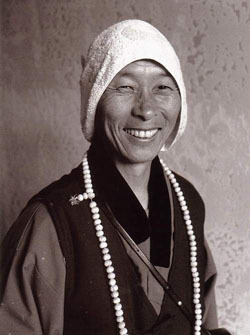
Spending fifteen years as the first Patriarch of the Jogye-san Monastic Compound(Jogye Chongnim) headquartered in Songgwang-sa, Master Kusan devoted much his life's energy to propagating Buddhism, through such activities as the founding of the Bulil International Seon Center. Directly and indirectly, some fifty of his disciples from both Korea and abroad are spreading the teachings of Korean Seon Buddhism around the world.
Career
Master Kusan was born December 17, 1909, in a small village in Mt. Jirisan in Namwon, Jeollabuk-do province. At the age of 14, after his father's sudden death, he took over management of his father's barber shop and family affairs, spending his young years in anguish. At 25, after coming down with an unknown illness, his moans of agony were interrupted by the words of a wandering Buddhist ascetic. “The body is the mind's reflection. Since the seat of one's original nature is pure, where can disease take root?” Hearing these words gave Kusan a sudden religious awakening. At that moment he decided to head to Yeongwonsa Monastery on Mt. Jirisan, to take part in a 100-day practice of devotion to the Bodhisattva Gwaneum. With his disease cured during the 100 days of prayer, Kusan decided to be ordained into the sangha. In 1937 at the age of 28, he received the precepts to become a novice monk at Songgwangsa Monastery from Master Hyobong.
Following this, with Songwangsa as his base, Master Kusan spent five years practicing ardently at various meditation halls (Seonwon). In 1943, to engage in serious practice, he built the “Correct Awakening” (Jeonggak) hermitage near the Sudoam Hermitage at Cheongamsa. For two years, he practiced with ferocity. In 1946, his master Hyobong became the first Patriarch of the Gayasan Monastic Compound (Gaya Chongnim) headquartered in Haeinsa, and Master Kusan took on the administrative responsibilities of the temple and also built and resided in the Beobwangdae Hermitage, midway up Mt. Gayasan, all while maintaining a diligent training regimen. In 1950, with the onset of the Korean War, the monks of Gayasan Monastic Compound scattered, and Kusan went to Eungseoksa in Jinju where he continued his Seon investigation. During the winter retreat in 1951, at the age of 42, Kusan penned his verse of enlightenment and submitted it to Master Hyobong:
The world's outer appearance is originally emptinessDo people point to emptiness because the mind resides there?For the withered tree above the crags, there are no seasonswhen spring arrives flowers bloom, in fall, it bears fruit
Master Hyobong accepted this verse and endorsed Kusan's enlightenment. Beginning in 1954, he assisted Master Hyobong as an avid supporter of the Buddhist purification movement. In 1966, with Master Hyobong's passing, Kusan returned to Songgwangsa, following his master's dying request to “restore Songgwangsa [which was mostly destroyed in the Korean War] and train many great people there.” Following the developments at Haeinsa, after three years effort the Jogyesan Monastic Compound (Jogye Chongnim) was established, the second Chongnim in Korea, at Songgwangsa in 1969.
As the first patriarch of the Monastic Compound, Master Kusan instituted a fundamental training program for his disciples, and as one of the three jewel temples, Songgwangsa, the “Sangha Jewel Monastery,” overflowed with the energy of its vivid restoration, the likes of which had not been seen since the days of National Master Bojo Jinul. To say nothing of the Korean monks, monks from the United States, Europe and elsewhere also came to Songgwangsa, constantly maintaining the highest levels of intensity in their training. In 1973, after attending the inaugural service at Sambo-sa in Carmel, California, in the United States, Kusan returned to Songgwangsa with a few foreign disciples and other practitioners to found Korea's first international Seon meditation center, “Bulil International Seon Center,” opening a new chapter in the globalization of Korea's traditional Seon teachings. Kusan continued along these lines, pouring his energy into the international propagation of Korean Buddhism, founding temples around the world, including Goryeosa in Los Angeles in 1980, Bulseungsa in Geneva in 1982, and Daegaksa near Carmel, California.
One day the following year, in 1984, as the restoration of Songgwangsa, together with the winter retreat, was coming to an end, Kusan let his disciples know that the karma of his life here was meeting its completion and left behind the following requests: “don't give my body any injections, perform the cremation in sitting meditation posture, live together in harmony without harm to the Seon tradition, do not live as a monk deceiving yourself, and devote yourself continuously to awakening.” He also left his “death verse”:
As the leaves of fall burn more crimson than the flowers of springAll of creation is completely laid bareAs living is empty, and dying too, is also emptyI go forth smiling, within the ocean-like absorption of the Buddha
On the afternoon of December 16th, at the Samiram Hermitage in Songgwangsa where he had first met his master Hyobong, surrounded by his many followers, Kusan assumed the lotus position and his seventy-four years of life came to a quiet end with his passing into nirvana.
Writings
Among Master Kusan's written works are his 1975 book, Seven Perfections, aimed at bringing Buddhism back into daily life, and his 1976 book, Nine Mountains, an English version of his dharma talks, written for the benefit of his foreign disciples. After receiving much attention from scholars of Buddhism and eastern philosophy around the world, Nine Mountains was revised and published in Korean as Seok Saja (Stone Lion). After Master Kusan's passing, his foreign disciples published Seon! My Choice, a compilation of their impressions and experiences regarding Korean Buddhism and their Seon training at the Bulil International Seon Center. In 1985, Master Kusan's disciples Stephen Batchelor and Martine Fages edited an English compilation of his dharma teachings, The Way of Korean Zen. The Society of Kusan Followers also published Kusan Seonmun (Seon Teachings of Kusan) in 1994, a volume of the Master's Seon sermons, and Kusan Seonpung (Seon Tradition of Kusan)in 1997, a collection of his dharma sermons delivered in the early 1980s while touring the United States, Taiwan, Europe and elsewhere.
Doctrinal Distinction
Master Kusan's practice was an exhaustive hwadu training. After gaining experience with the hwadu, “what is this?” Kusan then took up Zhaozhou's “MU” hwadu, leading his disciples in this practice as well. This hwadu was meant to lead one to understanding the state of mind that exists before saying “MU!” Kusan described his struggle this way:
“Investigating this hwadu, my investigation and the saying of “mu” coincide. In this state, I come even to defer sleep and forget meals. Standing alone, I reach to the point where I am alone, facing every enemy I've ever made during the past 10,000 years, wanting to sleep but unable, put in a position where I cannot go left or right, straight ahead or back, until finally, the place I have been leaning on exists no more, and I become unafraid of tumbling into emptiness. Thereafter, one day, I suddenly yell, 'Ha!,' and I'm left feeling as if heaven and earth have been overturned. When other people enter this place whose depth is unfathomable, they laugh out loud to themselves and do nothing but smile.”
He also explained that even after achieving an awakening, until you are able to precisely communicate your experiences to others, while pushing yourself to continuously refine your own opinions and understanding, you must engage in purification practices; then you must work to relieve the sufferings of all sentient beings.
Though Master Kusan spent 45 years practicing his hwadu with precisely this kind of discipline, he never stinted from getting involved in doing the work of the Buddha. Whenever he had a spare moment free from his practice, he could not keep still, such that he earned the nickname, “the working monk.”
Moreover, he never failed to join with the rest of the Buddhist community to participate in worship services, cooperative cleaning or building efforts, food offerings, or other such activities. In this way, the ever-thoroughly practicing Master Kusan emphasized the practice of making Buddhism a part of daily life, based on the idea that it was wrong to think of Buddhism as the sole preserve of a singular class of people, like monks and nuns, or that you have to live in the mountains to practice. Combining these methods under one teaching, Master Kusan promoted the “seven perfections” movement. He taught that a good way for Buddhist practitioners to implement the truth of Buddhism within their daily lives was to use six days of each week to practice each of the six bodhisattva perfections: charity on Monday, morality on Tuesday, perseverance on Wednesday, effort on Thursday, meditation on Friday, and wisdom on Saturday, and then to use Sunday as a service day, the day to practice the perfection of all works together.
Nine Mountains
FOREWORD
Buddhism is the formalized expression of a truth about life which is valid to any social situation in either past, present, or future. Since its introduction into Korea in the Fourth Century A.D., the Buddhist attitude towards life has played a vital role in the development of the Korean world-view, and its approach to living has had great influence in the shaping of Korean civilization. Although the last twenty years has seen the rapid encroachment on traditional Korean cultural values by Western material and religious outlooks, Buddhism continues to satisfy a deep need on the part of a large segment of the population for spiritual and psychological growth.
The author of this book is the inheritor of a unique tradition founded by National Master Bojo; feeling responsible for giving instruction in and transmitting the understanding of his lineage, he wishes to present this written outline of the teachings of Korean Buddhism. He believes that the practice of Buddhism, as taught in Korea, can lead Westerners to a deeper appreciation of the fruits of Buddhist practice in their lives.
The Seon (Zen) Master Kusan Suryeon (구산 수련) is the Master of Song Kwang Sa (Vast Pines Monastery), Jogye Chonglim, the monastery which represents the Sangha-jewel in Korea. Steeped in the long Korean meditation tradition which has been preserved along orthodox Chinese lines the Master's strong emphasis on practice, and his concern to maintain an atmosphere most conducive to sincere spiritual cultivation, have earned Song Kwang Sa the reputation of being the best among the three top Korean centers for meditation.
The Venerable Kusan is one of the few Masters in Korea who has taken a direct interest in the propagation of Buddhism not only within Korea, but in foreign countries as well. He regularly travels to deliver lectures to Buddhist lay groups in major cities throughout this country, and in 1971 toured the United States, delivering lectures at many of the major Buddhist centers there.
The selections from the Master's lectures included in this book are intended to provide a representative collection of his teachings on Buddhism, and include instructions for beginning students of Buddhism, lay-adherents, and monks who practice meditation. It is instructive to note the difference in his approach when instructing lay-people and monks. For people who have never had contact with the Korean Seon (Zen) tradition, it will be of interest to note the uniqueness of the Korean interpretation of Buddhism which is distinct from the meditation traditions of Japanese Zen or Chinese Ch'an, though there is still strong influence from the early Ch'an tradition which was current to T'ang Dynasty China (618—906).
The first selection, The Road to the Other Shore, contains much of the material the Master covers during conversations with people (especially Westerners) who have never been exposed to Buddhism before. It contains the essence of the Master's basic approach to Buddhism, and is also fairly representative of the Korean approach to Ch'an Meditation. It was written to provide a basic description of the Buddhist analysis of the world, the consequent approach to life, and the aims and practice of Buddhist meditation.
The second selection, The Seven Paramitas, is an outline for the practice of Buddhism during the ordinary activities of daily life and is especially directed to the needs of lay-adherents. It is a lecture delivered to a Buddhist lay-organization in Daejeon in 1976.
The final selection consists both of an introductory account of the lifestyle of those meditators residing in the Meditation Hall, and of The Formal Dharma Discourses which were composed in classical Chinese and were delivered to the meditation monks training at Song Kwang Sa during the three-month Winter and Summer Retreats of 1975-76. It must be emphasized that these lectures are instructions directed specifically to full-time cultivators who are developing hwadu (kung-an) meditation, and were delivered with two purposes in mind:
1) to provide the beginning student with an additional source for strengthening the sensation of doubt which is the indispensable core of hwadu meditation through hearing an exposition of the enlightened man's understanding; and 2) to give the advanced student that final push he needs to break through the i-ching or 'sensation of doubt', which will produce the experience of chien-hsing(見性 Jap. kensho) or the seeing into one's own true nature. If not read with these purposes kept carefully in mind, it will be easy to dismiss these discourses as paradoxical or incoherent nonsense, rather than seeing them for what they are in reality— advanced meditation directions. They are presented here for the benefit of those exceptional students who will be able to make proper use of these instructions.
The International Meditation Center would like to extend its appreciation to: Hae Heng Sunim and Hei Myong Sunim who read through and interpreted the Korean and Chinese manuscripts; Hei Myong Sunim who edited the material and made the English rendering; Ham Wol Sunim who typed all the drafts and wrote the introduction to Part III; Hyun Ho Sunim, Hyun Sung Sunim, Su Il Sunim, and Sung Il Sunim for their encouragement and help during all stages in the preparation of the translation.
It is hoped that Buddhist students at all stages of development will find these lectures inspiring, and that the instructions therein will be the catalyst required to produce the final achievement of Buddhahood.