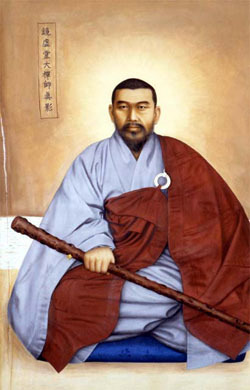
Master Gyeong-Heo is esteemed as a great revivalist of contemporary Korean Seon following on from Seon Master Hu-jeong Cheong-Heo (1520-1604).
1.Biography
Master Gyeongheo lived during a particularly violent, agitated period of the country, when the Joseon Dynasty was collapsing and Japanese colonization was just starting. He was born as the second son of his parents at Jadong-ri, Jeonju in 1846 C.E. He lost his father at an early age, and then his mother went to live with him at Cheonggyesa Temple when he was 8 years old; there he began to live as a monk under Venerable Gyeheo. When he was 13 years old, he first learned Chinese characters from a Confucian scholar who was staying at the temple. Learning came easily to him and he was praised as a brilliant boy. In the winter of the same year, Venerable Gyeheo recognized Gyeongheo’s ability and so sent the boy to study under a famous lecturer, Manhwa, in Donghaksa Temple. Gyeongheo learned and studied not only Buddhist sutras but also the Confucian and Taoist texts. When he was 22 years, he was appointed to the post of lecturer and taught the students at the Buddhist academy of Donghaksa Temple.
When he was 33 years old, there was a major change in his life. On the way Seoul to see his previous teacher, Gyeheo, who had given up his robes and returned to secular life, a heavy storm came up. In desperation, he went from door to door in the hope of finding shelter from the rain. At each house he was rejected as the families were afraid he would bring the raging epidemic to their house. Unable to find shelter, he was forced to spend the whole night under a big tree outside the village. He struggled with fear and with death. At that moment, he suddenly realized that the truth that the principle of life and death in his heart and so actually realized are the facts that he had only known intellectually until then. Then, he said, “Even though I am totally ignorant, I must be free of words. As I search through the teachings of the great masters, I will go beyond this world.” And he made a resolution in this pious and serious state of mind. The next day he returned to Donghaksa Temple, and then and there decided to no longer teach his students. He shut the door of his room and devoted himself to investigating his hwadu. After three months of diligent practice, he attained enlightenment on hearing the question of a novice, “ A cow has no nostrils? What does that mean?”
In spring of the next year, he moved to Cheonjangam Hermitage in Mt. Yeonamsan, and continued the practice which succeeds enlightenment. He said he was continuing the lineage of Yongam who was a successor of the Cheongheo and Hwanseong. At theage of 34, he recited his Nirvana poem.
“ I heard about the cow with no nostrils,
And suddenly the whole universe is my home.
Mt. Yeonamsan in June lies flat under the road.
A farmer, at the end of his work, is singing.”
For the next 20 years, from that time on, he founded many Seon training monasteries not only at Cheonjangam and Sudeoksa Temple, but also Beomeosa and Haeinsa in Gyeongsang-do Province, Songgwangsa and Hwaeomsa in Jeolla-do Province. He developed and spread the Seon tradition nationwide by teaching many Seon monks. He especially influenced the disciples of masters Mangong Wolmyeon, Hyewol, Suwol, Hanam and other Seon monks who have been instrumental in developing contemporary Buddhist history. These masters and monks, who succeeded the Seon tradition and lineage, made the foundation of the Jogye Order which is the center of Korean Buddhism today.
Master Gyeongheo suddenly disappeared from public view and the Buddhist world in 1905 C.E. when he was 59 years old. Up until then he had been involved in many projects, delivering a lot of dharma talks and attending many assemblies as a dharma teacher and an observer. He took to wearing secular clothes and he let his hair grow. He wandered around Ganggye in Pyeongan-do and Gapsan in Hamgyeong-do, and taught illiterate children. His disciples said that when he was 66 years old, on April 25th, 1912, he entered into final Nirvana. The following poem is his last hymn before his death.
“Light from the moon of clear mind
Drinks up everything in the world
When the mind and the light both disappear,
What is this?”
2.Writings
The existing writings of Master Gyeongheo were compiled by his disciples rather than written personally by him. In 1942, thirty years after his death, his disciple Mangong collected the late Gyeongheo’s materials and published a book, ACollection of Gyeongheo. This included such chapters as “Master’s Dharma Talks,” “Preface,” “Records,” “Letters,” “Activities,” “Poems,” “songs,” and his disciple “Hanam’s Activities,” and “A Short Lineage” written by Manhae Han Yong-un. The dharma talks encompass his main ideas and include “The Weeping of a Muddy Ox,” and “ How to Live as a Monk.” “The Song” emphasized the way of Seon practice and aspects of spreading Buddhism to the public while “The Preface” and “The Record” included the aims and major characteristics of The Retreat Community of Samadhi (meditation)and Prajna (wisdom).
In 1981,The Dharma Talks of Master Gyeongheo was published and this book included new material which had never been published before. For instance, “Hymns of Mt. Geumgangsan Travels,” “The 40 Verses of Seon,” “The “Biography of Master Gyeongheo written by Master Hanam,” “Thirty-eight Amusing Anecdotes of Master Gyeongheo” were added to the this edition.
Seonmun chwaryo(The Essential Sayings of the Seon House), a collection of the Seon Masters’ sayings and studies in China and Korea compiled by Master Gyeongheo in early 1900 C.E., is well known as a text of Seon.
3. Characteristics of His Thoughts
Master Gyeongheo showed himself as a mirror of Seon practice as he made special efforts to improve the Seon tradition through the foundation of a retreat community and the re-opening of many closed Seon monasteries. He was 53 years old when he founded the retreat community was in 1899 C.E. The community succeeded the tradition of The Retreat Community of Samadhi and Praijna of Master Bojo during Goryeo. The aim of the retreat community was the attainment of enlightenment. The main characteristic of this retreat community was to have a realistic view of liberation, with the vow of rebirth in the Trayastrimsa heaven (the heaven of the thirty-three gods). This is not for people who can attain enlightenment by themselves, but for the poor and the suffering whose only hope is through faith and vow.
In late Joseon, when Master Gyeongheo lived, the Seon tradition of the Seon Order which had been established in the late Silla period, was almost non-existent and practitioners were hard to come by. It was due to the retreat community of Master Gyeongheo that the Seon tradition was revived.
He continuously taught Seon, yet he was not limited to Seon practice; he openly enjoined the practices of chanting and mantra recitation and considered them as equally beneficial. In particular, he insisted on the unification of the Seon and Doctrinal approaches.
His thought was reflected in his other writings, “Song of the Ox Herd” and “Verses of the Ox Herd.” In these works he explains how the innate Buddha Nature is discovered and developed by using the symbolism of the ox. His view was different from those of other ox herd pictures popularized at that time, he didn’t even stick to the schematic pictures, nor even the number of ten scenes. He emphasized the innate place of Self Nature rather than simply showing the stages of evolution of the black ox into a white ox. In the final stage of the series, he would teach, “The ox herder, carrying his bag and ringing a hand bell, returns to the village; this is the final stage of an accomplished man.” This statement underlines the importance of drawing compassion into worldly life, thus benefiting all human beings and all other beings as well.
Master Gyeongheo was a reformer of Seon who made Seon practical and popular; he is revered as one of the great pioneers of Seon in showing the ultimate stage of enlightenment. He always extolled the virtues of Seon not only in his dharma talks but also in his dialogues and encounters of Seon questions and answers. His unusual behavior and written message were expedient means for spreading the teachings of Seon.
Seon Master's Episode
1] Heavy Sacks
Gyeongheo and Mangong, his disciple, were returning to their temple in the evening after getting some rice for their food. Especially that day, they got rice full of sack. Apart from their satisfaction, the sacks were heavy and it was still distant to their destination. Mangong felt tired and got pain on the shoulder, so it was very difficult to follow his master. Noticing this, Gyeongheo said, "I will use one method to get fast. Please see." They were passing a certain village. Then, a beautiful young woman was coming from the opposit side of them with a water jar on the head. She was apparently a bride just over 20 years old. When Gyeongheo faced her, he held her both ears and kissed her lips. The woman screamed, dropped and broke the jar, and ran back into her house. A distubance arose. Villagers ran out of their houses with sticks or clubs and shouted, "Wicked monks, stop there." The two monks began to run away. They ran so desperately that villagers couldn't follow them to the last. After a while, when they took a rest, Gyeongheo said, "Was the sack heavy?" Mangong said, "Regardlessly, I don't know how I could run so long way with it." Gyeongheo said, "Don't I have talent?" They laughed together looking at each other.
2] A Preach for Mother
One day, Gyeongheo gathered people to preach for the sake of his mother and told his student to fetch her. His mother was very glad, so she dressed herself with new clothes and paid her respects to him, and took a seat. Thereupon, Gyeongheo took off his own clothes piece by piece until he became all naked. He said, "Mother, please look at me." His mother waiting for a great preach was very surprised, got angry and said, "How can you preach like this ? How outrageous !" She returned to her room right away and locked the door of her room. Then, he smiled bitterly and said, "How can she be my mother ? When I was a child, she took off my clothes, washed my body, hugged and kissed me. Why can't she do that now ? How pitiful are those worldly customs !" His students had to beg her parden saying that it had been a great and special preach.
3] A Leper
Master Gyeongheo was dwelling at Cunggyesa temple, when a leper woman knocked at the door of his room.He noticed that she had wandered lacking in love. He allowed her to enter his room. Since then, he shared his mattress together with her for a week, until his disciple Mangong said, "I notice your Dharma is supreme, but we can't endure it. Please have her get out of here." Gyeongheo said, "You seem to have many boundaries catching you. Then I can't help it." So he had to tell her to leave.
Contestations over Korean Buddhist Identities
The "Introduction" to the Gyeongheo-jip
Gregory Nicholas Evon
This article partly derives from research contained in a Ph.D. dissertation (Evon 1999), and it represents a re-articulation of certain basic points made therein. Here, the fundamental point I seek to make is simply this: there exists an inherent conflict between the assumptions that a self-conscious Korean Buddhist identity can be founded on the singular notion of purity, or celibacy, and that this singular notion of identity, in turn, reasonably can be judged to be nationalistic or patriotic in the context of the Japanese colonial period (1910-1945). Such a general notion of identity, I would argue, at once elides the contestation over identity among Korean Buddhists themselves during the colonial period and ultimately conflates religious for national identities. Further, such elision and conflation seem to be products of post-liberation discourse. Throughout this paper I will use the expression post-liberation in order to allow for a distinction suggested elsewhere: that post-colonialism ought to refer to all that follows the “beginning of colonial contact” (Ashcroft, Griffiths, Tiffin 1999: 2). In that sense, however, post-colonialism is inaccurate to the extent that it allows for little distinction between the colonial period and its aftermath. Such a distinction is, in part, what this paper seeks to address?hence my employment of post-liberation. In this connection, it should be admitted that this paper makes some general claims in regard to post-liberation Korean Buddhist discourse without always staking these claims to definite examples. Yet as with all generalizations, these claims are not necessarily applicable to the entirety of specific cases, or to be exact, the entirety of the work of all scholars. On the other hand, at least this shortcoming can be explained partly in reference to Whitehead’s dictum that much can be learned about an era through what it assumes rather than expresses. By the very definition of assumption, we are forced to deal with frameworks of inquiry in which ideas are embedded, or assumed. These frameworks and implicit ideas limit the questions asked and the answers given, thus demanding an “unearthing of silences” which requires “a project linked to an interpretation” so we may locate “the retrospective significance of hitherto neglected events” (Trouillot 1995: 58).1 In this paper, the neglected events to be addressed are those surrounding the publication of a Korean Buddhist text in the colonial period, and the silences are those of post-liberation scholarship on these events. This paper, then, is an interpretation.
Gyeongheo and Mangong's a episode Gyeongheo and Mangong, his disciple, were returning to their temple in the evening after getting some rice for their food. Especially that day, they got rice full of sack. Apart from their satisfaction, the sacks were heavy and it was still distant to their destination. Mangong felt tired and got pain on the shoulder, so it was very difficult to follow his master. Noticing this, Gyeongheo said, "I will use one method to get fast. Please see." They were passing a certain village. Then, a beautiful young woman was coming from the opposit side of them with a water jar on the head. She was apparently a bride just over 20 years old. When Gyeongheo faced her, he held her both ears and kissed her lips. The woman screamed, dropped and broke the jar, and ran back into her house. A distubance arose. Villagers ran out of their houses with sticks or clubs and shouted, "Wicked monks, stop there." The two monks began to run away. They ran so desperately that villagers couldn't follow them to the last. After a while, when they took a rest, Gyeongheo said, "Was the sack heavy?" Mangong said, "Regardlessly, I don't know how I could run so long way with it." Gyeongheo said, "Don't I have talent?" They laughed together looking at each other.