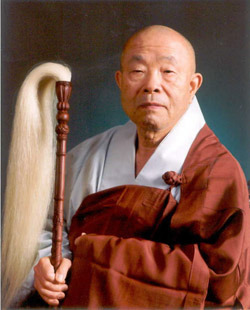
Beopjeon sunim, whose secular name is Kim Hyangbong, gained his nickname ‘Stone Mortar Practitioner,’ from his reputation of sitting glued to the ground like a stone mortar once he sat down in meditation. In 1939, he ordained as a monk at Bulgap monastery in Younggwang with Seolje sunim as his ordination sponsor and received his sramanera precepts. In 1948, he received his bhiksu precepts at Baekyangsa monastery with Seon master Manam Jongheon (만암 종헌, 曼庵 宗憲 : 1876-1956) as his preceptor.
In 1947, while he was traveling to Haein monastery from Baekyang monastery, he stopped at Bongam monastery in Mungyeong. There he encountered monks who were then attending the Retreat Society at Bongam Monastery--including Seongcheol sunim (성철, 性徹 : 1912-1993), Cheongdam sunim (청담, 靑潭 : 1902-1971), Hyanggok sunim (향곡, 香谷 : 1912-1978), Wolsan sunim (월산, 月山 1912-1997), and Jaun Seongu sunim (자운 성우, 慈雲 盛祐 : 1911-1992)--and decided to join them as its youngest member. His hwadu (keyword) at the time was ‘Who is carrying your corpse?”
This acquaintance with Seongcheol sunim led him to become Seongcheol sunim’s personal attendant. One day in 1951, as he was assisting and sometimes practicing with Seongcheol sunim, who was then cultivating in Cheonje cave at Anjongsa monastery in Tongyoung, Seongcheol sunim expounded the first line from the Song of Attaining the Way, by the eminent Chinese master Yongjia Xuanjue (永嘉 玄覺 : 665-713), which says, “Haven’t you seen it?” Seongcheol sunim asked him, “Do you understand this?” Beopjeon sunim replied, “If you ask me in that way, I will kick you in the back.” To this response, Seongcheol sunim said, “Your mind is clear.” The following day, he gave Beopjeon the dharma cognomen Dorim and formally assumed the role of his sponsor in the Dharma. From that point on, Beopjeon served as Seongcheol sunim’s personal attendant until Seongcheol sunim passed away in 1993. When Seongcheol sunim undertook his practice of ‘ten years without exiting’ at Seongjeon hermitage at Pagye temple, he put up a metal fence surrounding the entire area.
Though Beopjeon sunim was only 5 feet tall and reticent to speak, even Seongcheol sunim could not top his dedication as a Seon practitioner and told him to take a break: “I lost to you. Now, continue after eating your meal.” Beopjeon sunim attained awakening by cultivating the practice of ‘never going out the gate’ in the middle of the harsh winter; he barely ate cold rice with a few pieces of kimchi to satisfy his hunger, and did not bath or clean his place for over three months. There is a story that after validating his awakening, Seongcheol sunim announced that he would provide rice cake as a tribute to Beopjeon sunim’s completing his contemplation. However, due to his humble nature, Beopjeon sunim refused. Even nowadays, he still wakes up at three in the morning and climbs the mountain and exercises for an hour every morning and evening to maintain his good health. After lunch, he doesn’t accept audiences with anyone.
In 1985, Beopjeon sunim returned to Haein monastery and a year later began an eight-year term as abbot. In 1996, he was designated the seventh Seon master of the monastery (방장, 方丈), succeeding Hyeam Songgwan. In 2000, he was the convener of the Jogye Order’s Council of Elders. In the year 2002, he was nominated as the eleventh Supreme Patriarch of the Jogye Order. His words of teaching are widely known, such as: “Monks are those who specialize in spiritual cultivation; all strata of practitioners are produced by cultivation”; “All problems arise from the excessive greed of human beings,” and “Remind yourselves of the teaching, ‘Be of few desires and know contentment.’”
Dharma Talk to Begin the Winter Retreat 2009~2010
By Most Ven. Beopjeon
Supreme Patriarch of Jogye Order of Korean Buddhism
"Where is that Path?"
A monk asked Seon master Geonbong, “It is said all the Buddhas of all the worlds realized the state of Nirvana through a single path. What is the single path to realize the state of Nirvana?”
At this the Seon master took his stick and drew a line in the air and said, “It is here.”
The monk didn’t understand, so he went to Seon master Woonmoon and asked the same question. Seon master Woonmoon replied, “If I were to throw this fan, it would go all the way to the 33rd heaven and stick into the nostril of Indra, and if I were to strike a carp with this fan, it would fly into the air to create an intense rain storm.”
Just as a freshwater carp would not be found in the ocean, to say the path to Nirvana is this or that is meaningless. We can never approach the path to realize the infinitely unobstructed state of Nirvana of all the Buddhas with conceptual distinctions. This is why Master Geonbong drew a line in the air with his stick to show that state. Although the stick may be raised from the path to Nirvana, hundreds of times—an obscured monk will continue to walk in the dark the same path hundreds of times. Although this lofty teaching of the master is like the bright sun shining in the cloudless sky, childish beings will consider it easy or hard to create delusion, and even if kalpas were to pass, there would be no chance of enlightenment.
If you were to ask this mountain monk, the path to Nirvana, I would at once beat you with a club. And in the moment you try to open your mouth again, I would let a yelp so fierce as to make the mountains tremble and chase you out. If we think about it, the two masters, Geonbong and Woonmoon’s undue compassion only resulted in making the monk more blind—so the faults of the masters are not at all small. Monks and nuns doing retreat this winter may simply search for what the two masters were implying. However, we should never follow after the mere words of two old people. We must find the path to Nirvana on our own, below our own feet. We must know that only when we fervently and correctly hold the hwadu, can we resolve the path to Nirvana on our own.
If you attain the meaning, you attain the path to return home.
If you find the words, you will led on the wrong path to be farther away.
2553 Buddhist Era (2009) Beginning of Winter Retreat