Buddhist wall painting







Buddhist Painting
Buddhist Painting is not meant to pursue mere beauty, but rather, is a holy and divine art of drawing the subjects and themes of Buddhist principles. Accordingly, good Buddhist paintings depend on how well Buddhist principles are depicted and delivered rather than on revolutionary techniques and skills applied in the paintings. For example, if the liberation from all the sufferings is the main purpose of Buddhism, the most successful Buddhist painting is the one which depicts the scene that helps one to be liberated from all these sufferings.
Buddhist paintings have various purposes; First of all, they are used for decoration. Also, they are used to create solemnity. Secondly, they have the educational purpose of delivering the teachings of the Buddha more easily. Thirdly, they are used for worship.
Korean; Taenghwa (탱화, 幀畫 ,Thangka )
Byukhwas (벽화, Temple Murals)
There are three types of temple ‘Byukhwas’ (벽화, temple murals), based on whether they are painted on clay, wood or stone. ; clay, stone and wooden board. Most of the historical temples before the Choseon Dynasty were made of wood and clay, and were decorated with murals.
However, a majority of the paintings disappeared over time due to the destruction or restoration of the temples and so they are now hard to find.
In the case of murals painted on the wood surface, the boards are put on the outside walls of a wooden temple to protect the walls and murals are painted on them. These murals do not last long and it is hard to find ones from long ago. Stone wall paintings are done on the walls of cave temples. In Korea, there are no remaining examples and only a record of that they existed. However, many cave murals have survived many centuries in other parts of the world, for example in Ajanta, India, in Donhuan, Ungang and Daedong in China and throughout Central Asia.
Gamro-dos (감로도)
‘Gamro’ means the sweet teachings of the Buddha and ‘do’ means paintings and pictures. Gamro-dos (감로도) are also called Taenghwas for the spirits of the dead, or Gamrowang-do (Paintings of King Gamro) since it mainly depicts the Sutra of ‘Bulseoluranbunkyung’.(불설우란분경) King Gamro represents the Amitabul(아미타불, Amitahba), the main Buddha of the Western Paradise.
The paintings depict the manner of worship to ancestors and other spirits. The upper portion illustrates the scene of the Amitabul and the heavenly beings appearing before sentient beings at the purgatory, and the scene of a Bodhisattva taking those beings to the Western Paradise (the Pure Land). The bottom portion depicts the many different forms of sufferings in Hell and in the realms of sentient beings.
Byunsang-do(변상도)
Byunsang-do’ (변상도) are the paintings of the life of the Buddha Seokgamoni (Sakyamuni) and of various Buddhist stories. There are the main subjects; Bonsaeng-dos (본생도) which depict the former lives of the Buddha, Buljeon-dos(불전도), which show the panoramic depiction of his life and Jangeom-dos (장엄도), which feature the Western Paradise. Complicated sutras or profound doctrines are summarized in a painted form. These paintings are used as a means of edification for sentient beings by inspiring them to study the meanings of
Palsang-do (팔상도, Eight Scenes of the Buddha’s Life)
(1) Scene of the Buddha’s descent from ‘Dosolcheon’ (도솔천, Tusita heaven).
This painting illustrates the Buhhda Seokamoni(Sakyamuni) waiting in Dosolcheon and then descending from heaven to earth as the son of King Shuddhodana Gautama and Queen Maya; Queen Maya dreams of Homyoung Bosal (Bodhisattva Homyoung, 호명보살) riding an elephant and entering her between the right ribs. The King and the Queen listen to the interpretation of the dream from a Brahmin who is an expert in physiognomy. He predicts “A great son will be born. If he renounces the world and embraces a religious life, he will attain perfect Enlightenment and become the Savior of the three realms(삼계, Samgye, San.: triloka).
(2) Scene of the Buddha’s Birth in Lumbini Park
This painting depicts the aspects of nature which are associated with the Buddha’s birth; On a warm spring day, Queen Maya walks up the Lumbini Park with royal ladies in waiting who leave the palace to accompany her. The prince emerges from the right side of his mother who is standing upright and holding a branch of an Ashoka tree. Jeseokcheon (제석천, King Sacra, King of devas) attends the prince’s birth and wraps him in silk brought from the Heaven and all the heavenly kings make offerings of treasures. The prince, immediately after birth, takes seven steps and at each step, a lotus grows out of the ground to receive the Buddha-to-be. He steps from blossom to blossom and stops. With one hand pointing to Heaven and the other pointing to the earth, he exclaims “Above heaven and below heaven (In the heavens and on earth), I alone am the Honored One. (San.: wnaggo ham asmi lokassa). Nine dragons wash the prince with the clean water from their mouth and take the prince on their backs. Asita, an old hermit sage is called in the palace in order to read the physiognomy of the prince.
(3) Scene of Gautama’s Observation outside Four Gates
This scene shows the prince observing all the sufferings
Glossary of Terms
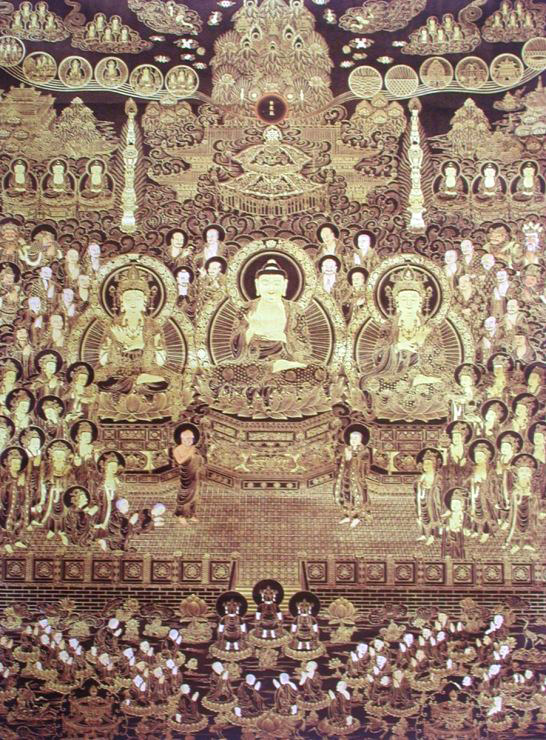
- Meoktaenghwa: A Taenghwa (Buddhist painting) drawn in gold powder (Igeum) on a black background.
- Tanghwabulsa: The Buddhist ceremony or act of enshring a Taenghwa.
- Doksungtaenghwa: A scroll painting depicting Naban Jonja (The Lonely Saint).
- Sansintaenghwa: A scroll painting depicting the Mountain Spirit (Sansin).
- Seokgataenghwa: A painting of Sakyamuni Buddha.
- Sihwangtaenghwa: A scroll painting depicting the Ten Kings who judge the weight of sins in the underworld.
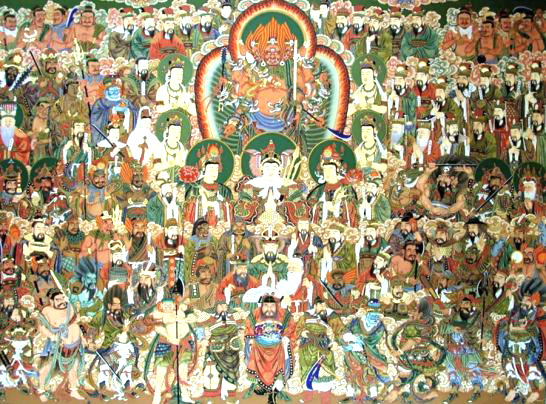
- Sinjungtaenghwa: A scroll painting depicting the assembly of guardian deities (Hwaeom Sinjang) hung on the wall.
- Jowangtaenghwa: A portrait painting of the Kitchen God (Jowang).
- Chilsungtaenghwa: A Taenghwa depicting the Seven Stars (Big Dipper) personified as the Seven Star Tathagatas.
- Hubultaenghwa: A Taenghwa enshrined behind a Buddha statue.
Taenghwa (Buddhist Hanging Paintings)
1. Sakyamuni Hubul Taenghwa (Sakyamuni Behind-the-Buddha Painting)
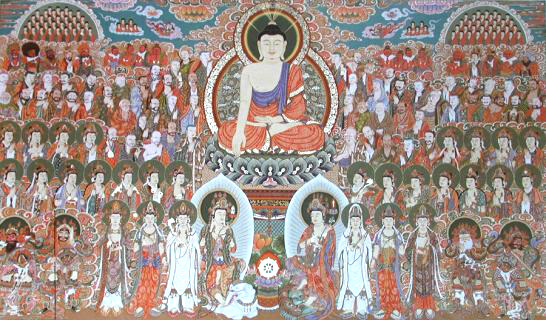
This painting is enshrined in halls where Sakyamuni Buddha is the main deity, such as the Daeungjeon, Yeongsanjeon, Palsangjeon, or Eungjinjeon. In the Palsangjeon, the "Eight Scenes of the Buddha's Life" are enshrined. In other halls, the Yeongsan Hoesang Do (Painting of the Assembly at Vulture Peak), which depicts the scene of the Buddha preaching the Lotus Sutra at Vulture Peak in India, is used.
In the Sakyamuni Hubul Taenghwa, Sakyamuni Buddha sits on the central Sumeru Altar.
- Bodhisattvas: To his left and right are attending Bodhisattvas. Commonly, Manjusri and Samantabhadra, or Dipankara and Maitreya are depicted. It is possible to arrange 4, 6, 8, 10, 12, or more Bodhisattvas symmetrically. When eight are depicted, they are usually Manjusri, Samantabhadra, Avalokitesvara, Maitreya, Bhaisajyaraja, Gadgadasvara, Aksayamati, and Nityoyukta.
- Disciples: Sometimes only Mahakasyapa and Ananda are drawn, but often the 10 Great Disciples are arranged symmetrically. Mahakasyapa is depicted as an old man with long white eyebrows, while Ananda and Rahula are shown as young men.
- Guardians: The Four Heavenly Kings are placed at the outer edges.
- Appearance: Buddhas and Bodhisattvas are usually gold or yellow. Other figures vary in skin tone. Without specific ritual implements, they are mostly depicted with hands clasped in prayer. Brahma and Indra resemble Bodhisattvas but have lighter skin and wear monastic robes under their celestial garments.
- Elaborate Compositions: In larger compositions, Boy Manjusri and Boy Samantabhadra, along with Brahma and Indra, are included. Above them, the Eight Vajra Warriors are placed, along with the Eight Legions (Dragons, Devas, Asuras, etc.). Numerous manifestation Buddhas may also appear in the halo or clouds.
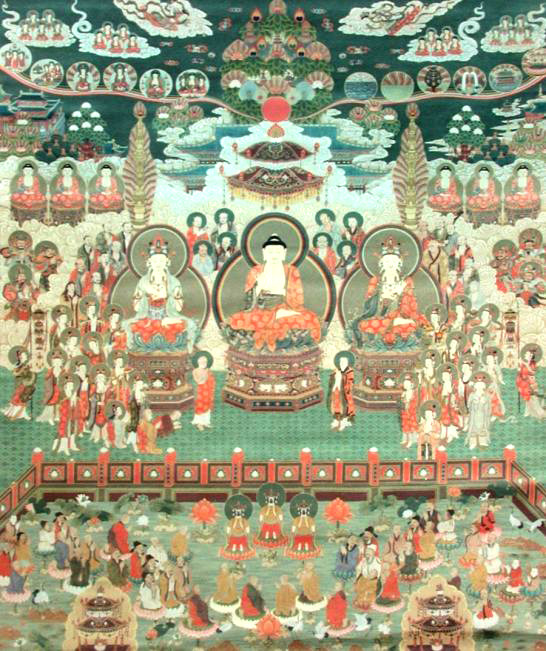
2. Virocana Samsinbul Taenghwa (Three Bodies of Buddha)
Since this painting enshrines the Three Bodies of the Buddha (Trikaya), Virocana (Dharmakaya), Rocana (Sambhogakaya), and Sakyamuni (Nirmanakaya) are often painted together on one canvas or divided into three separate scrolls.
- Center: Dharmakaya Virocana.
- Left: Sambhogakaya Rocana.
- Right: Nirmanakaya Sakyamuni.
These are found in Daejeokgwangjeon (Hall of Great Light), Birojeon, or halls dedicated to Manjusri or Avatamsaka. The Virocana painting likely depicts the sermon at the Hall of Universal Light or the Place of Quiescence from the Avatamsaka Sutra.
- Virocana: Depicted large, sitting in the lotus position performing the Wisdom Fist Mudra (Jigwonin). He is surrounded by Bodhisattvas and Sravakas (disciples). Manjusri (Wisdom) and Samantabhadra (Virtue) attend him, forming the "Three Sages of Virocana."
- Rocana (Left): Characterized by wearing a jewel crown like a Bodhisattva but performing Sakyamuni’s first teaching mudra. This signifies his role as the Adornment Bodhisattva and preacher.
- Sakyamuni (Right): Sits in the "Touching the Earth" mudra (Bhumisparsha) and the teaching mudra.
- Example: The Daegwangmyeongjeon at Tongdosa Temple features a tripartite painting. The central Virocana scroll includes 14 Bodhisattvas, 10 disciples, and Buddhas of the ten directions. The side scrolls mirror this complexity with their respective deities and guardians.
3. Amitabha Hubul Taenghwa (Amitabha Behind-the-Buddha Painting)
Enshrined in the Geungnakjeon (Hall of Supreme Bliss), this painting vividly depicts Amitabha Buddha preaching in the Western Pure Land. The composition is similar to the Yeongsan Hoesang Do, but the mudra is different (Teaching or Amita Meditation Mudra), and the attendants are Avalokitesvara and Mahasthamaprapta (or Ksitigarbha).
Variations of Korean Amitabha Paintings:
- Solo Amitabha: Sitting on a lotus pedestal performing one of the nine grades of mudras.
- Triad: Amitabha with Avalokitesvara and Mahasthamaprapta (or Ksitigarbha).
- 5 or 9 Deities: Amitabha with 4 or 8 Great Bodhisattvas.
- Complex Assembly: Amitabha, 8 Bodhisattvas (always including Ksitigarbha), Arhats, and the Four Heavenly Kings (e.g., Donghwasa Temple).
- Pure Land Illustration (Byeonsang): A two-tier composition with the celestial palace above and the lotus pond of the Pure Land below, detailing the scene of paradise.
Amitabha Raigo Do (Welcoming Descent Painting): This depicts Amitabha coming to welcome the deceased into the Pure Land.
- Amitabha alone.
- Amitabha Triad coming to welcome.
- Amitabha with 8 Bodhisattvas on clouds.
- Amitabha with a large retinue (disciples, musicians, etc.).
- Dragon Ship: The "Dragon Ship of Wisdom" carrying the souls, guided by Bodhisattva Innowang and Avalokitesvara toward Amitabha.
Gwangyeong Byeonsang Do (Visualization Sutra Illustration): Based on the Contemplation Sutra, this depicts the causal story of the sutra (Queen Vaidehi) and the 16 Visualizations of the Pure Land.
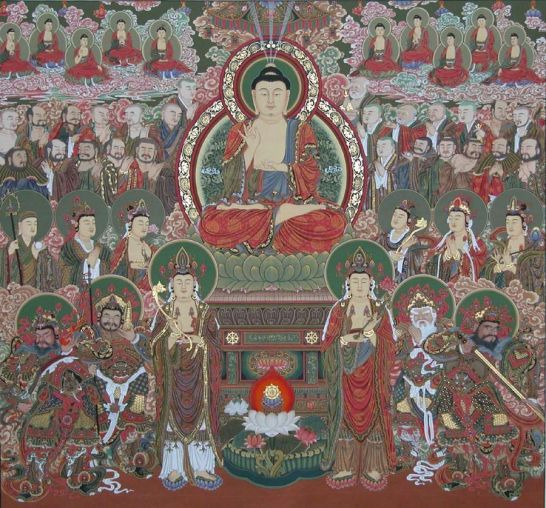
4. Bhaisajyaguru Hubul Taenghwa (Medicine Buddha)
This painting visualizes the Eastern Lapis Lazuli Pure Land of Bhaisajyaguru (Medicine Buddha).
- Form: The Buddha holds a medicine bowl in his left hand.
- Attendants: Suryaprabha (Sunlight Bodhisattva) holding a sun or with a sun in his crown, and Candraprabha (Moonlight Bodhisattva) with a moon.
- 12 Generals: 12 Yaksa Generals are depicted, often symmetrically. In Korea, they correspond to the 12 Zodiac animals, though they are usually painted as humans with fierce expressions rather than having animal heads.
- Example: The painting at Tongdosa’s Yaksajeon shows the Medicine Buddha surrounded by a semicircle of 8 Bodhisattvas, disciples, and the 12 Generals, with dynamic Vajra warriors below.
5. Cheonbul Taenghwa (Thousand Buddhas Painting)
Based on the "Many Buddhas" ideology, this depicts 1,000 or 3,000 Buddhas. It is found in the Cheonbuljeon or Manbuljeon.
- It may depict the Past, Present, and Future Thousand Buddhas, or just the Present.
- Composition: The Triad (Dharmakaya, Sambhogakaya, Nirmanakaya) and the Five Dhyani Buddhas are central, surrounded by rows of small Buddhas.
- Examples: Seonunsa Temple (1754) has four scrolls with 250 Buddhas each. Gwangdeoksa Temple has three scrolls, each depicting 1,000 Buddhas.
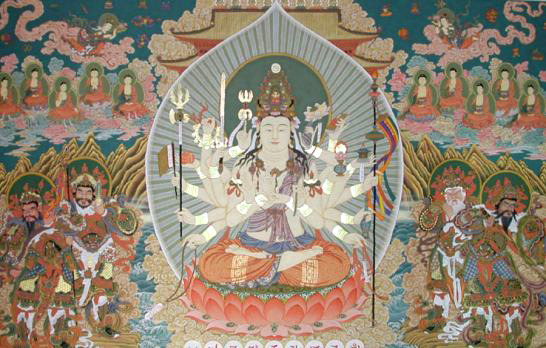
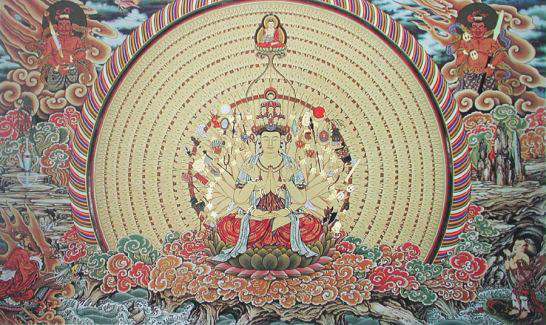
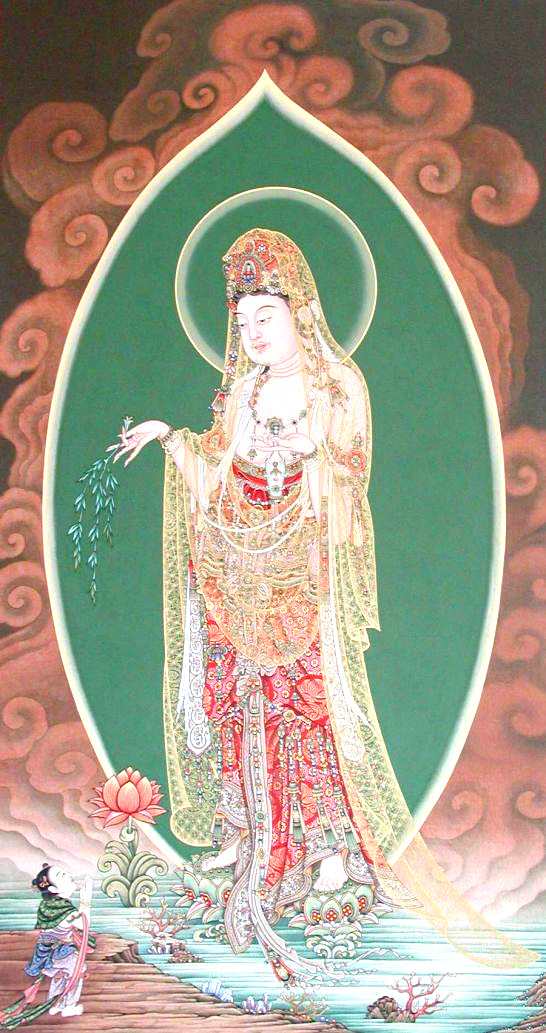
6. Gwaneum Taenghwa (Avalokitesvara Painting)
Enshrined in the Wontongjeon or Gwaneumjeon. The main figure is Avalokitesvara, attended by the Sudhana (Boy Pilgrim) and the Dragon King.
- Arya Avalokitesvara (Seong Gwaneum): Draped in white or celestial robes, often wearing a transparent veil over the head. Holds a Kundika (ritual flask) and willow branch.
- 11-Faced Avalokitesvara: The 11 faces symbolize the stages of enlightenment and the Buddha’s fruit.
- Thousand-Hand Avalokitesvara: Represents infinite compassion to save all beings. Often depicted with 42 main hands holding implements.
- Water-Moon Avalokitesvara (Suwol Gwaneum): Depicts the Bodhisattva sitting on a rocky outcrop on Mt. Potalaka, gazing at the moon reflected in the water. Features include bamboo, a blue bird, and the boy Sudhana seeking truth. This style was famous in the Goryeo Dynasty.
7. Hwaeom Taenghwa (Avatamsaka Painting)
A visual representation of the Avatamsaka Sutra, usually found in the Hwaeomjeon.
- Structure: Depicts the "Seven Locations and Nine Assemblies" of the sutra.
- Composition: A large lotus pond (World Seed) is at the bottom. Above are the scenes of the assemblies arranged in tiers. The bottom also features Sudhana’s pilgrimage to visit 53 teachers.
- Uniqueness: The main Buddha in the nine assemblies is depicted in the form of a Bodhisattva, representing the realization of the Buddha-nature. It visualizes the Lotus Treasury World.
8. Mireuk Taenghwa (Maitreya Painting)
Depicts the Dragon Flower World or Tusita Heaven of Maitreya, the Future Buddha. Found in Mireukjeon or Yonghwajeon.
- Mireuk Pure Land: Maitreya preaching in the Tusita Heaven palace.
- Mireuk Descent: Maitreya becoming a Buddha under the Dragon Flower Tree to save beings.
- Mireuk Welcoming: Maitreya descending on clouds to welcome spirits (similar to Amitabha).
- Attributes: Often wears a crown featuring a stupa or holds a stupa/lotus.
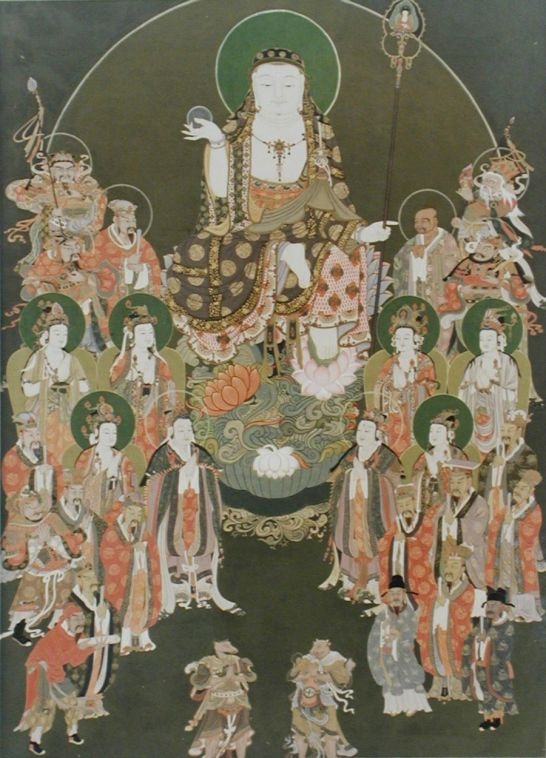
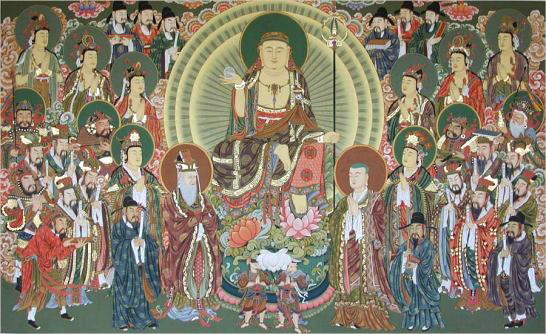
9. Jijang Taenghwa (Ksitigarbha Painting)
Ksitigarbha Bodhisattva appears as a monk (shaved head or wearing a headscarf) rather than in royal attire.
- Attributes: Holds a Cintamani (wish-fulfilling jewel) in the right hand and a Khakkhara (six-ring staff) in the left. The six rings symbolize the Six Perfections (Paramitas).
- configurations:
- Solo: Standing or sitting, common in early Joseon.
- Triad: With Monk Domyeong and the Demon King Mudok.
- With Retinue: Includes the Triad plus 4-6 Bodhisattvas and sometimes the Ten Kings of Hell.
- Full Assembly: Ksitigarbha, Domyeong, Mudok, the Ten Kings, and other underworld officials. (Common in late Joseon).
10. Samjang Taenghwa (Three Stores Painting)
A unique Korean form derived from Ksitigarbha worship. It depicts the Bodhisattvas of the three spheres:
- Heaven: Cheonjang Bodhisattva (Left) – Ruler of celestial beings/stars.
- Earth: Jiji Bodhisattva (Center/Void Store) – Ruler of earthly beings.
- Underworld: Jijang Bodhisattva (Right) – Ruler of the dead.
- Each Bodhisattva has their own retinue. This painting is not found in other countries.
11. Sinjung Taenghwa (Guardian Deities Painting)
Also called Sinjang Taenghwa. Even in halls without a main Buddha painting (like those housing Buddha's relics), a Guardian painting is always present on the side wall.
- The Altar: Called the Sinjung-dan. The deities vowed to protect the Dharma and receive offerings after the Buddha.
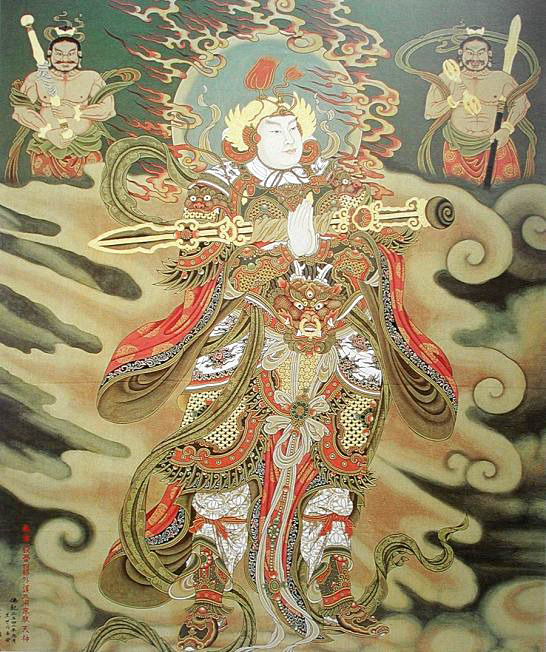
- Main Figures: Skanda (Dongjin Bosal), Brahma, or Indra.
- Visuals: Military generals, fierce spirits, and celestial beings. The number of figures ranges from 1 to 104. Skanda is central, usually depicted as a young general with a winged helmet holding a sword.
12. Chilseong Taenghwa (Seven Stars Painting)
A Buddhist adaptation of the Daoist Big Dipper worship.
- Main Buddha: Tejaprabha Buddha (Chiseonggwang Yeorae), symbolizing the North Star.
- Attendants: Sunlight and Moonlight Bodhisattvas.
- Retinue: The Seven Star Tathagatas (Big Dipper stars personified) and the Seven Star Lords (Daoist figures).
- Purpose: Praying for longevity, rain, and offspring (especially sons in the Joseon era). The painting blends Buddhist Buddhas with Daoist officials in court dress.
13. Dokseong Taenghwa (The Lonely Saint Painting)
Depicts Naban Jonja (Pindola), who attained enlightenment alone.
- Setting: Sitting on a rock in deep mountains with pine trees and clouds.
- Attributes: White eyebrows, holding a staff and rosary (or fungus of immortality).
- Attendants: Sometimes a tea-brewing boy attendant is shown.
- Significance: Known for granting prayers swiftly.
14. Sansin Taenghwa (Mountain Spirit Painting)
Depicts the Mountain Spirit, an indigenous Korean deity absorbed into Buddhism. Enshrined in the Sansingak.
- Imagery: An old man with a white beard sitting in a rocky canyon, accompanied by a tiger.
- The Tiger: A manifestation of the spirit. In Korean art, the tiger is often depicted as friendly, goofy, or affectionate rather than terrifying.
- Syncretism: The monk-like appearance (holding a sutra or rosary) signifies the integration of shamanism into Buddhism.
15. Nahan Taenghwa (Arhat Painting)
Depicts the Arhats (Disciples) who protect the Dharma until Maitreya comes. Found in the Eungjinjeon.
- Diversity: The 16 Arhats are depicted in various casual poses—sitting, standing, or turning away—often with distinct facial expressions.
- Arrangement: Usually 16 separate scrolls or grouped in sets.
- Significance: Linked closely with Zen (Seon) Buddhism.
16. Jeseok Taenghwa (Indra Painting)
Depicts Indra (Jeseok-cheon), the Ruler of the Heavens.
- Origin: Originally a Hindu god, adopted as a Buddhist protector. In Korea, this blended with the indigenous belief in the Sky God (Hwanin).
- Composition: Indra is in the center, flanked by attendants. Sometimes depicted with Brahma.
- Role: Corresponds to the ruler of the 33 Heavens (Trayastrimsa).
17. Jowang Taenghwa (Kitchen God Painting)
Depicts the Kitchen God (Jowang), enshrined in the Jowang-dan in the kitchen.
- Roots: Fire worship and indigenous folk religion.
- Role: Oversees the kitchen, reports the family's deeds to heaven, and protects the fire.
- Imagery: The Kitchen God is central, flanked by a wood-gathering strongman and a rice-cooking matron. Sometimes represented simply by a bowl of fresh water (Jowang-jungbal) on the stove.
18. Sambul Hoedo (Three Buddhas Assembly)
A painting depicting Sakyamuni Buddha flanked by Bhaisajyaguru (Medicine Buddha) and Amitabha Buddha.
- Symbolism: Represents the chaotic world (Sakyamuni), the wish for health/longevity (Medicine Buddha), and the afterlife (Amitabha).
- Placement: Found behind the main altar in large Daeungjeon halls.
- Composition: Can be one large canvas or three separate scrolls. It effectively combines the Yeongsan Hoesang, Medicine Buddha, and Pure Land assemblies into one grand display.