Lotus Lantern Festival
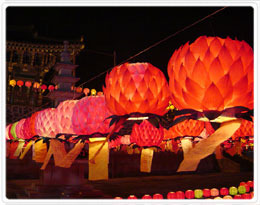
1. The History
India - The Lantern of a poor woman
It is said that, in India at the time of the Buddha, people showered the Buddha with flowers, burned incense and made the offering of lanterns. Lantern offerings are described in the sutras. The story of ‘The Poor woman, Nanta’ in a sutra named ‘Hyounwu-kyoung (현우경)’ describes the lantern offerings at the time of the Buddha.
It happened when the Buddha lived on Vulture Peak Mountain (영취산). It was dark at night and all the lanterns were blown away by the strong wind. The only lantern that was shining brightly even late into the night was that of a poor and destitute woman named Nanta who had offered it with sincere efforts and prayers. Looking upon the woman’s lantern, the Buddha said, “Any mind, seeking after the Buddha-Dharma, is just as steady as this woman’s lantern. This woman will attain enlightenment from the merit gained from the offering of this lantern and will be called ‘Sumideunggwang-yourye (수미등광여래)’.”
Silla Dynasty - Gandeung (간등)
Records indicate that on Jan. 15th, 866 A.D. (the 6th year of King Kyoungmun’s rule, 경문왕) and Jan. 15th, 890 A.D. (the 4th year of Queen Jinseong’s rule, 진성여왕), both according to the lunar calendar, the royal court went to visit Hwangryongsa and watched the Lotus Lantern Festival.
Koryo Dynasty - Youndeunghwoi (연등회)
Buddhism was the national religion during the Koryo Dynasty. Youndeunghwoi (연등회, national Dharma Assembly officially managed by the court) along with Palgwanhwoi (팔관회, another type of Dharma Assembly mainly for guardian kings and the Naga King) became two major national holidays. The court created an official administrative body called ‘Youndeungdogam(연등도감)’ to arrange these national events. Every Jan. 15th or Feb. 15th, from the palace to the countryside, the king and the whole nation wished for good harvest, lit colorful lanterns, held parties and enjoyed singing and dancing. In 1245 A.D. (the 32nd year of King Gojong, the 23rd king of the Koryo Dynasty, 고종), the Lotus Lantern Festival by Mr. Yi Choi (최이) started on Apr. 8th organized according to the lunar calendar. The tradition continues on until today.
Choseon Dynasty - Hoginori (호기놀이), Gwandeungnori (관등놀이)
During the Choseon Dynasty, many official events were discontinued but the festival continued on as a traditional folk custom. Children played ‘Hoginori (호기놀이)’ prior to the Buddha’s Birthday, a game where they cut pieces of paper, put them around supporting poles, and walked around town asking for rice or money to buy the materials for lotu
2. Charateristics (Unique Features) of Lotus Lantern Festival
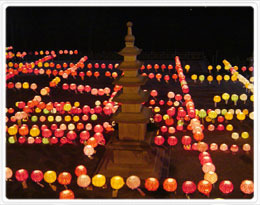
1) Festival as a Folk Culture Tradition
Names of the festival throughout history :
Gandueng (간등, Silla Dynasty) -> Youndeunghwoi (연등회, Koryo Dynasty) -> Gwandeungnori (관등놀이, Choseon Dynasty) -> Lotus Lantern Festival (Today)
During the Silla Dynasty, lanterns were lit during the ceremony of Gandeung (간등). In the Koryo Dynasty, Youndeunghwoi (연등회) was the grandest festival supervised by Youndeungdogam (연등도감), an administrative body of the kingdom. During the event, dazzling lanterns were everywhere from the palace to the countryside, parties were held and people enjoyed singing and dancing.
During the Choseon Dynasty, the lotus lantern festival on the Buddha’s Birthday was passed down in various forms as a folk tradition. Every household put up a supporting pole and lit as many lanterns as the number of members in their family. Colorful lanterns were hung on streets and at night people, men and women, packed the streets throughout the town or city holding lanterns and enjoyed watching the sea of light. It was a custom to go to Jamdubong of Mt. Namsan and to watch the scene. Nowadays, the Lotus Lantern Festival in the Jongno district maintains the tradition.
2) Seoul’s Leading Tranditional Festival of Seoul
‘Youndeunghwoi (연등회)’ took place in Gaesung, the capital city of the Koryo Dynasty. Gwandeungnori (관등놀이) in the Choseon Dynasty was a popular ceremony held in the downtown area and marketplaces. In the case of Hanyang (old name of Seoul), Jongno was the center. As the Buddha’s Birthday was approaching, children played ‘Hoginori (호기놀이)’ in order to pay for the materials for their lanterns. Stores sold a variety of colorful lanterns and toys and the festive mood filled the whole city. This Gwandeungnori festival was celebrated during the entire 600 year long history of Seoul. In order to maintain this exciting tradition, the Lotus Lantern Festival is held in the Jongno.
3) Festival of Colorful Lanterns
This is a magnificent festival of a large variety of dazzling lanterns; the float-sized lanterns featuring the Four Guardian Gods, elephants, dragons and flying goddesses, as well as 100,000 individual lanterns.
3. Festival Schedule
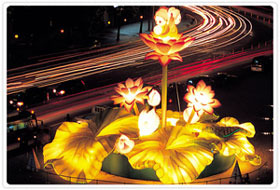
During the festival, there is a large variety of dazzling lanterns; A beautiful parade of float-sized colorful lanterns featuring white elephants, dragons and pagodas, and a procession of 100,000 individual lanterns are accompanied by exciting music and dance by a traditional Korean troupe (연희단). You are invited to watch this marvelous and exciting festival in the spectators’ seats in front of the Pagoda Park.
Featuring : Dazzling Lantern Parade, Musical Performance and Korea’s Traditional Four Percussion Play, Lantern Parade
When : 7:00 ~ 9:30, Sunday, May 8th, Buddhist Era 2549(2005) 7:00 ~ 9:30
Where : Jongno (Dongdaemun ~ Ujeongukro)
Footage :
1) Festival as a Folk Culture Tradition
Names of the festival throughout history :
Gandueng (간등, Silla Dynasty) -> Youndeunghwoi (연등회, Koryo Dynasty) -> Gwandeungnori (관등놀이, Choseon Dynasty) -> Lotus Lantern Festival (Today)
During the Silla Dynasty, lanterns were lit during the ceremony of Gandeung (간등). In the Koryo Dynasty, Youndeunghwoi (연등회) was the grandest festival supervised by Youndeungdogam (연등도감), an administrative body of the kingdom. During the event, dazzling lanterns were everywhere from the palace to the countryside, parties were held and people enjoyed singing and dancing.
During the Choseon Dynasty, the lotus lantern festival on the Buddha’s Birthday was passed down in various forms as a folk tradition. Every household put up a supporting pole and lit as many lanterns as the number of members in their family. Colorful lanterns were hung on streets and at night people, men and women, packed the streets throughout the town or city holding lanterns and enjoyed watching the sea of light. It was a custom to go to Jamdubong of Mt. Namsan and to watch the scene. Nowadays, the Lotus Lantern Festival in the Jongno district maintains the tradition.
Scroll Painting Ceremony
Gwoibuljae (괘불재, Scroll Painting Ceremonies)
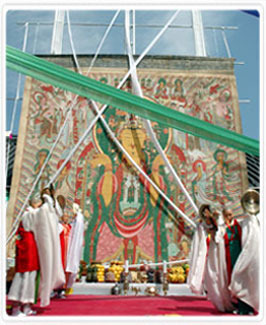
Gwoibuljae refer to the Buddhist paintings that are hung behind an alter in a big outdoor Dharma assembly or special ceremonies such as Youngsanjae(영산재), Yesujae(예수재, ceremony for preparation for death by accumulating merit for future lifetime) and Suryukjae (수륙재, ceremony for lonely, wandering ghosts in the water and on earth). Gwoibuljae (괘불재, Scroll Painting Ceremonies) refers to Dharma assemblies or ceremonies outdoors where a Gwoibul is hung behind the alter. The process of hanging a Gwoibul is Gwoibul Moving Ceremony (괘불이운).
Depending upon which assembly or ceremony is being held, a certain scroll, representing certain characteristics, is chosen. They are also Taenghwas (탱화, Thangkas) and depict the Buddha and the Bodhisattvas.
There are many themes in scroll paintings: the Assembly at Vulture Peak Mountain (Youngsanhwoisang, 영산회상), the Kshitigarbha Bodhisattva, the Avalokitesvra Bodhisattva (Bodhisattva of love & compassion), the Naga King (Yongwang, 용왕, San.: Sagara-nagar-aja), the Ten Judges and so on. Depending upon which assembly or ceremony is being held, a certain scroll, representing certain characteristics, is chosen.
In the case of the ceremony for the Assembly at Vulture Peak Mountain(Youngsan-jae, 영산재), when longevity and rest in the Pure Land are wished for, the painting of the Assembly at Vulture Peak Mountain, in which the Seokgamoni (석가모니, Sakyamuni) Buddha expounds sermons on Vulture Peak .
The Jijang Bosal (지장보살, Kshitigarbha Bodhisattva) or Amitabul (아미타불, Amitahba) is hung in the case of the Yesujae (예수재, ceremony for preparation for death and next lifetime) or the Suryukjae (수륙재, ceremony for lonely, wandering ghosts in the water and on earth). The scroll paintings of the Gwanseum-bosal (Avalokitesvara Bodhisattva) is hung on the Avalokitesvara Bodhisattva Day (관음재일), the Yongwangdo (용왕도, painting of the Naga King) is hung for the Yongwangjae (용왕재, Naga King Ceremony) and the painting of the mountain spirits is hung for the Sanwangdaesindo(산왕대신도, Mountain Spirits Ceremony). However, it is rare to hang a scroll painting because there are only a few scroll paintings at each temple. Also it is difficult to hang one outdoors and they are too large to hang in where most big Dharma assemblies are held.
The Gwoibuljae (괘불재, Scroll Painting Ceremony) of Mihwangsa is held in November every year and it celebrated its 3rd Gwoibuljae in 2004. Many locals and tourists gather and watch the scroll painting inspiring faith and fully enjoy the beauty of the Buddhist culture along with nature. This is one of many Buddhist ceremonies and this is where<
Young-san-jae
Youngsanjae (영산재)
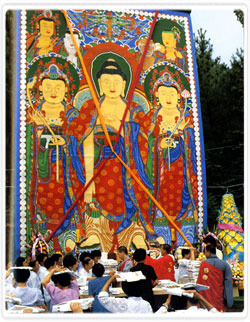
One of the Buddhist Ceremonies
Designation No. : Intangible Cultural Assets No. 50
Year Designated: Nov. 5th, 1973
This was designated as Special Intangible Cultural Assets as of November 5th, 1973. It is one of the nine rituals and is held to send the spirits of the dead to paradise 49 days after death. The ritual includes Sanjugwongongjae (상주권공재), Siwanggakbaejae (시왕각배재) and Youngsanjae (영산재). Among them, Youngsanjae (영산재) is the biggest ritual and requires long time. Its rituals signify the Youngsanhwoisang (영산회상, the Assembly at Vulture Peak Mountain). It is meant to inspire the spirits to take refuge and return to the Pure Land. It is also held to wish for the wellbeing of the nation, soldiers and big organizations.
Its procedures are very complicated. First of all, it begins with the moving ceremony of the scroll painting. Homage service is performed. The scroll painting is hung in the center and alters are set up in front of it. There are three alters. The alter for top realm which enshrines the Buddha and Bodhisattvas, the alter for middle realm which enshrines guardian gods and the alter for bottom realm houses the spirits of the dead.
When the main ritual is finished, the closing ceremony is performed with all the participants. The main ritual is administered by the officiant Sunim but this closing ceremony is distinctive in the regard that all the participants are involved. Lastly, there are Buddhist art performances such as Beompae and ceremonial dances. They are performed every year in Bongwonsa.
Ye-su-jae
Yesujae and Saengjeon-yesujae (예수재 & 생전 예수재)

This is held in a leap month in the Buddhist community and is an abbreviation of Yesusiwangchiljae (예수시왕칠재). Longevity and rest in the Pure Land are wished in this ceremony of preparation for death and next life. Originally it was held in leap years but now is generally held in leap months.
The 49th day after death is the big Judgment Day for the spirits of the dead. It will be decided where to go in the next life among the Six Realms and whether to be reborn. Yesugae is a ritual performed with sincerity in this lifetime to prevent any bad Karma in the next life. During one’s lifetime, people want to accumulate merit in this life in order to pave the way for a good rebirth.
During the Dang Dynasty in China, Ven. Hyounjang Sunim, a grand master, brought several sutras to China from India. Among the sutras, one called Susaengkyoung (수생경) stood out. It described a zodiac system involving twelve animals with distinct characteristics according to the year one is born. The zodiac can predict their traits and which years of life will be lucky or unlucky. The suffering of unlucky years is said to come in the form of eighteen kinds of sufferings. He translated it into Chinese and taught it to the public. Since then, some Buddhists perform Yesujae (예수재) in order to prevent the unlucky times.
Palmandaejangkyoung Festival
Palmandaejangkyoung Festival (팔만대장경 축제, Tripikata Koreana Festival)
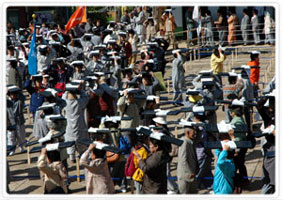
This is a Buddhist cultural festival held around Haeinsa and Mt. Gaya that commemorates Tripikata Koreana’s (팔만대장경, Palman-daejangkyoung, 80,000 complete sutra collection, National Treasure No. 32) designation as a Unesco World Heritage site. It is hosted by the Festival Organizing Committee of Tripitaka Korean and cordinated by the Ceremonial Committee of Tripikata Koreana Festival. It began in 2001 and is held every April.
There are many activities and events during the Festival; There is a temple stay program for foreigners; experiencing traditional temple food; rubbed-printing, carving and copying of the Tripikata Koreana, ceramics making; hiking contests to Mt. Gaya; a festival photo contest; lantern hanging; painting & writing contests for children; a writing contest for teenagers; a dance contest; and Jeongdaebulsa (정대불사), a very pious walking parade ceremony in which people walk on the temple ground with the wooden blocks of Koreana Tripitaka on their heads. This is an exercise of piety. It also helps to preserve the ancient blocks by airing them annually.
Many other activities and events are featured during the Festival; a lantern festival; film showing; a variety of folk dance performances and demonstrations; Barachum (바라춤, the Cymbals Dance) & Nabichum (나비춤, the Butterfly Dance); orchestra performance; percussion ensemble performances; traditional Korean drawing & painting exhibitions; special display of space arts; local specialty products; night time market. Through these events and performances, not only Buddhists but the general public and foreigners are exposed to Buddhist culture.
As a special ceremony held during the Festival is Palman-daejangkyoung Moving Ceremony (팔만대장경 이운행사, the moving ceremony of wooden blocks of Tripikata Koreana). It represents the ceremony performed 600 years ago, when the wooden blocks were moved from Seonwonsa in Kanghwado to Haeinsa in Hapcheongun. A Dharma ceremony to commemorate the move is held, and a variety of moving features are demonstrated. Replicas of the wooden blocks are moved through downtown Hapcheon and are placed in Janggyounggak (장경각, the Hall of Koreana Tripitaka), where there is an enshrining ceremony.
- Footage
Housed in a special hall of Haeinsa the Tripitaka Koreana (Palman-Daejangkyoung) is a World Cultural Heritage site designated by UNESCO. Known in Korean as Koryo Daejanggyoung (고려 대장경, Great Collection of Sutras of Koryo Dynasty, 918-1392), the Tripitaka Koreana (National Treasure No. 32) is one of the most sacred treasures of Korean Buddhism.
Ta-rye-jae
Mahn Gong's TaryeJae
Mahn Gong (1871-1946)
Mahn Gong suhnim was a disciple of Gyurng Hur suhnim and is one of the great figures in the history of modern Korean Buddhism. After inheriting Gyurng Hur suhnim's teaching he contributed greatly to shaping a framework for modern Korean Seon Buddhism
At the age of 14, under the direction of his two teachers, Tae Hur suhnim, his vocation master and Gyurng Hur suhnim, his preceptor, Mahn Gong entered Churn Jahng Sah Temple in Sur Sahn for monastic practice. Gyurng Hur suhnim showed Mahn Gong a special concern and therefore Mahn Gong was able to have 10 years of authentic meditation experience with Gyurng Hur suhnim, in spite of their different positions as a teacher and a student. He realized that all forms of existing things and manifestations of the dharma are merely a creation of one's mind.
There is one story handed down, showing his attitude towards life. After his enlightenment, when he was the abbot of Mah Gok Sah Temple, he was asked to attend a meeting arranged by the Governor-General of the Japanese Authority ruling Korea at the time, and there he boldly criticized the Governor's proposal for manipulating the Korean Buddhist Order. The Governor-General held absolute power of life and death over the Korean people during the Occupation. No one who cherished their own life ever dared to oppose him. When the feared Governor-General from Japan announced that from hereafter, the celibate Korean monks would all be required to marry, Mahn Gong suhnim stood up to him by saying, "Anyone who causes a monk to break the precepts will fall into hell." His dignified attitude can be ascribed to his long practice and accumulation of dharma power.
These days there is no doubt that he is the founder of the Durk Soong Seon family tradition, which is now one of the main streams in Korean Buddhism. His book of Seon poems provides insight into his teaching and lifestyle.
Music Concerts at Mountain Temples
Music Concert at Mountain Temples
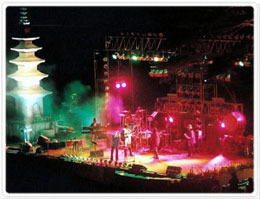
Music concerts at mountain temples are the main attractions of local festivals. They lead the popular Buddhist culture of these days. Buddhist cultural festivals occur from late Summer to Fall
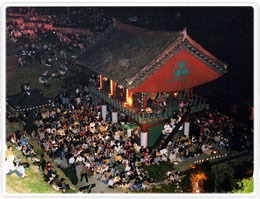
Hwa-um Festival

Hwaeom Festival (화엄축제, Avatamsaka Festival)
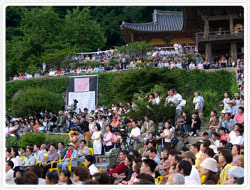
Hwaeom Festival (화엄축제, Avatamsaka Festival) of Buseoksa is a very large festival which features; seminars on Ven. Eoisang Sunim’s (의상 스님) ideology, Hwaeom School temple tours, Hwaeom music concert and a Buddhist art festival. It promotes the temple inside and outside the community establishing itself as a stimulant for the local culture.
Seminars on Ven. Eoisang Sunim’s ideology are held during the Hwaeom Festival. Professional scholars, including professionals, participate in them and present theories about Ven. Eoisang Sunim and his ideology. The Sinim created a new Buddhist ideological system, called Hwaeom and spread both the Gwanseumbosal (관세음보살, the Avalokitesvara) Faith and the Amitabul (아미타불, the Amitahba Buddha) Faith among common people, contributing to popularity of the religion. He embraced society and lived for its people, shedding light over every part of the Silla Dynasty in the seventh(7th) century. Hwaeom Buddhist Art Performance Festival on the last day of the program displays a distinctive combination of Buddhist arts and culture, helping ordinary people to understand the Buddhism.
Cremation Ceremony
Dabisik (다비식, Cremation Ceremony)

Dabisik (다비식, Cremation Ceremony) especially refers to ceremonies concerning cremation during the overall funeral ceremonies of Buddhism. In general, the term is used to refer to the whole process.
Here are the processes of Dabisik. First, a pyre is made of wood, charcoal and thatched bags and the casket is put on it. The fire is set from the west in May and September, from the north in February, June and October, from the east in March, July and November and from the south in April, August and December.
Once the fire is set, a homage service to the Amitabul (Amitabah) is held. When the body is burned to a certain degree, it is turned over. When it is burned down, the bones are gathered out of the ashes, crushed and ground up.
‘Om Bajana Sadama’, the mantra wishing for return to the Original Place is chanted in order for the body to ascend to the Boryundae (보련대), a sacred lotus-shape alter.
- Footage
This film shows the cremation ceremony of Ven. Wolha Sunim (월하스님), former Honored Leader (Jongjeon, 종정) of the Jogye Order ? Jan. 2004
Ordination Ceremony of Daejongsas
Ordination Ceremony of Daejongsas(대종사 품수식)

On May, 31st 2004, the Jogye Order of Korean Buddhism held the official ordination ceremony for ‘Daejongsa’ (대종사, grand masters) at Daejeokgwangjeon (대적광전, The Hall of Great Peace and Light) The ordination ceremony ordained 27 senior Sunims including Ven. Beopjeon, the Supreme Patriarch (Jongjeon, 종정) ‘Daejongsa’ and it is expected to have a positive influence on the hierarchy of the Order.
Daejongsa List
1. Beopjeon (법전, 法傳)
Sami Ordination under Ven. Seolho at Baekyangsa in 1935/ the current Supreme Patriarch (Jongjeon, 종정)
2. Seokju (석주, 昔珠)
Sami Ordination under Ven. Lisan at Beomeosa in 1928/
3. Beomryong (범룡, 梵龍)
Sami Ordination under Ven. Taewon at Ujeomsa in 1929/ Josil Sunim(Senior Seon master) of Biroam.
4. Docheon (도천, 道川)
Sami Ordination under Ven. Mukeon at Mahayeonsa in 1929/ A current member of the Council of the Elders
5. Wondam (원담, 圓潭)
Sami Ordination under Ven. Gyoungseon at Sudeoksa in 1933/ A current member of the Council of the Elders
6. Susan (수산, 壽山)
Sami Ordination under Ven. Jongheon at Baekyangsa in 1938/ A current member of the Counci
Paper Lotus Lantern Making & Tea Preparations
Paper Lotus Flower Making and Tea Ceremony
This is the footage showing ‘Paper Lotus Flower Making and Tea Ceremony’ which was held in Beopryounsa on May 19th. Arranged by the Korean Buddhism Information Technology Council, the event featured a lecture on lotus lantern making, a lantern-making workshop, an experience of traditional temple food and a demonstration of traditional tea preparation. Fourteen wives of ambassadors and deputy ambassadors of eight countries attended.
-The Tea Ceremony-
Korea has an ancient tradition of drinking tea to ease the tension of daily routines. Of course there are ancient tea traditions in other nations as well, such as China and Japan, and more recent traditions in the West, but the Korean tradition remains distinctive.
The Korean tradition features neither the formality of Japan nor the popular daily routines of China and the West. It is somewhere in between, with the freedom of being neither totally monastic nor totally secular. And the goal is not merely to drink the tea. It is an opportunity to enjoy the fragrance, to think about the meeting of the water and the tea leaves, and to become one with others in attendance and with the tea and nature itself.
For centuries, Zen meditators have enjoyed tea drinking as a means of reflecting upon themselves, nature, and the principles of the universe. There's an old saying that drinking alone, one reflects; drinking with another is an opportunity for discussion; and drinking with two or more other people affords the opportunity to practice etiquette.
The predecessors have also said that tea drinking affords the opportunity to quietly appreciate the tea fragrance, color and beauty; and by striving for truth in this, tea drinking can lead one on to the world of enlightenment, thereby making the concentration in tea drinking a form of Zen in itself. This gave rise to the saying, "Zen and tea are the same flavor."
Drinking tea is done with full utilization of all five senses. Listening to the sound of the water boiling. Smelling the fragrance. Seeing the beautiful color of the tea in the teacup. Tasting the tea. And feeling and enjoying the warmth of the tea-filled teacup.
Tea comes in an endless variety of fragrances and flavors, and one can truly come to appreciate the fragrance and flavor by quietly rolling a bit of tea around the mouth. In this way, one can discover the various subtle flavors in tea that usually go unnoticed, including the bitter, the tart, and the sweet.