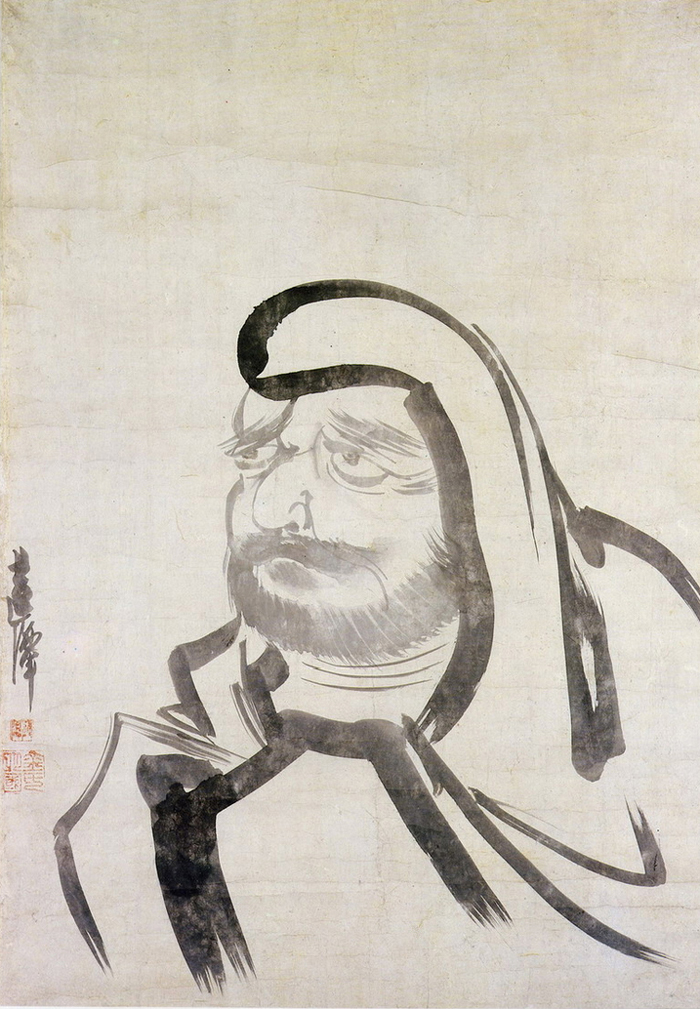
Part 1: Bodhidharma
The Blue-Eyed Barbarian: Origin and Arrival
Bodhidharma (known as Damo in China, Daruma in Japan, and Dalma in Korea) is a figure shrouded in the mists of history and legend. Historically, he is believed to have lived during the 5th or 6th century CE. Most accounts describe him as a Buddhist monk from the "Western Regions," likely a prince of the Pallava dynasty in Kanchipuram, South India, or possibly from Persia.
He is famously described in texts as "The Blue-Eyed Barbarian" due to his intense gaze and foreign features. Unlike the scholarly monks who preceded him, focusing on the translation of sutras, Bodhidharma traveled to China with a radical new approach to spirituality: a direct transmission of insight that bypassed intellectual analysis.
The Great Encounter: Emperor Wu of Liang
One of the most defining moments in Zen history is Bodhidharma’s meeting with Emperor Wu of Liang. The Emperor was a devout Buddhist who had built temples, sponsored monks, and funded the copying of scriptures.
When Bodhidharma arrived, the Emperor asked him:
"I have built many temples and ordained many monks. What is my merit?"
Bodhidharma replied bluntly:
"No merit whatsoever."
The Emperor, confused and perhaps offended, asked, "Why?" Bodhidharma explained that these were merely finite, worldly achievements that did not result in true enlightenment. Frustrated, the Emperor asked, "Then what is the highest meaning of the holy truth?"
Bodhidharma answered: "Vast emptiness, nothing holy."
This interaction established the core tone of Zen: a rejection of superficial religious piety in favor of a piercing realization of the absolute nature of reality (Emptiness). Realizing the Emperor did not understand, Bodhidharma left the court, famously crossing the Yangtze River standing on a single reed.
Nine Years of Wall-Gazing
Bodhidharma traveled north to the Shaolin Monastery on Mount Song. Finding the monks there too weak for rigorous meditation, or perhaps simply seeking solitude, he retreated to a cave nearby.
There, he sat facing a wall for nine years. This practice, known as bi-guan (wall-gazing), became the foundation of Zazen (sitting meditation).
- The Legend of the Legs: It is said he sat for so long that his legs atrophied and fell off (which is why Daruma dolls in Japan are round and legless).
- The Legend of the Eyelids: During his meditation, he once fell asleep. Furious at his lack of discipline, he cut off his eyelids and threw them to the ground. According to legend, the first tea plants sprang up from where his eyelids landed. This story highlights the intimate connection between Zen meditation and tea ceremony (caffeine being used to keep monks awake).
The Second Patriarch and the "Red Snow"
A monk named Shenguang (later Hui-ke) sought Bodhidharma's teaching. For days, Bodhidharma ignored him as he meditated in the cave. To prove his sincerity, Shenguang stood outside in the freezing snow. Finally, in a desperate act of devotion, Shenguang cut off his left arm and presented it to Bodhidharma.
Bodhidharma then accepted him. Shenguang asked: "My mind is not at peace. Please pacify my mind." Bodhidharma replied: "Bring me your mind, and I will pacify it." Shenguang paused, searched within, and said: "I have searched for my mind, but I cannot find it." Bodhidharma smiled: "There. I have pacified your mind."
This moment of direct pointing—realizing the "self" or "mind" is not a tangible entity—marked the transmission of the Dharma to China.
Core Philosophy: The Four Sacred Verses
Bodhidharma did not leave behind volumes of writing. His teaching is summarized in a four-line stanza attributed to him, which defines the Zen school to this day:
A special transmission outside the scriptures, Not founded upon words and letters; By pointing directly to [one's] mind, It lets one see into [one's own true] nature and [thus] attain Buddhahood.
He emphasized that enlightenment is found within the self, not in external idols or texts. He relied heavily on the Lankavatara Sutra, which focuses on the "Mind-Only" doctrine.
Legacy and Shaolin Kung Fu
Bodhidharma is also credited with teaching the Shaolin monks physical exercises to strengthen their bodies for long meditation. These exercises, recorded in the Yi Jin Jing (Muscle/Tendon Change Classic), are mythologically considered the roots of Shaolin Kung Fu. While historians debate the accuracy of this, Bodhidharma remains the spiritual patron saint of martial arts.
He passed away around 532 CE. A final legend says that years after his death, a Chinese official encountered him walking back toward India in the mountains, carrying a single sandal. When his tomb was opened, it was empty, save for the other sandal.
Back