Amithabha Buddha
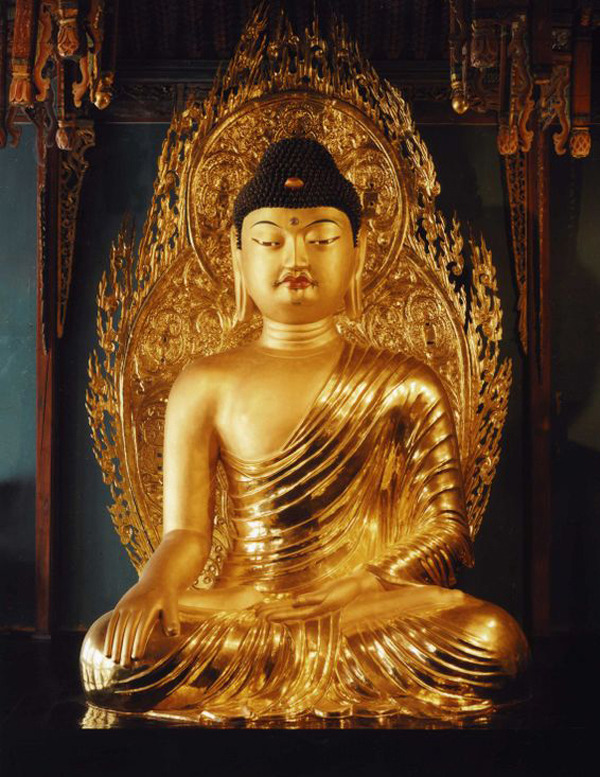
National Treasure no. 45. Seated Amitabha, clay, 2.78 m. Buseok Temple.
The Eternal Light of the West: The Clay Amitabha Buddha of Buseoksa Temple
Introduction: Entering the Sanctuary of Infinite Life Perched on the serene slopes of Mount Bonghwang in Yeongju, Korea, lies Buseoksa Temple, the "Temple of the Floating Stone." Established in 676 AD by the Great Monk Uisang, this temple is a masterpiece of Korean Buddhist architecture and philosophy. At its heart stands the Muryangsujeon (Hall of Infinite Life), one of the oldest surviving wooden buildings in Korea.
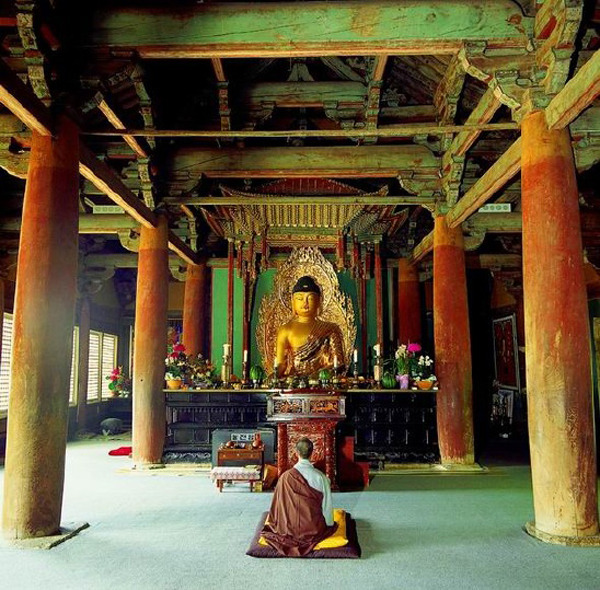
When visitors step into this ancient hall, they are immediately struck by a profound sense of presence. Unlike typical Buddhist halls where the main altar faces the entrance, the layout here is strikingly different. The gaze of the visitor is drawn not to the center, but to the western side of the hall, where a golden figure sits in majestic silence. This is the Clay Seated Amitabha Buddha (National Treasure No. 45), a masterpiece of the Goryeo Dynasty and a spiritual beacon that has watched over the Korean peninsula for nearly a millennium.
A Masterpiece in Clay: Rare and Resilient The Buseoksa Amitabha is a "Sojo" (Clay) statue, meaning it was created by applying layers of fine clay over a wooden frame and then finishing it with gold leaf. Standing at 2.78 meters (about 9 feet) tall, it is the largest and oldest clay Buddha statue in Korea.
Creating a clay statue of this magnitude requires immense skill and patience. The artist must ensure the clay does not crack as it dries and that the heavy material adheres perfectly to the wooden skeleton. The fact that this statue has survived for centuries without significant damage is a testament to the advanced sculptural techniques of the Goryeo era. The golden surface, glowing softly in the natural light filtering through the paper windows, gives the figure a warm, living quality that stone or bronze cannot easily replicate.
The Philosophy of Orientation: Facing East One of the most defining characteristics of this Buddha is its orientation. In most Korean Buddhist temples, the main Buddha is seated in the center of the hall, facing South, like a king receiving his subjects. However, the Amitabha Buddha at Buseoksa is seated against the western wall, facing East.
This arrangement is deeply rooted in the doctrine of the Western Pure Land (Sukhavati). According to Buddhist sutras, Amitabha resides in the Pure Land located in the "West." By placing the statue in the west of the hall looking east, the architecture physically manifests this cosmology.
- For the Pilgrim: When you enter the hall and face the Buddha, you are looking towards the West—symbolically looking towards the Pure Land and salvation.
- For the Buddha: The Buddha gazes towards the East, looking out into the world of suffering (Samsara) with compassion, ready to welcome beings into his paradise.
This lateral positioning allows the grand wooden columns of the Muryangsujeon to frame the view, creating a deep sense of spatial hierarchy and solemnity.
Artistic Style: A Bridge Between Eras Art historians value this statue as a crucial link between the idealized beauty of the Unified Silla period and the more humanistic style of the Goryeo Dynasty.
- Silla Influence: The statue’s broad shoulders and voluminous chest recall the grandeur of the famous Seokguram Grotto Buddha. It retains a sense of divine proportion and majesty.
- Goryeo Characteristics: Yet, the face tells a different story. The cheeks are plump, the lips are thick, and the eyes are sharp and slanted. The expression is not just serene but grave and imposing, reflecting the unique aesthetic of the Goryeo people. The drapery of the robes is also distinct; the folds flow naturally over the legs and chest in parallel "U" shapes, showing a move towards realistic rigidity.
Behind the statue stands a magnificent wooden mandorla (halo). While the stone halo originally intended for the statue is now lost (its remains found nearby), this wooden replacement is a work of art in itself. Carved with intricate flame patterns, it represents the light of truth radiating from the Buddha’s body, filling the hall with spiritual energy.
The Mystery of the Mudra An intriguing aspect of this statue is its hand gesture, or mudra. The Buddha’s right hand reaches down to touch the ground—a gesture known as the Bhumisparsha Mudra (Touching the Earth). Traditionally, this mudra is associated with Sakyamuni Buddha (the historical Buddha) calling the earth to witness his enlightenment.
Why, then, is this statue identified as Amitabha?
- The Location: The hall is named Muryangsujeon, which means the "Hall of Infinite Life" (Muryangsu is the Korean translation of Amitayus, another name for Amitabha).
- Historical Records: The stele of State Preceptor Wonyung at the temple explicitly states that an Amitabha statue was enshrined here.
- Goryeo Flexibility: During the Goryeo Dynasty, strict iconographic rules were sometimes relaxed. The Bhumisparsha mudra was widely used for various Buddhas to emphasize the concept that "all Buddhas are ultimately one."
Thus, despite the hand gesture, there is no doubt that this figure reigns as the Lord of the Western Paradise.
Conclusion: A Timeless Invitation To stand before the Buseoksa Amitabha is to experience a moment of transcendence. As the sun sets over the Sobaek Mountain range, the golden light strikes the statue’s face, enhancing its benevolent expression. For a moment, the boundary between the artistic and the sacred dissolves.
We invite you to gaze into the eyes of this ancient guardian. Whether you seek artistic inspiration or spiritual solace, the Amitabha Buddha of Buseoksa waits in the West, eternally facing the East to guide your way home.
Back